Three colourless, odourless gases, and one test that tells them apart: a burning splint. And inside the jar: why hydrogen molecules move four times as fast as oxygen’s.
Step 1 of 5 · The splint test
Step 1 of 5
The splint test
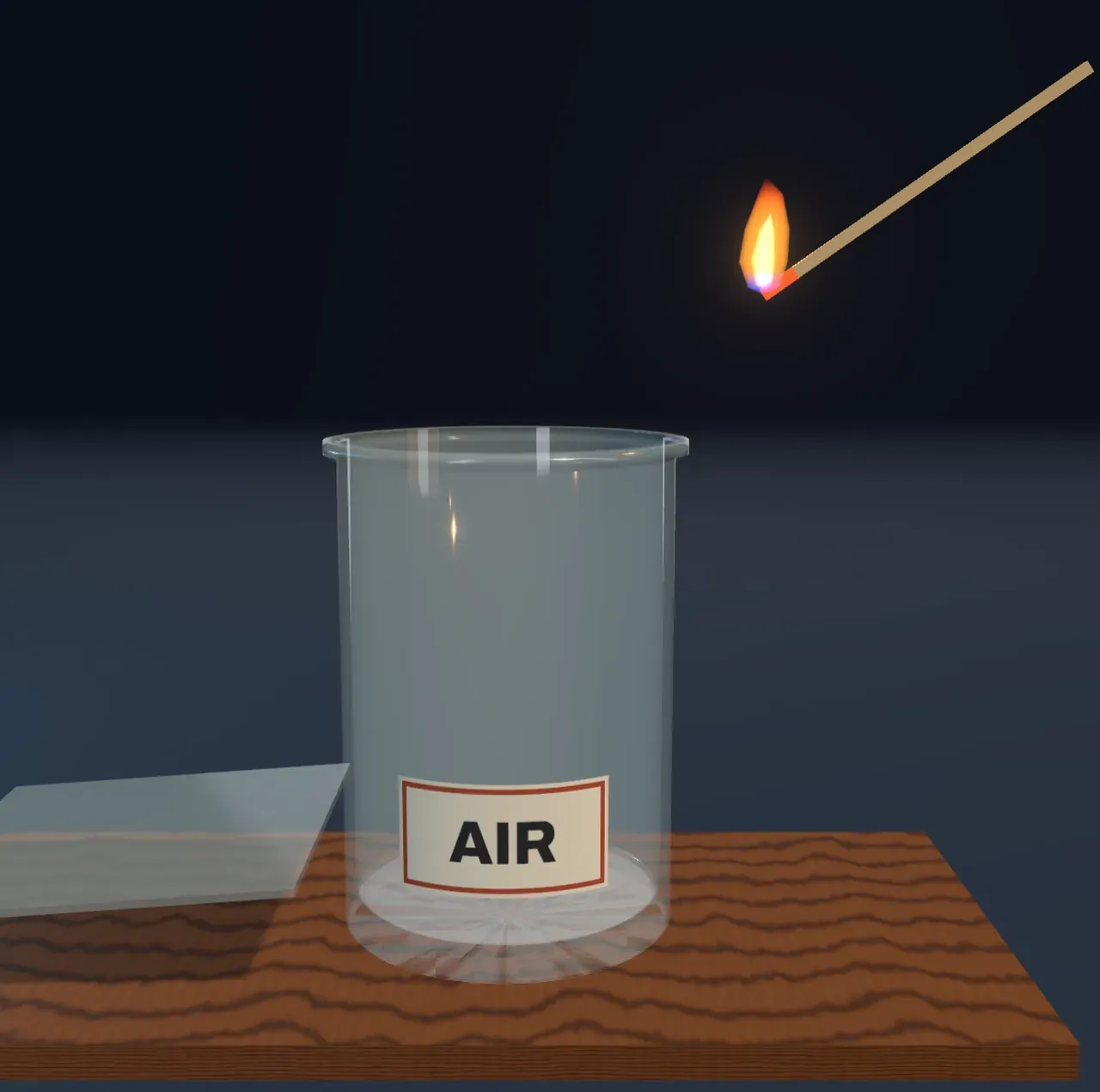
Hydrogen, oxygen and nitrogen are colourless, odourless gases, and in a closed jar you cannot tell them apart by looking. In the lab they are told apart by what they do to a flame. In the Scene a burning splint is brought to the mouth of a jar full of air, and it keeps burning quietly.
Step 2 of 5
The pop
Hydrogen is a flammable gas: it burns in oxygen. When the splint reaches the mouth of the jar, the hydrogen escaping from it mixes with the air and catches all at once, with a small pop. That is the test for hydrogen. Look at what is left on the glass after the pop.
Step 3 of 5
Nitrogen
In nitrogen the splint goes out. Nitrogen does not burn and does not support burning, because its molecule, , holds its two atoms in a very strong triple bond. It is the gas that makes up about 78% of the air, which is why wood burns gently in air: only about a fifth of the molecules that hit it are oxygen.
Change Gas in the jar between the four options, and compare.
Step 4 of 5
Inside the jar
Zoom to the molecules is at Molecules: the jar has been closed, with hydrogen molecules inside. In a gas the average kinetic energy of a molecule depends only on the temperature, . From that you can work out the average speed:
where is the molar mass in kilograms per mole.
Step 5 of 5
Light and fast
At the same temperature every gas has the same average kinetic energy, . So a light molecule moves faster: the speed goes inversely as the square root of the mass, . The jar now holds oxygen; compare its speed in the table beside the Scene with hydrogen’s.
Loading the interactive version…
Loading the interactive version…
Each step sets up the Scene for you, and a control marked “fixed” stays put for that step.
Practice · Predict, then look
The jar holds air now, and the burning splint keeps burning quietly in it. What will the splint do in a jar of pure Oxygen?
Practice · Predict, then look
The jar holds air now, and the burning splint keeps burning quietly in it. What will the splint do in a jar of pure Oxygen?
Practice · Choose
At a jar of hydrogen the splint gives a pop, and a thin mist is left on the glass. What is it?
Practice · Choose
At a jar of hydrogen the splint gives a pop, and a thin mist is left on the glass. What is it?
Practice · Calculate
The jar holds hydrogen at 293 K. The average speed of gas molecules is , with in kilograms per mole. For hydrogen . What is the average speed?
Practice · Calculate
The jar holds hydrogen at 293 K. The average speed of gas molecules is , with in kilograms per mole. For hydrogen . What is the average speed?
Practice · Calculate
The molar mass of oxygen, , is 32 g/mol, and of hydrogen, , 2 g/mol. At the same temperature, how many times faster are the hydrogen molecules?
Practice · Calculate
The molar mass of oxygen, , is 32 g/mol, and of hydrogen, , 2 g/mol. At the same temperature, how many times faster are the hydrogen molecules?
Lesson complete. Every practice question here is done.