A ride with no engine
After a roller coaster’s chain has hauled it to the top of the first hill, nothing pushes it again. Every drop, climb and loop that follows is paid for by that one climb. The coaster is spending something it collected on the way up, and the name for that something is energy.
Stored in height, shown in speed
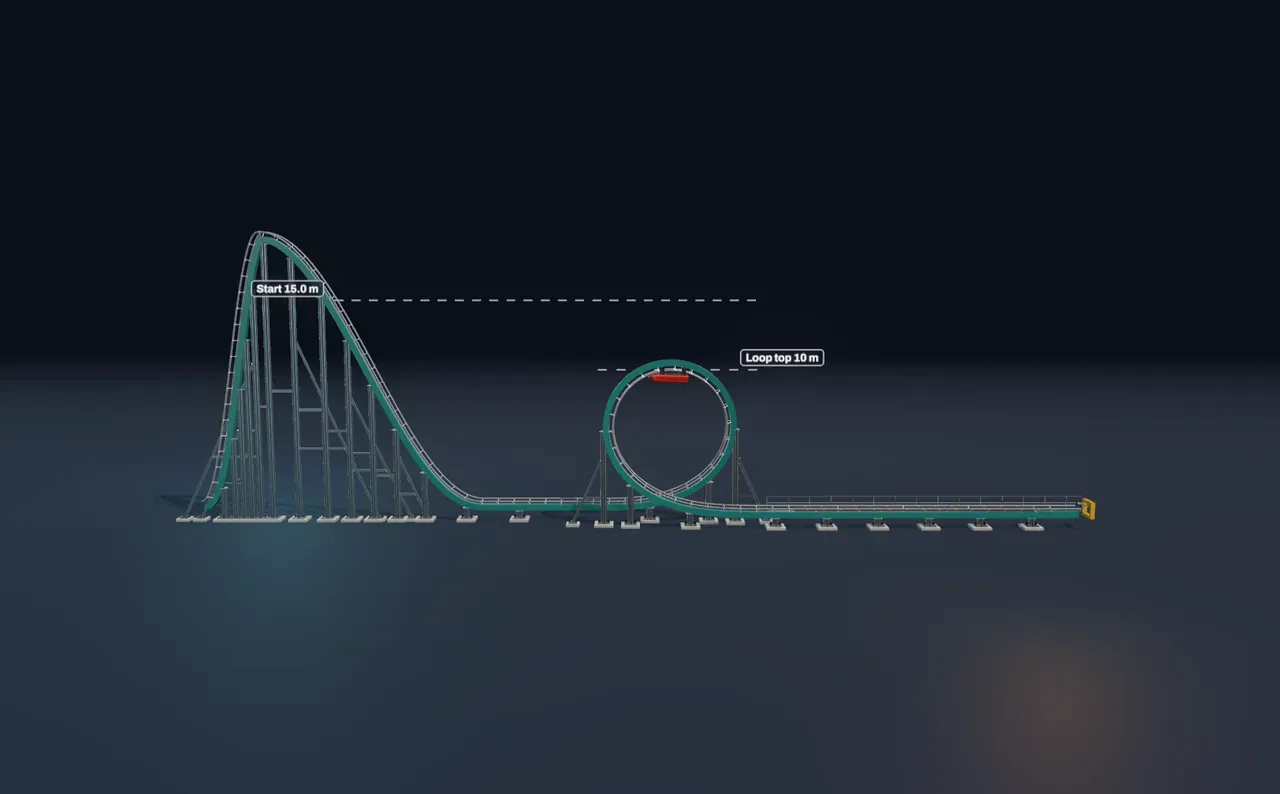
A car at the top of a hill has potential energy: energy stored by its position, ready to be released by falling. It equals the car’s weight times its height, mgh. A 500 kg car 15 metres up holds about 74,000 joules (a joule is roughly the energy needed to lift an apple by a metre).
As the car drops, the height turns into speed. Moving things carry kinetic energy, equal to ½mv². Because speed is squared, doubling the speed takes four times the energy. At the bottom of a 15 metre drop, if nothing were lost, the car would be doing about 17 metres per second, a little over 60 kilometres an hour.
On the way up the next rise the exchange runs backwards: the car slows as it climbs and speed turns back into height.
The total stays the same
Choose On under Show the energy and four columns appear: potential, kinetic, heat, and their total. As the car runs, the first three trade places, but the total stays level. That is the conservation of energy: energy is never made or destroyed, only moved from one form to another.
The heat column grows slowly as rolling resistance warms the wheels and rails, and then all at once in the brakes, where the car’s remaining kinetic energy becomes heat in the brake fins.
Making the loop
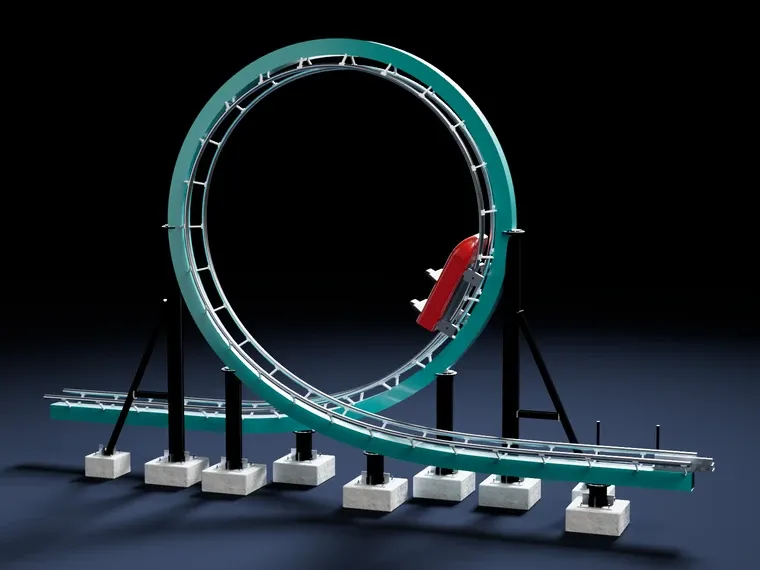
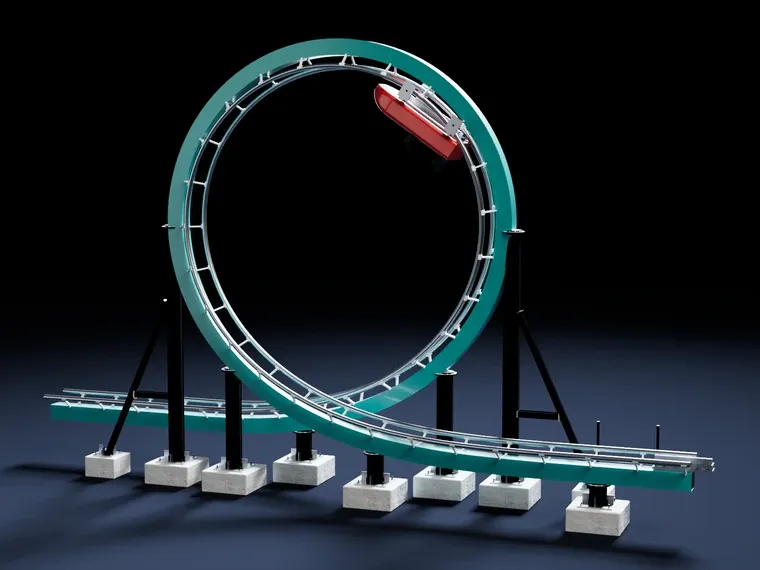
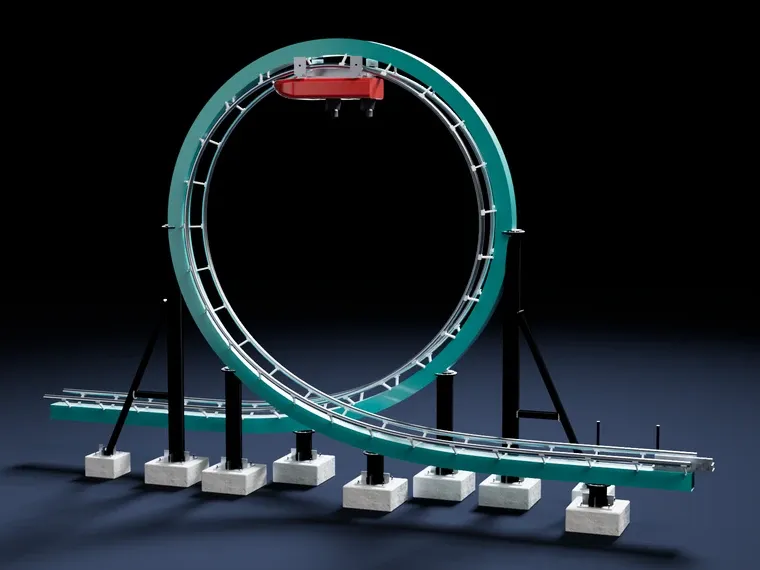
At the top of the loop the car is upside down. It stays on the rail only if it is moving fast enough that the rail has to push on it to keep it curving. Too slow, and gravity alone bends its path more tightly than the loop, so it drops away from the rail.
This loop is a teardrop 10 metres tall. Its sides start almost straight and curve more and more tightly as they rise, and over the top the track bends round a circle of 4.2 metres radius. The car has to arrive at the top fast enough for that tight bend. With nothing lost to friction it must start about 12.1 metres up; with this coaster’s little rolling resistance it needs a bit more, about 12.8 metres. Start below about 6.2 metres and the car never gets past the point where the loop stands upright; it simply rolls back.
A circular loop of the same 10 metre height would ask for more: two and a half times its 5 metre radius, or 12.5 metres without friction.
Try it: set Start height to 4, then 10, then 13.5 metres: the car rolls back, falls off, then just makes it round. Then change Car mass and notice that the energy columns grow and shrink while the car’s speed stays exactly the same.
Mass cancels because both forms of energy are proportional to it: a heavier car has more energy to spend but needs more for each metre per second.
What this model leaves out
This car has no up-stop wheels. A real coaster’s car has a wheel under each rail as well as above and beside it, holding the car to the track, so a slow car stalls and rolls back instead of falling off. The model leaves those wheels out so that you can see what the rail alone can do: push, but never pull.
Real loops are teardrops, like this one, for the riders’ sake. A car that only just made a circular loop would press its riders into their seats at six times their weight at the bottom. The teardrop’s gentle sides take the fast car at the bottom on a wide curve, and its tight top turns the slow car quickly, so the push the riders feel stays much more even.
The model also ignores air resistance and the energy that goes into spinning the wheels, and it treats rolling resistance as a constant drag.