On a real track rolling resistance turns part of the energy into heat, but the total is conserved. How much heat is made, how much energy is left for motion, and what is the power of a motor that lifts the car?
Step 1 of 7 · The total
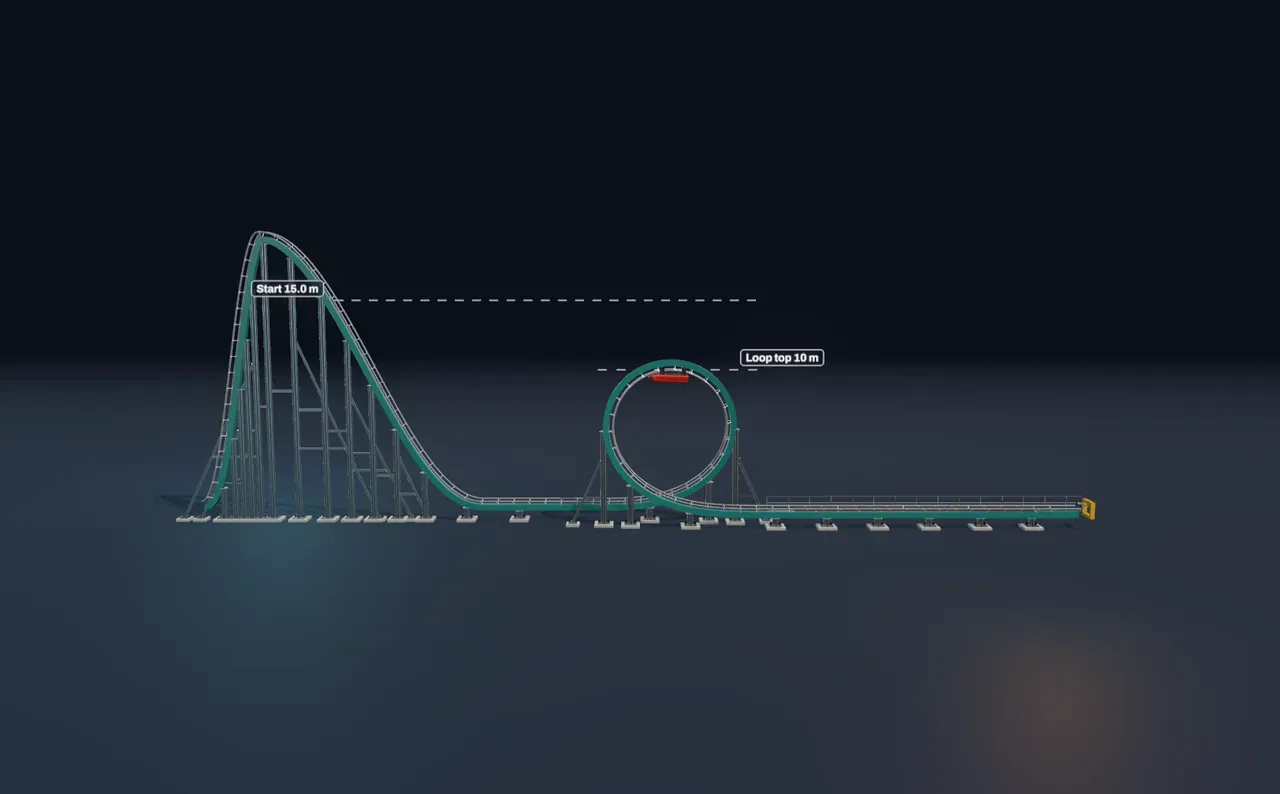
In the last lesson the track was perfectly smooth. The track in this Scene is the Article’s roller coaster: it has rolling resistance, a small steady force that pulls the car back all the way along, and brakes at the end of the ride.
Step 1 of 7
The total
When you choose On under Show the energy, four columns appear: potential energy, kinetic energy, heat, and the sum of the three. Predict what the total column will do during the ride, then watch.
Step 2 of 7
How much heat
Rolling resistance is friction, and like all friction it does negative work on the car. That work does not vanish: it warms the wheels and the rails. The energy that becomes heat equals the size of the friction’s work, the force times the distance:
Here the force is a fixed fraction of the weight, with , and the distance is the length of track the car has covered, not the height it has dropped.
Step 3 of 7
What is left for motion
Conservation of energy still holds, with one more term: what was potential at the start is now shared between kinetic energy and heat.
The farther the car travels, the more energy has become heat, and the less is left for motion.
Step 4 of 7
A higher start
Without friction, 12.5 m is enough to make the loop. Here the Just enough preset of Start height is 13.5 m.
Try it: lower the Start height to 13 m and to 12.5 m, and watch what happens at the top of the loop.
Step 5 of 7
Power
Before every ride a chain hauls the car to the top of the hill. The chain’s motor does work, and it also matters how fast it does it. Power is the work done each second:
The unit of power is the joule per second, called the watt: 1 W = 1 J/s. A 10 W bulb turns 10 J of electrical energy into light and heat every second, and a car engine delivers tens of thousands of watts, tens of kilowatts.
Step 6 of 7
Faster, the same work
Sometimes it is handy to work out power from a force and a speed. A force pushing a body at speed in its own direction does, each second, times one second’s distance of work, so
Step 7 of 7
In summary
- Friction turns energy into heat, , the size of its negative work. The total energy is conserved: .
- Because of the heat, the car has to start higher to make the loop.
- Power is the rate of doing work, , in watts: 1 W = 1 J/s. The same work in half the time is twice the power.
Loading the interactive version…
Loading the interactive version…
Each step sets up the Scene for you, and a control marked “fixed” stays put for that step.
Practice · Predict, then look
There is rolling resistance, and it warms the wheels and the rails. What will happen to the total column while the car rides?
Practice · Predict, then look
There is rolling resistance, and it warms the wheels and the rails. What will happen to the total column while the car rides?
Practice · Calculate
Rolling resistance pulls the 500 kg car back with a force of times its weight. From the release, 15 m up, to the bottom of the loop the car covers 26.9 m of track. How much energy has become heat by then? Use .
Practice · Calculate
Rolling resistance pulls the 500 kg car back with a force of times its weight. From the release, 15 m up, to the bottom of the loop the car covers 26.9 m of track. How much energy has become heat by then? Use .
Practice · Calculate
The car started with 73.6 kJ of potential energy, and by the bottom of the loop 1.98 kJ has become heat. How much kinetic energy does it have at the bottom of the loop?
Practice · Calculate
The car started with 73.6 kJ of potential energy, and by the bottom of the loop 1.98 kJ has become heat. How much kinetic energy does it have at the bottom of the loop?
Practice · Choose
Without friction the car makes the loop from 12.5 m. Here, with rolling resistance, it needs 13.5 m. Why?
Practice · Choose
Without friction the car makes the loop from 12.5 m. Here, with rolling resistance, it needs 13.5 m. Why?
Practice · Calculate
The chain hauls the 500 kg car at a steady speed to the top of the hill, 20 m above the bottom, in 40 s. Ignore friction. What is the chain’s power? Use .
Practice · Calculate
The chain hauls the 500 kg car at a steady speed to the top of the hill, 20 m above the bottom, in 40 s. Ignore friction. What is the chain’s power? Use .
Practice · Choose
Another chain hauls the same car to the same height in 20 s instead of 40 s. Compared with the first chain:
Practice · Choose
Another chain hauls the same car to the same height in 20 s instead of 40 s. Compared with the first chain:
Lesson complete. Every practice question here is done.