Ordinary light is a crowd
A light bulb, a candle or the Sun gives off light because countless atoms each let go of a little packet of energy, a photon, whenever they happen to. Each one leaves at its own moment, in its own direction, with its own exact colour. The waves are out of step with each other, and they spread in every direction. That is why a torch beam widens and fades.
A laser makes light in which the photons march in step: one colour, one direction, crest lined up with crest. The word was an acronym: light amplification by stimulated emission of radiation.
Excited atoms, two ways down
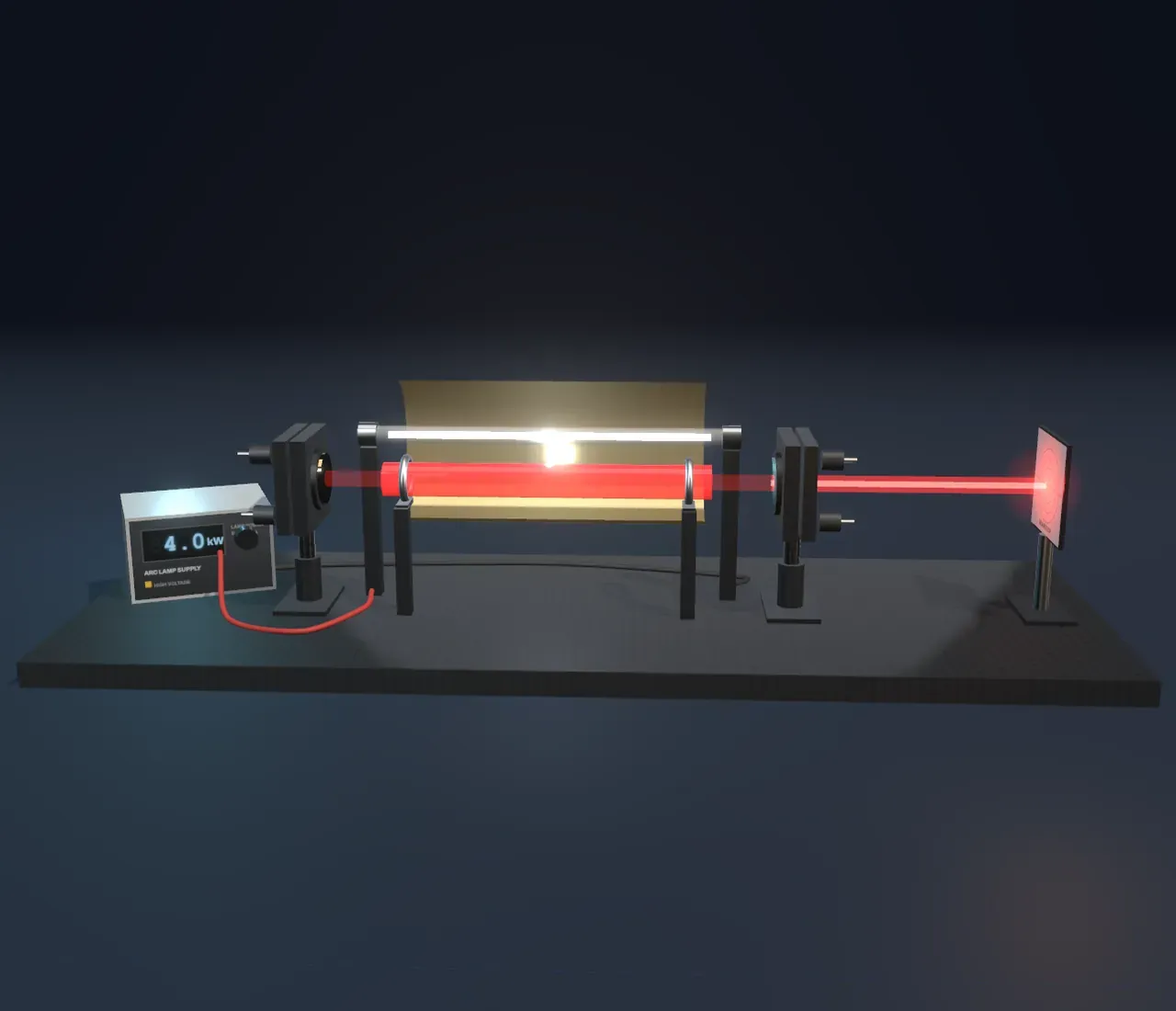
The scene’s laser is a rod of ruby: aluminium oxide with a sprinkling of chromium ions, which give it its colour. A bright lamp beside it is the pump. Its green and blue light lifts chromium ions to a higher energy. They slide at once to a level just below, and stay there for about three thousandths of a second, a long time for an atom.
An excited ion can fall back in two ways. On its own, at a random moment, it emits a red photon in a random direction: spontaneous emission, the dim red glow of a pumped ruby. Or a passing red photon can nudge it into letting go early, and then the new photon is an exact copy of the one that passed: same direction, same colour, same phase. That is stimulated emission, and it is how one photon becomes two, two become four.
Why it needs a threshold
There is a catch. An unexcited ion absorbs those same red photons. While most ions sit in the ground state, a photon crossing the rod is more likely to be swallowed than copied. In ruby, more than half of all the ions must be excited before the rod amplifies at all. That condition is called a population inversion.
Then the mirrors come in. A full mirror at one end and a nearly full one at the other send the light back and forth through the rod, so it is copied again on every pass. The threshold is the pump power at which each round trip adds as much light as the mirrors and the rod lose. Below it, any light along the rod dies away and the ruby only glows. Above it, the light along the axis grows until it uses up the extra excitation as fast as the lamp supplies it.
Try it: raise Pump power slowly from zero and watch the two charts beside the Scene. The share of ions excited climbs past half, then stops rising at threshold, and from that point every extra kilowatt goes into the beam, which grows in a straight line.
The output mirror
Some light has to get out, so one mirror lets a little through: that is the beam. A leakier Output mirror lets more out on each pass but also loses more, so the rod must be pumped harder before it lases. A tighter one lases sooner but lets out only a trickle. Somewhere between lies the mirror that gives the most light for a given lamp.
What this model leaves out
The scene shows the steady state of the standard rate equations, which track only how many ions are excited and how much light is in the rod. Real ruby lasers are usually pumped by brief flashes, and their output comes as a train of spikes. Running one continuously needs strong cooling, which the model ignores, along with how the beam’s shape is set by the mirrors’ curves. The pump’s efficiency is a rough assumption, so the threshold and the watts are indicative rather than a particular laser’s. Spontaneous light from ruby really spans only a fraction of a nanometre of colour; the scene widens that spread so the difference from the beam’s single colour can be seen.