A ruby laser: photons of one energy, a threshold above which a beam appears, stimulated emission that copies photons, and a mirror that leaks too much.
Step 1 of 9 · One colour
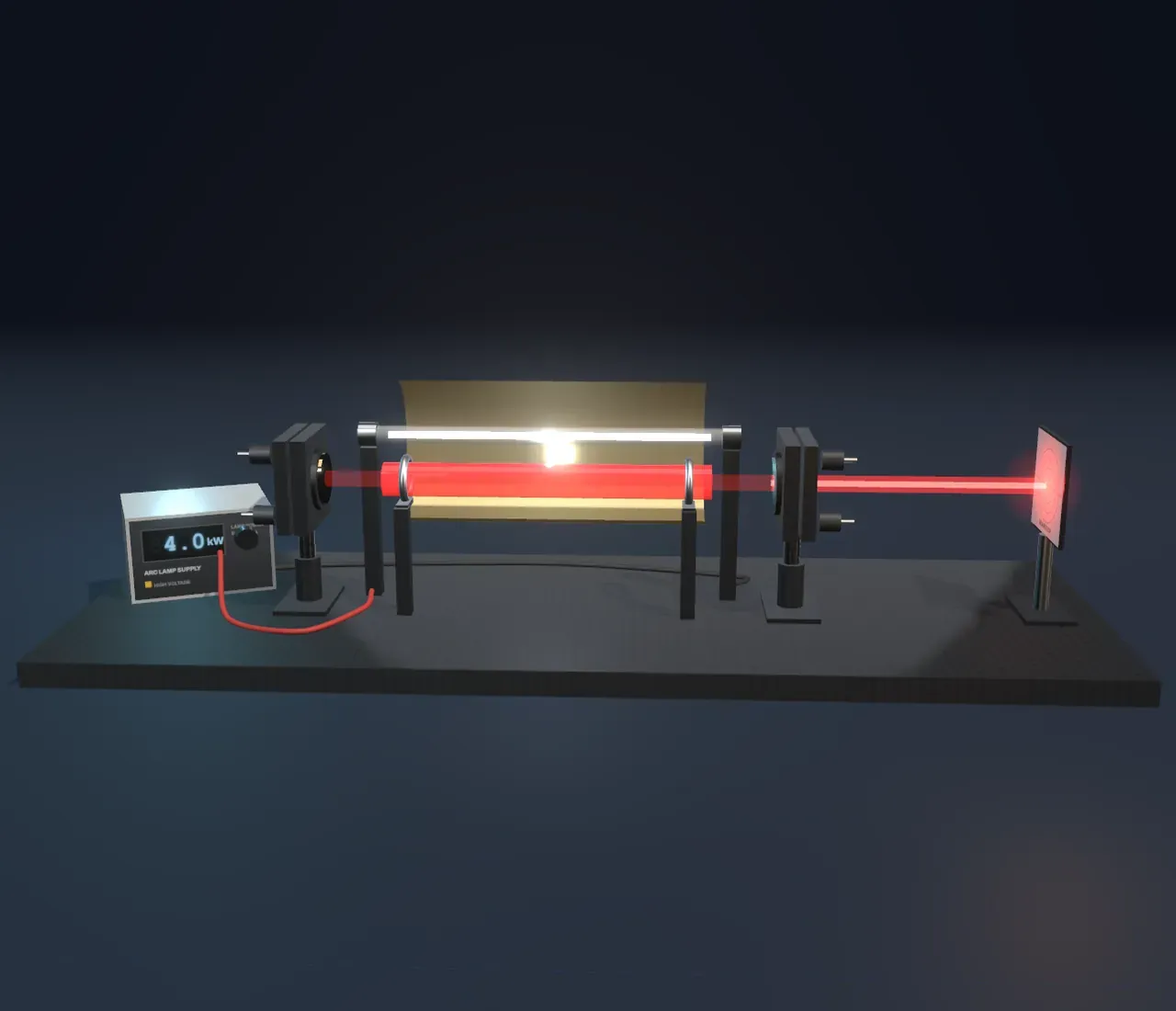
The first laser, in 1960, was a rod of ruby. The Scene shows a ruby laser on an optical table: a ruby rod between two mirrors, and an arc lamp shining on it. What you learned about light as a wave, its wavelength and frequency, will help you see why the light that leaves it is unlike any other light.
Step 1 of 9
One colour
Light is given out and absorbed in packets called photons. Each photon has an energy that depends only on its frequency:
J·s is Planck’s constant. The chromium ions in ruby give out light of one wavelength, so all their photons have the same energy. Such energies are handy to measure in electronvolts: 1 eV = 1.602 × 10⁻¹⁹ J.
Step 2 of 9
The threshold
The lamp excites chromium ions, and they fall back to the ground state giving out red light. The Pump power is now fixed at 1.5 kW, below the threshold. Predict what will happen when it is raised.
Step 3 of 9
Copies of a photon
Show the photons shows the ions as points and the light as wave trains. Compare the light glowing in every direction with the light moving along the axis, between the mirrors.
Step 4 of 9
The output mirror
One mirror reflects nearly all the light. The other, the Output mirror, lets a small share of it out at each bounce: that is the beam. This mirror sets how much light stays inside to amplify itself.
Step 5 of 9
A stream of photons
Power is energy each second. Knowing the energy of one photon, you can count how many photons leave each second.
Step 6 of 9
How fast it swings
Light also has a frequency: how many times a second its electric field turns over. It is tied to the wavelength through the speed of light.
Step 7 of 9
Held at threshold
Under Show the photons the excited ions are marked. Whatever more the pump gives the laser, where does it go?
Step 8 of 9
How much gets out
The flash lamp draws kilowatts, and the beam gives a few watts. Most of the energy goes somewhere else.
Step 9 of 9
On the edge
The mirror that lets the beam out is also a leak. The more it lets out, the harder the laser has to be pumped to come on.
Loading the interactive version…
Loading the interactive version…
Each step sets up the Scene for you, and a control marked “fixed” stays put for that step.
Practice · Calculate
The ruby laser gives out red light with a wavelength of 694.3 nm. What is the energy of one of its photons, in electronvolts?
Practice · Calculate
The ruby laser gives out red light with a wavelength of 694.3 nm. What is the energy of one of its photons, in electronvolts?
Practice · Predict, then look
At a Pump power of 1.5 kW the ruby only glows dimly. What will happen when the pump is raised to 4 kW?
Practice · Predict, then look
At a Pump power of 1.5 kW the ruby only glows dimly. What will happen when the pump is raised to 4 kW?
Practice · Choose
What makes a laser’s light different from a lamp’s?
Practice · Choose
What makes a laser’s light different from a lamp’s?
Practice · Predict, then look
The Pump power is fixed at 3 kW, and the laser runs with a 98% Output mirror. Swap it for a 60% mirror, which lets far more of the light out. What will happen?
Practice · Predict, then look
The Pump power is fixed at 3 kW, and the laser runs with a 98% Output mirror. Swap it for a 60% mirror, which lets far more of the light out. What will happen?
Practice · Calculate
At a Pump power of 4 kW about 8.8 W leaves in the beam. Each photon carries about 2.86 × 10⁻¹⁹ J. How many photons leave in the beam each second?
Practice · Calculate
At a Pump power of 4 kW about 8.8 W leaves in the beam. Each photon carries about 2.86 × 10⁻¹⁹ J. How many photons leave in the beam each second?
Practice · Calculate
The ruby laser’s red light has a wavelength of 694.3 nm, and the speed of light is 3.00 × 10⁸ m/s. What is its frequency?
Practice · Calculate
The ruby laser’s red light has a wavelength of 694.3 nm, and the speed of light is 3.00 × 10⁸ m/s. What is its frequency?
Practice · Predict, then look
The Pump power is at 3 kW, above threshold, and the laser is running. About 54% of the chromium ions are in the upper level. Predict: what will happen to that share when the pump is raised to 6 kW?
Practice · Predict, then look
The Pump power is at 3 kW, above threshold, and the laser is running. About 54% of the chromium ions are in the upper level. Predict: what will happen to that share when the pump is raised to 6 kW?
Practice · Calculate
At a Pump power of 4 kW about 8.8 W leaves in the beam. What percentage of the lamp’s power becomes laser light?
Practice · Calculate
At a Pump power of 4 kW about 8.8 W leaves in the beam. What percentage of the lamp’s power becomes laser light?
Practice · Reach the target
The Pump power is fixed at 2.5 kW. A leakier mirror lets more of the light out, but raises the threshold. Find the Output mirror at which 2.5 kW is exactly the threshold: the laser only just comes on. Press Check.
Practice · Reach the target
The Pump power is fixed at 2.5 kW. A leakier mirror lets more of the light out, but raises the threshold. Find the Output mirror at which 2.5 kW is exactly the threshold: the laser only just comes on. Press Check.
Lesson complete. Every practice question here is done.