A telescope does three things: it gathers light, separates detail and magnifies. The eyepiece sets the magnification, but only the aperture sets how much light and how much detail, because of diffraction.
Step 1 of 5 · Magnification
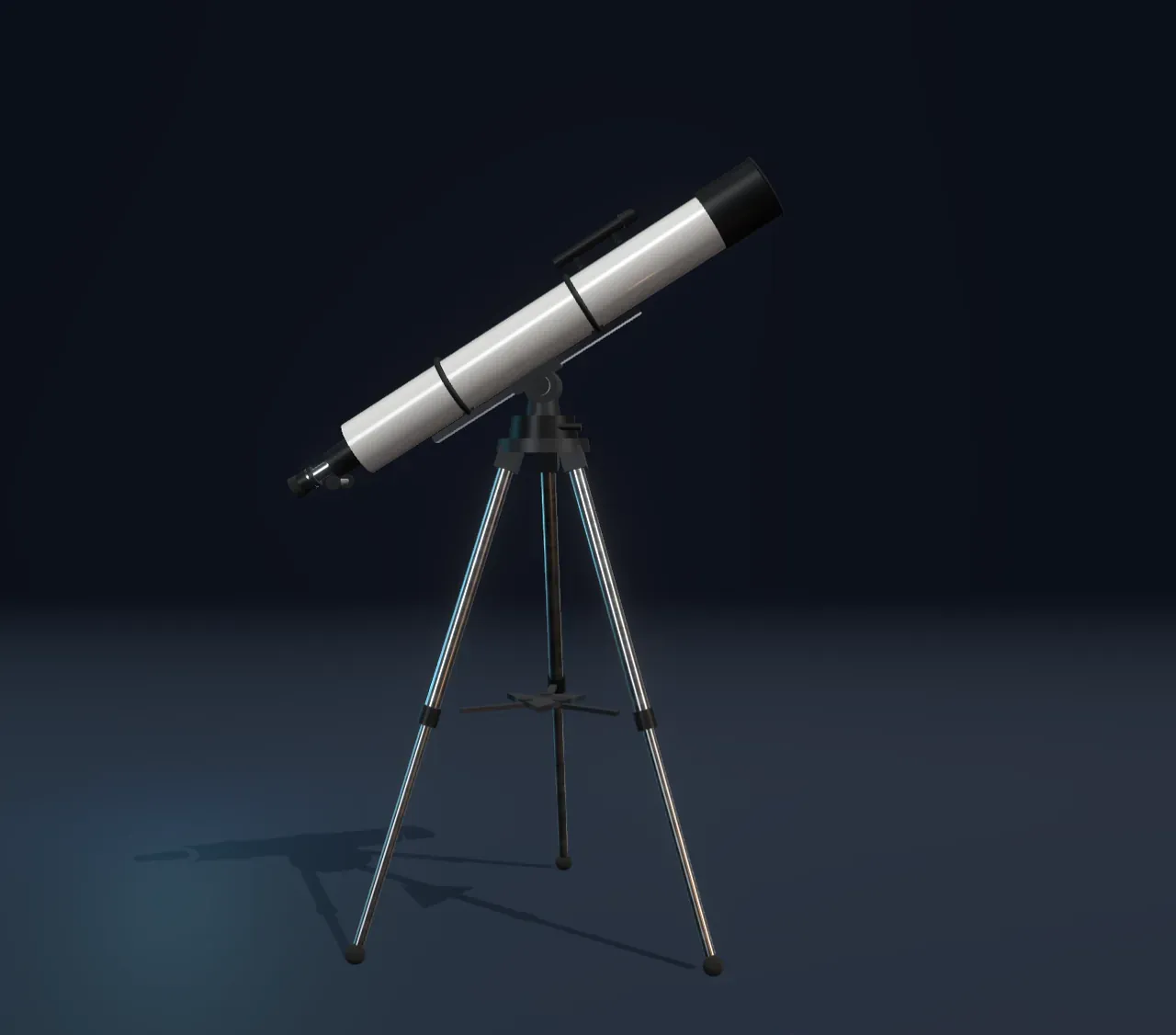
In the light Unit you saw how a lens forms an image, and how light spreads as it passes a narrow opening. A telescope uses both. The Scene shows an amateur’s telescope pointed at Epsilon Lyrae, the Double Double: two pairs of close stars, with what the eyepiece shows charted beside the Scene.
Step 1 of 5
Magnification
The main lens, or mirror, forms an image of the sky at its focus. The eyepiece is a magnifying glass for looking at that image. Both telescopes in the Scene have a focal length of 1000 mm, and the magnification is
Step 2 of 5
Gathering light
The Aperture is the diameter of the main lens or mirror. The larger it is, the more light the telescope gathers, and the fainter the stars it shows.
Step 3 of 5
The diffraction limit
Light passing an opening spreads a little, like a water wave passing a gap. So even a perfect telescope shows a star not as a point but as a small disc. Two stars closer together than that merge into one blob.
Step 4 of 5
Empty magnification
An Aperture of 50 mm and a 10 mm eyepiece, 100×. Predict what a shorter eyepiece will do, then look at the chart.
Step 5 of 5
Mirror or lens
In a reflecting Telescope, a Newtonian, a parabolic mirror at the bottom of the tube gathers the light, and a small flat mirror sends it out of the side to the eyepiece. Show the light path cuts the tube open and shows the rays.
Loading the interactive version…
Loading the interactive version…
Each step sets up the Scene for you, and a control marked “fixed” stays put for that step.
Practice · Calculate
The telescope has a focal length of 1000 mm, and the Eyepiece focal length is 25 mm. What is the magnification?
Practice · Calculate
The telescope has a focal length of 1000 mm, and the Eyepiece focal length is 25 mm. What is the magnification?
Practice · Calculate
A dark-adapted eye’s pupil is about 7 mm wide. The telescope’s Aperture is 250 mm. How many times more light does it gather than the eye?
Practice · Calculate
A dark-adapted eye’s pupil is about 7 mm wide. The telescope’s Aperture is 250 mm. How many times more light does it gather than the eye?
Practice · Calculate
An Aperture of 100 mm, and green light of 550 nm. Diffraction smears each star into a small disc of angular radius in radians. What is that radius in arcseconds? (A radian is about 206,265 arcseconds.)
Practice · Calculate
An Aperture of 100 mm, and green light of 550 nm. Diffraction smears each star into a small disc of angular radius in radians. What is that radius in arcseconds? (A radian is about 206,265 arcseconds.)
Practice · Predict, then look
An Aperture of 50 mm at 100×: each close pair of the Double Double, 2.3″ apart, shows as one smeared star. Switch to a 5 mm eyepiece, 200×. What will you see?
Practice · Predict, then look
An Aperture of 50 mm at 100×: each close pair of the Double Double, 2.3″ apart, shows as one smeared star. Switch to a 5 mm eyepiece, 200×. What will you see?
Practice · Choose
All the world’s large telescopes use a mirror rather than a lens. Why?
Practice · Choose
All the world’s large telescopes use a mirror rather than a lens. Why?
Lesson complete. Every practice question here is done.