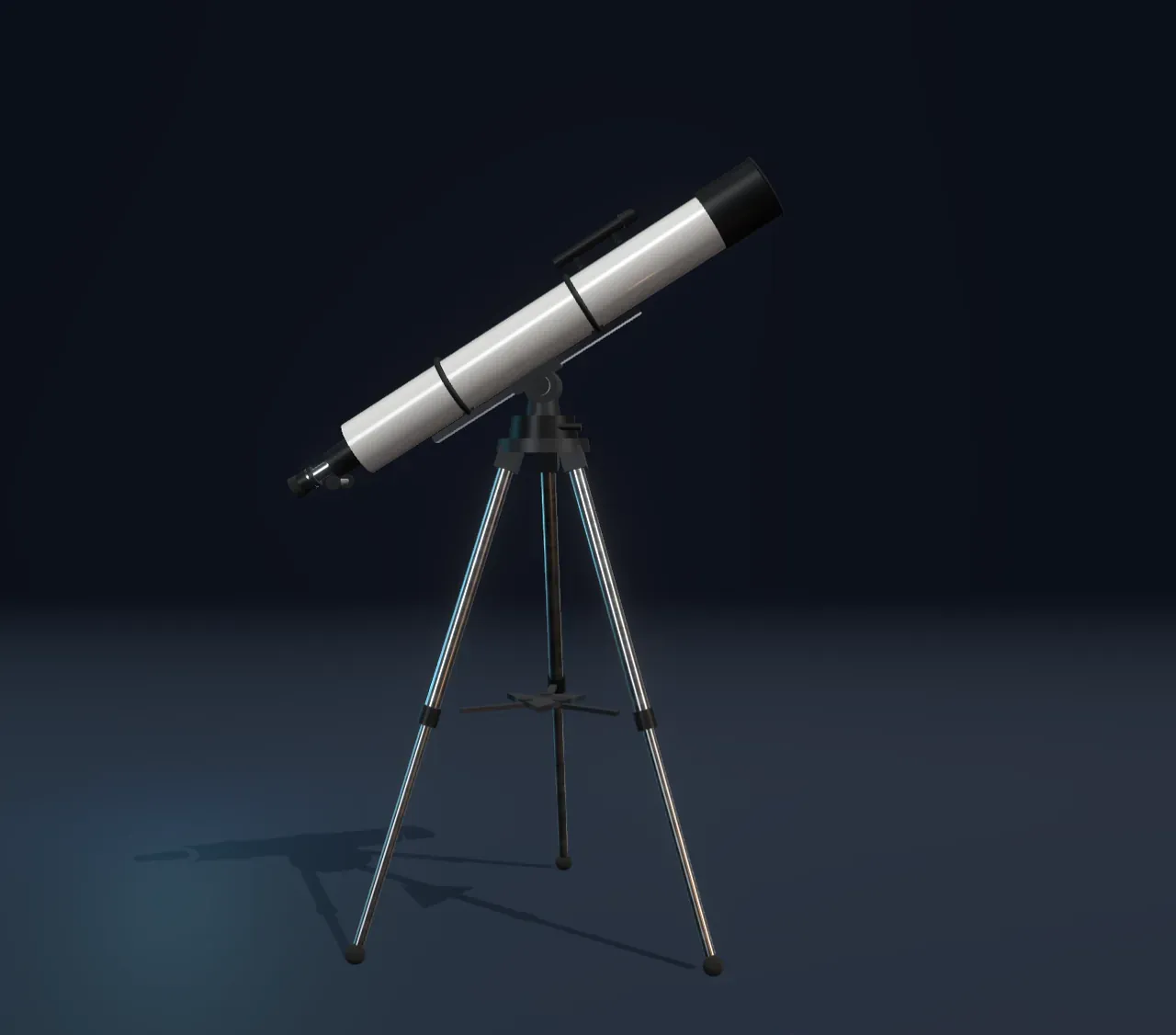
One star, or four?
High in the summer sky, near the bright star Vega, sharp-eyed people see that one faint star is really two, close together. Point even a small telescope at them and each of those two turns out to be a pair of its own. Astronomers call the four the Double Double, Epsilon Lyrae. Each close pair is only about 2.3 seconds of arc apart, roughly the width of a coin seen from two kilometres away.
What does the telescope do to show them? It is tempting to say it magnifies, but magnification alone would only spread out the same blur. A telescope does two other things first: it collects light, and it brings that light to a sharp focus.
Collecting light
The opening at the front of a telescope, its aperture, works like a bucket held out in the rain. The wider it is, the more starlight it catches. Collecting area grows with the square of the width, so a 100 millimetre telescope gathers about 200 times as much light as the 7 millimetre pupil of a dark-adapted eye. Stars far too faint to see suddenly appear. Doubling the aperture shows stars about 1.5 magnitudes fainter, and there are many more faint stars than bright ones.
Two ways to make a focus
A refractor uses a lens at the front of a long tube. The glass bends incoming rays so they meet at a point, the focus, about a metre behind it. The trouble is that glass bends blue and violet light a little more than red, so the colours focus in slightly different places. A single lens would ring every bright star with a rainbow smear. Opticians fix most of this by pairing two kinds of glass whose colour errors almost cancel, but a faint violet halo is usually left around bright stars.
A reflector uses a curved mirror instead. Isaac Newton built the first practical one in 1668, partly to escape the colour problem: a mirror reflects every colour the same way. In his design the mirror sits at the bottom of the tube, curved into a paraboloid so that parallel rays all meet at one point. Before they get there, a small flat mirror tilted at 45° turns them out through the side of the tube to the eyepiece. That small mirror blocks a few per cent of the light, and the thin vanes holding it make the four spikes seen on bright stars in many astronomy photographs.
Try it: choose Reflector, set Aperture to 50 mm and then 250 mm, and watch the eyepiece view fill with faint stars. Choose On under Show the light path to follow the rays off the two mirrors.
Sharpness comes from width too
Even a perfect telescope cannot focus a star to a true point. Light is a wave, and a wave passing through a circular opening spreads into a tiny disc with faint rings around it. The wider the opening, the smaller the disc. Two stars closer together than about their disc’s width merge into one blur. A handy rule from the 19th-century observer William Dawes says a telescope can split two equal stars about 116 arcseconds divided by its aperture in millimetres apart. That is about 2.3″ for a 50 mm telescope, so the Double Double’s pairs sit right at its limit.
What the eyepiece adds
The eyepiece is a small magnifying glass for the image at the focus. Its focal length sets the magnification: the telescope’s focal length divided by the eyepiece’s. With a 1000 mm telescope, a 25 mm eyepiece magnifies 40 times and a 10 mm eyepiece 100 times. The magnification must be high enough for your eye to see the gap, since an eye on its own can split about one arcminute. Beyond roughly twice the aperture in millimetres, extra magnification only makes the blur bigger. Astronomers call that empty magnification.
What this model leaves out
The biggest limit on most nights is the air. Moving pockets of warm and cool air make stars shimmer and smear them to 1″ or 2″, so a large telescope rarely reaches its full sharpness from the ground. That is one reason telescopes are put on mountains and in space. The eyepiece view here also assumes a truly dark sky; streetlights hide the faint stars. The faintest-star figure is a rule of thumb, and real eyes vary. The colour halo is for a typical two-element lens, the star discs are drawn as soft blobs with one ring, and the eye’s own limit is taken as one arcminute. Both telescopes keep a 1000 mm focal length while their width changes, which a real maker would rarely do.