A camera counts photons: the aperture and the shutter set how much light reaches each pixel, the ISO only amplifies what was counted, and few photons mean grain.
Step 1 of 7 · The f-number
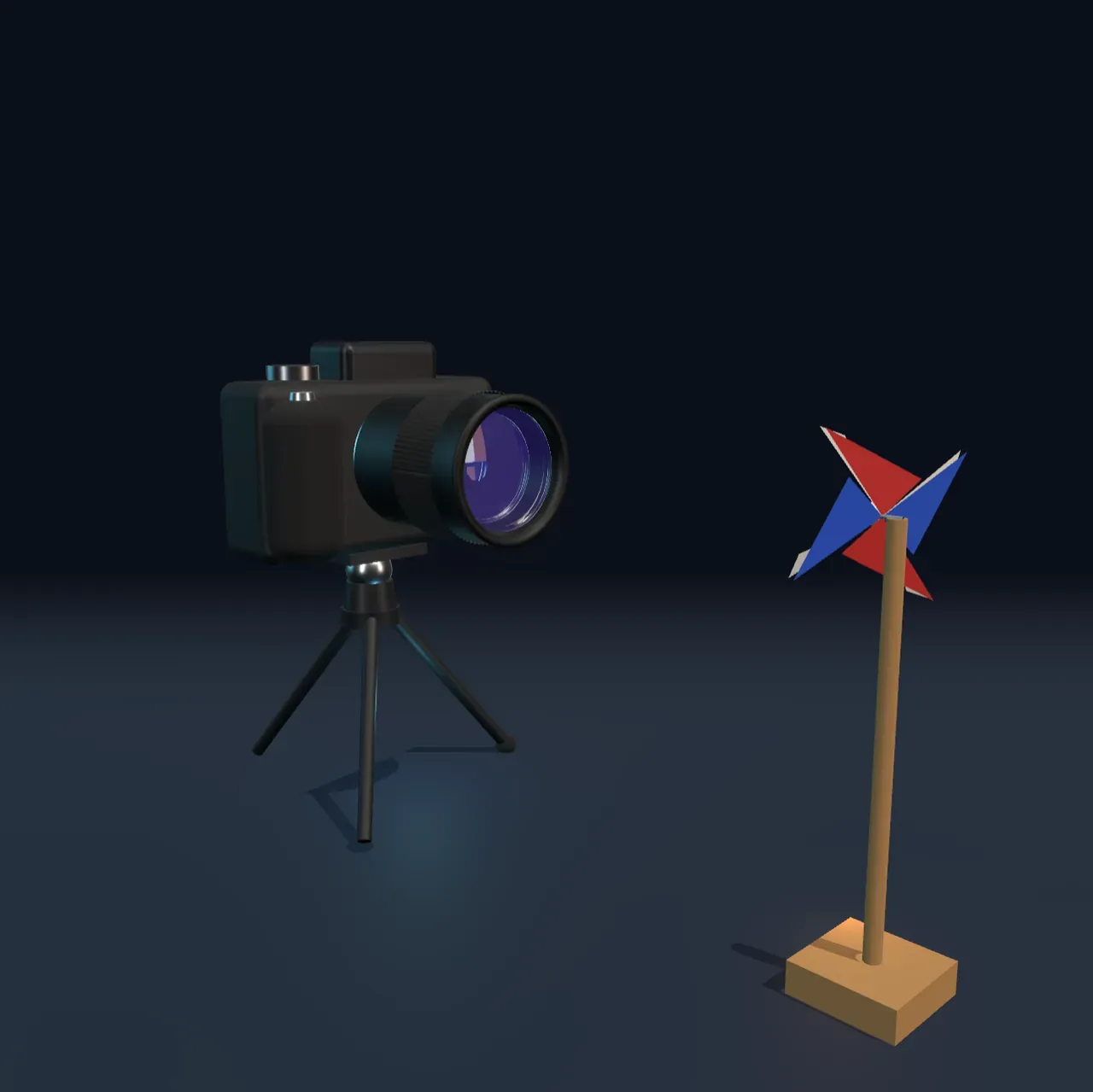
In the Lesson on lenses you saw how a lens forms an image on a screen. In a camera the screen is a sensor: millions of pixels, each counting the photons that land on it. The Scene shows a camera with a 50 mm lens pointed at a pinwheel in a garden, with the photo it takes beside the Scene.
Step 1 of 7
The f-number
The aperture is an adjustable opening inside the lens. Its size is written as an f-number, the focal length divided by the opening’s diameter:
The larger the f-number, the narrower the opening.
Step 2 of 7
Two stops
The light reaching each pixel depends on the opening’s area and on how long the shutter is open. Photographers measure light in stops: each stop is a factor of two.
Step 3 of 7
A faster shutter
The shutter speed is how long the sensor is exposed to light. ISO is the gain applied to the signal the pixels measured.
Step 4 of 7
Counting photons
Photons arrive at random, like raindrops. A pixel that should count photons sometimes counts a few more and sometimes a few less, by about , and that noise shows as grain. Cut to the pixels shows the pixels and the red, green and blue filters over them.
Step 5 of 7
Motion blur
The pinwheel turns twice a second. While the shutter is open, the blades move across the sensor.
Step 6 of 7
One number for two
A smaller aperture and a slower shutter can let in the same light. Photographers sum up each pair in one number.
Step 7 of 7
Counting the noise
Under Cut to the pixels you see the photons landing on the pixels. The number each pixel counts varies a little from shot to shot, and that is the noise.
Loading the interactive version…
Loading the interactive version…
Each step sets up the Scene for you, and a control marked “fixed” stays put for that step.
Practice · Calculate
The lens has a focal length of 50 mm, and the Aperture (f-number) is f/4. What is the diameter of the iris opening?
Practice · Calculate
The lens has a focal length of 50 mm, and the Aperture (f-number) is f/4. What is the diameter of the iris opening?
Practice · Predict, then look
Close the Aperture (f-number) from f/4 to f/8, with the shutter still at 1/250 s. How much light will reach each pixel?
Practice · Predict, then look
Close the Aperture (f-number) from f/4 to f/8, with the shutter still at 1/250 s. How much light will reach each pixel?
Practice · Reach the target
The Shutter speed (s) is fixed at 1/1000, four times faster, to freeze the pinwheel, and the Aperture (f-number) is fixed at f/4. The photo is too dark. Change the ISO until it is correctly exposed, then press Check.
Practice · Reach the target
The Shutter speed (s) is fixed at 1/1000, four times faster, to freeze the pinwheel, and the Aperture (f-number) is fixed at f/4. The photo is too dark. Change the ISO until it is correctly exposed, then press Check.
Practice · Predict, then look
Go from f/4 at ISO 100 to f/16 at ISO 1600, with the same shutter. The photo is just as bright. How will it look?
Practice · Predict, then look
Go from f/4 at ISO 100 to f/16 at ISO 1600, with the same shutter. The photo is just as bright. How will it look?
Practice · Calculate
The pinwheel turns twice a second. The Shutter speed (s) is fixed at 1/60. Through how many degrees does the pinwheel turn while the shutter is open?
Practice · Calculate
The pinwheel turns twice a second. The Shutter speed (s) is fixed at 1/60. Through how many degrees does the pinwheel turn while the shutter is open?
Practice · Calculate
Aperture (f-number) at f/8, and Shutter speed (s) at 1/250. Photographers mark each such pair with a single exposure value, . What is the exposure value here?
Practice · Calculate
Aperture (f-number) at f/8, and Shutter speed (s) at 1/250. Photographers mark each such pair with a single exposure value, . What is the exposure value here?
Practice · Calculate
f/16, 1/250 and ISO 1600: the photo is as bright as before, but a grey pixel gets only 256 photons. The noise is , where is the sensor’s read noise. What is the signal-to-noise ratio, ?
Practice · Calculate
f/16, 1/250 and ISO 1600: the photo is as bright as before, but a grey pixel gets only 256 photons. The noise is , where is the sensor’s read noise. What is the signal-to-noise ratio, ?
Lesson complete. Every practice question here is done.