Clouds between the stars
The space between the stars is not quite empty. On average it holds about one atom in every cubic centimetre, mostly hydrogen, with a pinch of dust: grains of carbon and silicate rock a tenth of a micrometre across, about one part in a hundred of the gas by mass. In places this gas gathers into clouds a hundred or a thousand times denser, tens of light-years across. These are nebulae, Latin for mists.
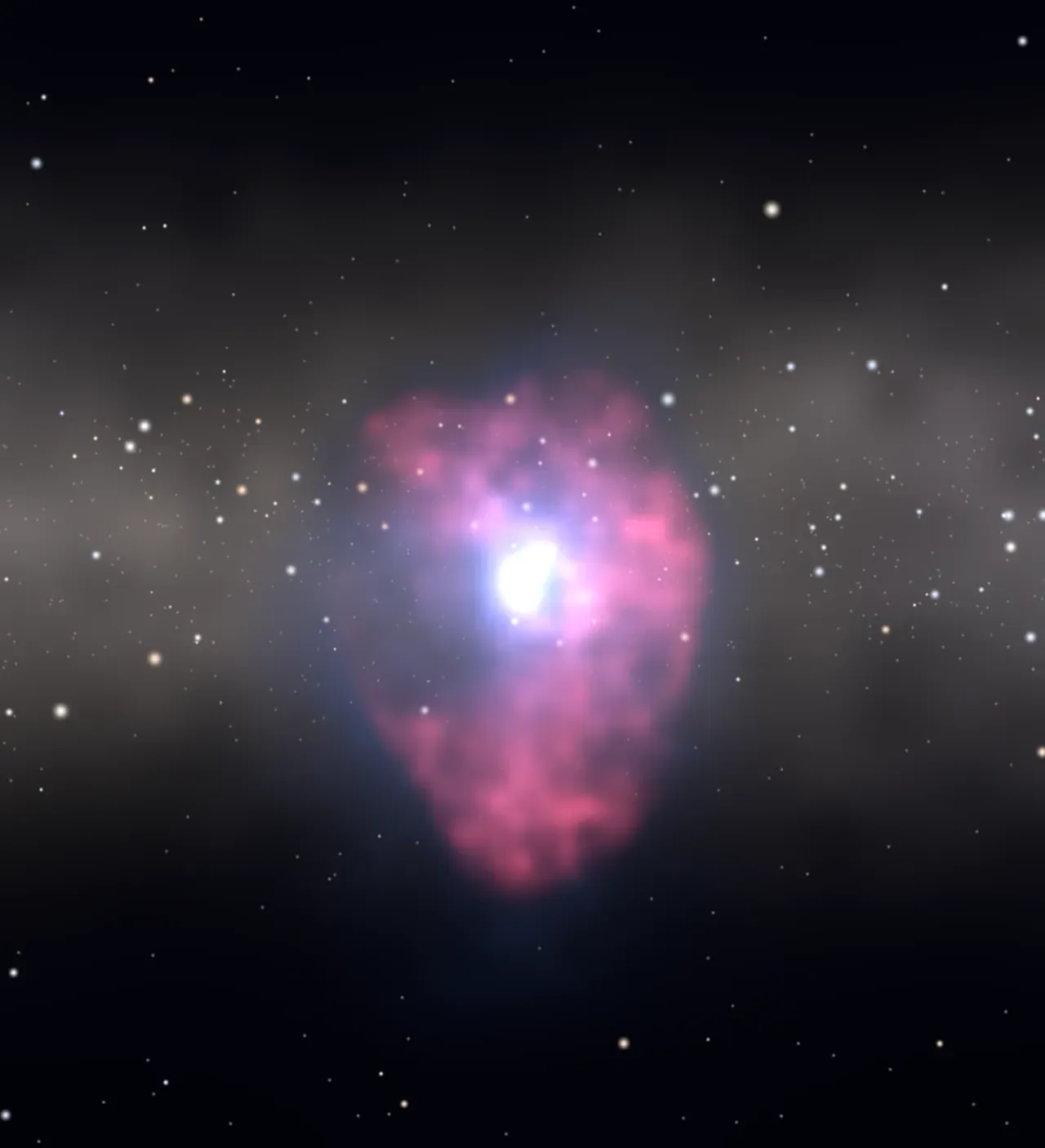
A nebula is still thinner than almost any vacuum made on Earth, yet it is so large that a line of sight through it crosses an enormous amount of gas and dust. Whether we see it at all, and in what colour, depends almost entirely on the stars inside it or near it. The scene puts one star at the centre of a cloud 33 light-years across and lets you choose the star.
Dark nebulae: dust against the stars
Start with a cool, faint star, a red dwarf or a star like the Sun. It lights almost nothing, and its light never reaches far through the cloud. What you see instead is the cloud’s shadow: its dust absorbs the light of the stars behind it, so it shows as a black patch on the bright band of the Milky Way. This is a dark nebula. The Horsehead Nebula in Orion and the Coalsack beside the Southern Cross are dark nebulae.
How dark depends on how much dust the light has to cross. Astronomers count dimming in magnitudes, where each 2.5 magnitudes is ten times fainter. About two thousand million million million hydrogen atoms in a column one centimetre square carry enough dust to dim starlight by one magnitude. At 100 atoms per cubic centimetre the cloud’s middle dims the stars behind by about one magnitude, to two-fifths of their light; at 1,000 atoms it dims them by more than 10 magnitudes, over ten thousand times, and they vanish.
Try it: choose Red dwarf under Star’s temperature, then move Gas density from 20 to 1,000 atoms per cubic centimetre. The cloud goes from almost invisible to a black gap in the star field, and the stars at its edge turn redder.
Dust dims blue light more than red, because its grains are smaller than a wavelength of visible light, and grains that small catch short waves more than long ones. Stars seen through the edge of a dark cloud look redder than they are. The spectrum beside the Scene shows this: the grey light from the stars behind is cut most at the blue end.
Reflection nebulae: dust lit blue
Choose Blue-white B star. A star of about 14,000 kelvin is three times wider than the Sun and some three hundred times brighter. Its light is strong enough to make the dust round it shine, because each grain scatters some of the light that hits it, like smoke in a sunbeam. Seen from Earth the cloud glows with the star’s own light: a reflection nebula.
It glows blue, bluer than the star itself, for the same reason the dust reddens what passes through it. The grains scatter short waves more than long ones, so the light that is bounced towards us is rich in blue, and the light that carries on is left redder. The wisps round the brightest stars of the Pleiades are a reflection nebula; the cluster is drifting through a dusty cloud that is not its own.
Emission nebulae: hydrogen split and rejoined
A hot star does something no cooler star can. Choose Hot O star: at 39,000 kelvin, ten times wider than the Sun and nearly two hundred thousand times brighter, it pours out ultraviolet. A photon with more than 13.6 electronvolts of energy, ultraviolet shorter than 91 nanometres, can knock the electron out of a hydrogen atom: it ionises it, leaving a bare proton and a free electron. This star sends out about such photons every second, a one followed by 49 zeros.
Protons and electrons find each other again. When an electron is captured it usually lands high in the atom and falls down its energy levels in steps, giving off a photon at each step. The step from the third level to the second makes red light at 656 nanometres, called hydrogen-alpha, and with a little blue-green from the step from the fourth level, the gas glows pink-red. This is an emission nebula. The Orion Nebula, the Lagoon and the Eagle Nebula are emission nebulae lit by hot young stars. Round the very hottest stars, oxygen atoms that have lost two electrons add a green glow at 501 nanometres, as in the Orion Nebula’s bright heart.
The bubble the ultraviolet can hold
The star does not ionise the whole cloud. Every time an electron and a proton rejoin, the atom is ready to be split again and uses up another ultraviolet photon. The star can only keep so many atoms split at once: as many recombinations each second as it sends out ionising photons. That fixes a bubble of split hydrogen round the star with a sharp edge, the ionisation front, where the ultraviolet runs out. Bengt Strömgren worked out its size in 1939, and it is called a Strömgren sphere.
The number of recombinations in each cubic centimetre grows as the square of the density, because each needs a proton and an electron to meet. For a star sending out ionising photons each second into gas of atoms per cubic centimetre, the balance is
where is how quickly hydrogen recombines, so the radius shrinks as . Doubling the density shrinks the bubble to about two-thirds.
Try it: with Hot O star, drag Gas density from 20 to 1,000. In thin gas the whole cloud glows. At 100 atoms per cubic centimetre the bubble reaches about ten light-years from the star; at 1,000 only two. That small bubble glows far brighter, with more atoms to rejoin in every part of it, but the thick dust round it hides most of its light. Then step Split its light to Its atoms to see the front.
This is why the youngest emission nebulae, still buried in the dense clouds that made their stars, are found with radio and infrared telescopes: those waves get through the dust.
Inside the cloud
Step Split its light to Its atoms. The near half of the cloud is cut away and the cut face shows what it is made of. Inside the front every hydrogen atom has been split: protons, drawn pink, and free electrons, drawn sky-blue, darting between them, at about 10,000 kelvin. Outside it the atoms are whole, drawn white, cold at tens of kelvin, and amber dust grains are scattered all through. Around a cool star there is no front at all, only neutral atoms and dust.
Step on to Its light. Ultraviolet photons, drawn violet, leave the star and each is used up where it splits an atom at the front; red hydrogen-alpha photons are born inside the bubble and stream out, because the gas is clear to them. The star’s visible light runs out through the cloud and some of it bounces off dust grains, coming away blue.
What this model leaves out
The cloud is a sphere of noisy clumps with a single star at its centre. Real nebulae are lumpy, torn and moving; their stars come in clusters, born from the same cloud, and their winds and radiation blow the gas outwards, carving cavities, pillars and bright rims like the Eagle Nebula’s. Many nebulae are a mix of all three kinds at once, as the Trifid Nebula is, with a red emission region, a blue reflection region and dark lanes of dust across both.
The star is an ideal blackbody on the main sequence. A real hot star gives off somewhat fewer ionising photons than a blackbody of its temperature, so the bubbles here are a little too large. The recombination rate is taken at 10,000 kelvin, the dust at the Milky Way’s average, and the extinction comes from the gas density alone. The scene compresses brightness heavily: real emission nebulae are faint, and most of their colour shows only in long-exposure photographs, not to the eye at a telescope.
Two other kinds of nebula come from the deaths of stars rather than their births: planetary nebulae, the shells a Sun-like star puffs off at the end of its life, and supernova remnants like the Crab Nebula. They glow for the same reason as an emission nebula, gas split by radiation or shocks and rejoining. They are part of the star life cycle.