Clouds of gas and dust between the stars: why some glow red, some blue and some are black patches, and how big a bubble a hot star keeps ionised.
Step 1 of 5 · A glowing cloud
Step 1 of 5
A glowing cloud
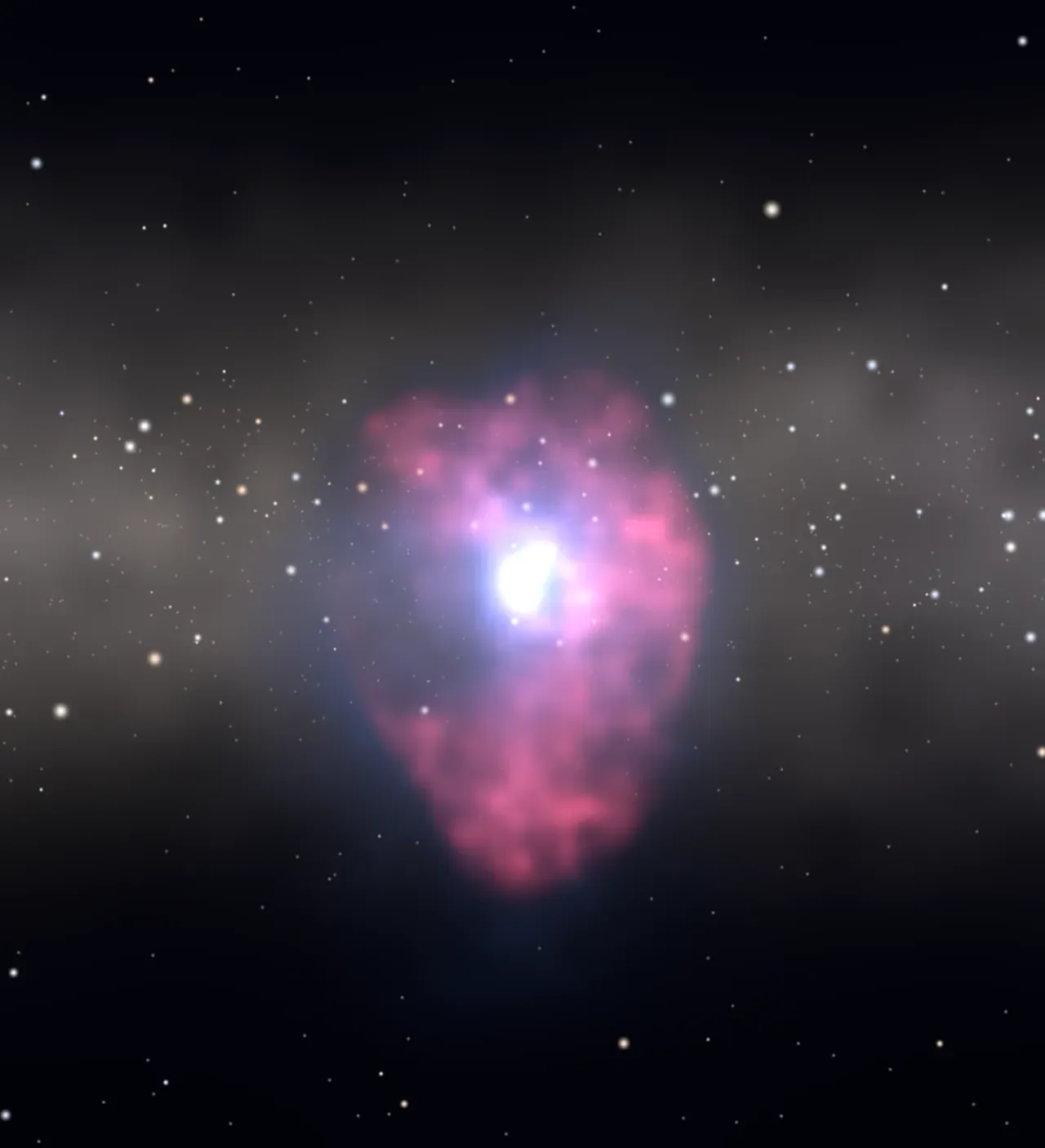
Between the stars there is gas and dust, thinner than any vacuum a lab can make. Where they gather into a cloud, there is a nebula. The Scene has one cloud with one star in it, and two things decide how the cloud looks: Star’s temperature and Gas density. The star is now a Hot O star, at 39,000 K.
Step 2 of 5
Light that splits atoms
Split its light is at Its atoms: the cloud is cut open, and on the cut face you see separate protons and electrons inside the bubble, and whole hydrogen atoms outside it. In the Stars and the universe Unit you saw that an atom gives out and absorbs only photons of particular energies. Splitting it apart takes a photon with enough energy.
Step 3 of 5
The bubble
The star splits atoms, and at the same time electrons and protons in the bubble rejoin. The bubble grows until the two rates are equal. Bengt Strömgren worked out its radius in 1939:
is the number of ionising photons the star gives out each second, the density and a constant for the rate of rejoining.
Step 4 of 5
Blue dust
A cooler star gives out far less ultraviolet. Predict what will happen to the cloud when we swap the O star for a B star.
Step 5 of 5
A black cloud
Most stars are too cool to light a cloud. But a dense enough cloud shows even without light: dust absorbs the light of the stars behind it, the blue most of all, so the stars at its edge look reddish. New stars are born in cold, dark clouds like these.
Loading the interactive version…
Loading the interactive version…
Each step sets up the Scene for you, and a control marked “fixed” stays put for that step.
Practice · Choose
The star in the middle of the cloud is a Hot O star, blue-white, yet the gas round it glows red and pink. Where does the red light come from?
Practice · Choose
The star in the middle of the cloud is a Hot O star, blue-white, yet the gas round it glows red and pink. Where does the red light come from?
Practice · Calculate
Splitting a hydrogen atom in its ground state takes a photon of at least eV. What is the longest wavelength that can still do it, in nm? .
Practice · Calculate
Splitting a hydrogen atom in its ground state takes a photon of at least eV. What is the longest wavelength that can still do it, in nm? .
Practice · Calculate
At a Gas density of atoms per cm³ the star holds an ionised bubble about light-years in radius. The density is now locked at , eight times as much. Using , what is the bubble’s radius, in light-years?
Practice · Calculate
At a Gas density of atoms per cm³ the star holds an ionised bubble about light-years in radius. The density is now locked at , eight times as much. Using , what is the bubble’s radius, in light-years?
Practice · Predict, then look
What will happen to the cloud when Star’s temperature drops from the O star to a Blue-white B star, at about 14,000 K?
Practice · Predict, then look
What will happen to the cloud when Star’s temperature drops from the O star to a Blue-white B star, at about 14,000 K?
Practice · Reach the target
The star is like the Sun, and the cloud is so thin you can hardly see it. Turn it into a dark nebula, a black patch hiding the stars behind it, and press Check.
Practice · Reach the target
The star is like the Sun, and the cloud is so thin you can hardly see it. Turn it into a dark nebula, a black patch hiding the stars behind it, and press Check.
Lesson complete. Every practice question here is done.