What is left of a heavy star that exploded: a ball the width of a city that spins hundreds of times a second and sweeps us like a lighthouse.
Step 1 of 6 · A lighthouse in space
Step 1 of 6
A lighthouse in space
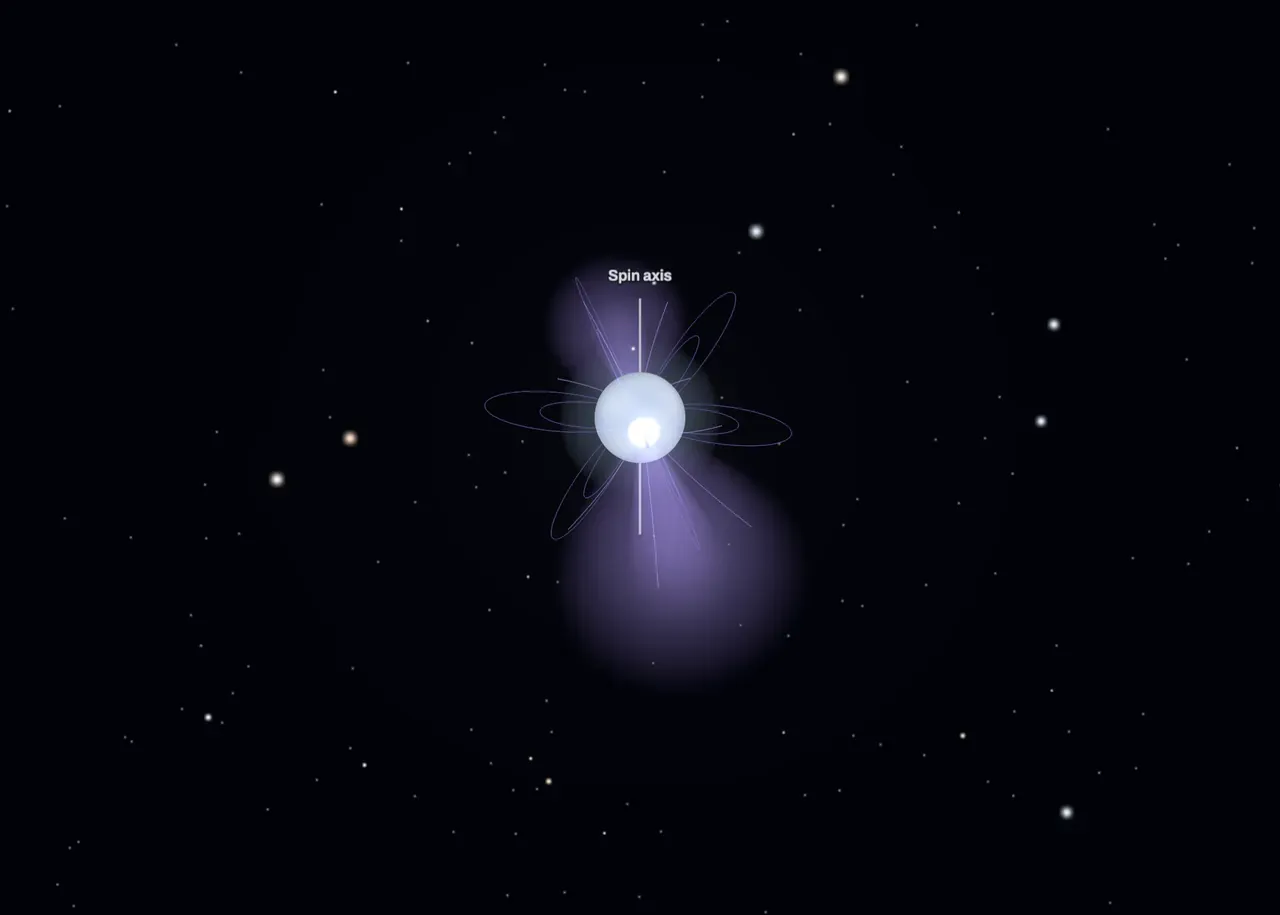
When the core of a heavy star collapses in a supernova, electrons and protons are squeezed together into neutrons. What is left is a neutron star: more than the Sun’s mass in a ball about 12 km in radius. A teaspoon of it weighs about a billion tonnes. In 1967 Jocelyn Bell Burnell, a research student in Cambridge, found a radio signal that repeated every seconds with a clock’s precision.
Step 2 of 6
The Crab
Show the pulses is On: a line leads to the Earth, and the plot shows the signal the telescope receives, turn after turn. The Scene slows the spin down so you can see it, but the plot is marked in real time.
Step 3 of 6
Spinning up
A neutron star spins fast because angular momentum is conserved: when a core thousands of kilometres across collapses to a ball a few kilometres across, it spins faster, like a skater pulling in their arms. Some pulsars are spun up even further by gas they steal from a neighbouring star.
Step 4 of 6
Tilt decides what we see
Beam tilt is the angle between the magnetic axis and the spin axis. Predict what will happen when the two are nearly lined up.
Step 5 of 6
Two beams
Every neutron star has two beams, one from each magnetic pole. So far only one of them has hit us.
Step 6 of 6
Counting pulses
What the telescope measures is the pulses that arrive each second, not the turns. When the beams stand square to the axis, both sweep past us.
Loading the interactive version…
Loading the interactive version…
Each step sets up the Scene for you, and a control marked “fixed” stays put for that step.
Practice · Choose
A radio telescope receives short, regular pulses from the pulsar. What makes them?
Practice · Choose
A radio telescope receives short, regular pulses from the pulsar. What makes them?
Practice · Calculate
Spin rate is locked at the Crab Nebula’s pulsar, turns a second. How many milliseconds pass between two pulses?
Practice · Calculate
Spin rate is locked at the Crab Nebula’s pulsar, turns a second. How many milliseconds pass between two pulses?
Practice · Calculate
Spin rate is locked at the Fastest known, turns a second. A neutron star has a radius of about 12 km. How fast does its equator move, in km/s?
Practice · Calculate
Spin rate is locked at the Fastest known, turns a second. A neutron star has a radius of about 12 km. How fast does its equator move, in km/s?
Practice · Predict, then look
What will happen to the pulse train on the plot when Beam tilt changes to just between the magnetic axis and the spin axis?
Practice · Predict, then look
What will happen to the pulse train on the plot when Beam tilt changes to just between the magnetic axis and the spin axis?
Practice · Reach the target
Some pulsars send a second, fainter pulse each turn, half a turn after the first. Change Beam tilt until both beams reach the Earth every turn, and press Check.
Practice · Reach the target
Some pulsars send a second, fainter pulse each turn, half a turn after the first. Change Beam tilt until both beams reach the Earth every turn, and press Check.
Practice · Reach the target
Beam tilt is locked at , so both beams reach the Earth every turn. Change the Spin rate until the telescope receives 100 pulses a second, and press Check.
Practice · Reach the target
Beam tilt is locked at , so both beams reach the Earth every turn. Change the Spin rate until the telescope receives 100 pulses a second, and press Check.
Lesson complete. Every practice question here is done.