What is left when a big star dies
A star many times heavier than the Sun ends its life in a supernova. Its iron core, which can no longer release energy by fusion, collapses under its own weight in less than a second. Electrons are squeezed into protons and turn them into neutrons, and the collapse stops only when the neutrons themselves are packed shoulder to shoulder. The outer layers bounce off and blast into space. What stays behind is a neutron star.
A neutron star holds about one and a half times the Sun’s mass in a ball about 24 km across, the size of a city. It is as dense as an atomic nucleus: a teaspoonful of it would weigh billions of tonnes. The pull at its surface is about two hundred billion times Earth’s.
Spinning up
The collapsing core keeps its spin, the way a skater spins faster as she pulls in her arms. A core that turned lazily as part of the star, shrunk from thousands of kilometres across to a couple of dozen, ends up turning many times a second. The Crab pulsar, left by a supernova that astronomers in China recorded in 1054, still turns about 30 times a second.
The star’s magnetic field is squeezed in the same way. It ends up around a hundred million tesla, millions of times stronger than any magnet built on Earth. That field turns with the star, and like the Earth’s, its axis does not have to line up with the spin axis.
A lighthouse in space
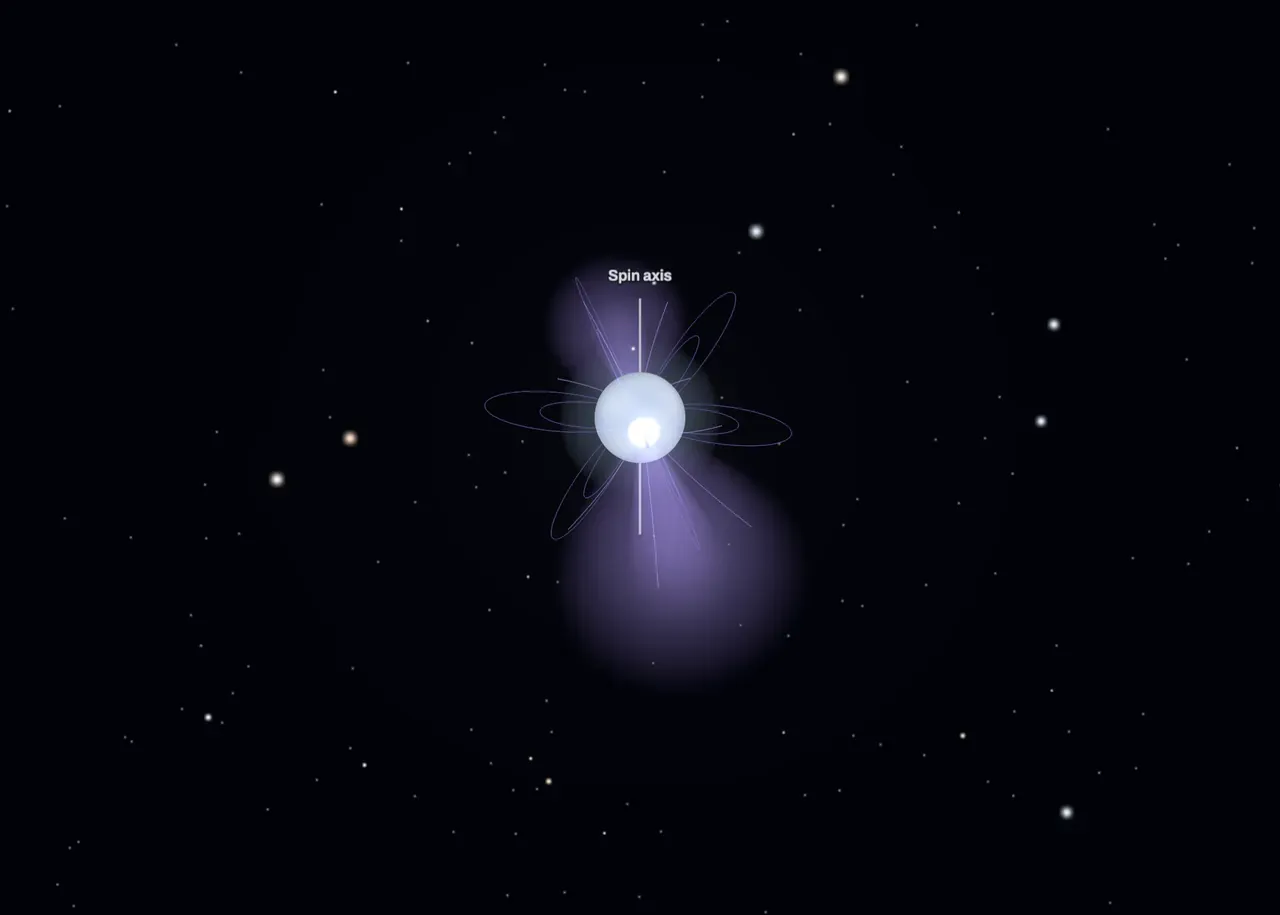
Above each magnetic pole, the field lines run out into space instead of looping back to the star. The spinning field drags charged particles off the surface and flings them out along those open lines, and they give off a narrow beam of radio waves from each pole. Because the magnetic axis is tilted, the two beams sweep round the sky every turn, like the lamp of a lighthouse.
From Earth we see none of this directly. We see a flash each time a beam crosses our line of sight, so a radio telescope records a regular train of pulses, one per turn of the star. That is a pulsar. The pulses come as often as the star spins, so timing them measures its spin directly.
Try it: choose On under Show the pulses, then press Fastest known under Spin rate. The pulses on the plot keep their shape, but the time between them shrinks to 1.4 ms: the star turns 716 times a second.
Tilt decides what we see
Whether a pulsar pulses for us depends on where its beams point. If the magnetic axis sits close to the spin axis, each beam traces a small circle round the pole and never comes near Earth. The star is still there and still beaming, but we never notice it. Astronomers estimate that we see only a minority of the pulsars in our galaxy for this reason.
Tilt the beams further and one of them starts to brush across Earth. At first it only grazes us and the pulse is weak; as the beam’s centre comes closer to our line of sight, the pulse grows taller and lasts longer. If the magnetic axis lies almost across the spin axis, both beams can sweep past, half a turn apart, and we see a main pulse and a second one, an interpulse, every turn. A small fraction of known pulsars, including the Crab, show one.
Try it: set Beam tilt to 20° and the pulse train goes flat. Raise the tilt slowly from about 65° and watch a pulse appear, then take it to 90° to see the interpulse.
Clocks in the sky
The first pulsar was found in 1967 by Jocelyn Bell Burnell, a graduate student at Cambridge, in the paper charts of a new radio telescope. Its pulses came every 1.34 seconds, so regularly that the team half-jokingly labelled it LGM-1, for “little green men”, before more were found and the spinning neutron star explained them all. More than three thousand pulsars are known today.
A pulsar slowly loses spin as its turning field carries energy away; the Crab’s turn gets longer by about a hundred-thousandth of a second each year. The fastest pulsars are old ones that were spun up again, over millions of years, by gas falling onto them from a companion star. These millisecond pulsars tick so steadily that they rival atomic clocks. Timing pulsars revealed the first planets ever found around another star, in 1992, and showed two neutron stars in orbit losing energy exactly as Einstein’s gravitational waves predict.
What the model leaves out
The scene is not to scale. A real neutron star is only about 24 km across, while its beams start hundreds of kilometres above it and spread over thousands. The drawn star also turns far more slowly than a real one; the label under the plot says how much. Radio waves are invisible, so the beams are drawn as violet light, and the field lines are a simple tilted magnet’s, without the way they sweep back where they would have to move near the speed of light.
Each beam is a smooth cone 15° wide, and Earth sits 80° from the spin axis. Real beams are patchy and their exact shape is still studied; slower pulsars have narrower beams and faster ones wider. Real pulses also vary from one turn to the next, arrive with radio noise, and are smeared out by the thin gas between the stars, which delays low radio frequencies more than high ones. The model does not slow the star down over time.