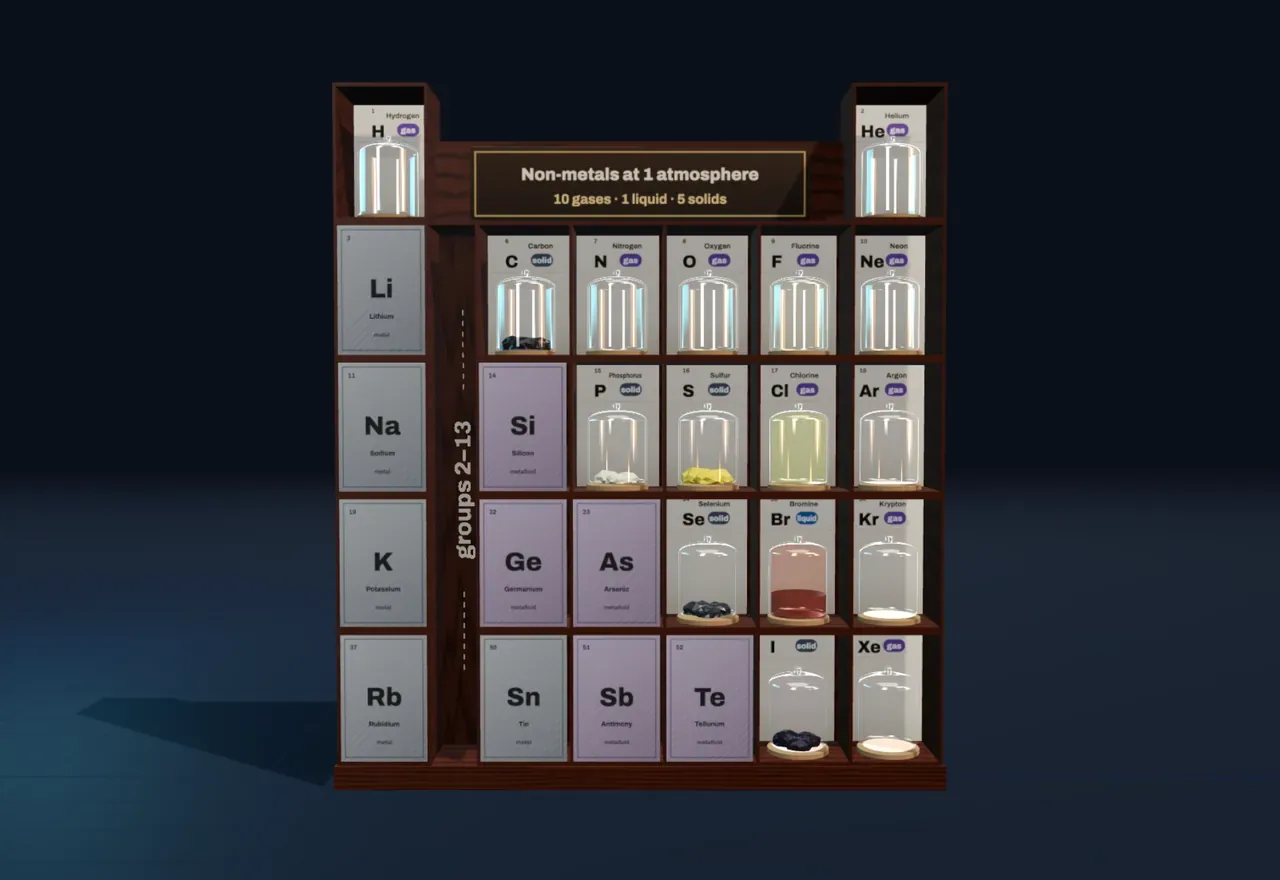
Mostly gases
About one element in seven is a non-metal, and the non-metals sit together in the top right corner of the periodic table, with hydrogen as a lone outlier above the metals on the left. At room temperature they are a strange collection. Ten of the sixteen in the cabinet are gases: hydrogen, nitrogen, oxygen, fluorine, chlorine and the noble gases from helium to xenon. One, bromine, is a dark red liquid. The other five, carbon, phosphorus, sulfur, selenium and iodine, are solids, and most of those are brittle and dull rather than shiny and bendable like a metal.
Compare that with the metals: all but mercury are solid at room temperature, and most melt only when they are glowing hot. The non-metals melt and boil at a few tens or hundreds of kelvin. Nitrogen boils at 77 K, which is −196 °C. Even iodine, a solid you can hold, melts at 387 K, a little hotter than boiling water.
Try it: choose Deep cold under Temperature. Every ampoule but helium’s holds a frozen solid. Then step through Liquid air, Room and Hot oven and watch the solids melt and the liquids boil away, one element at a time.
Strong inside, weak between
The reason lies in what each sample is made of. Choose Molecules under Show the molecules. The noble gases are single atoms, each with a full outer shell of electrons and no need to bond. Hydrogen, nitrogen, oxygen and the halogens (fluorine, chlorine, bromine and iodine) are pairs of atoms, joined by a covalent bond in which the two atoms share electrons. White phosphorus is a little pyramid of four atoms, P₄, and sulfur a crown-shaped ring of eight, S₈. Grey selenium is long spiral chains.
The bond inside each of these molecules is strong, and none of them breaks in the scene, however hot you make it. The pull between separate molecules is a different matter. It is a weak, fleeting attraction that comes from each molecule’s electrons briefly bunching to one side, so that neighbouring molecules tug on each other a little. Melting and boiling only have to overcome that weak pull, which is why so little heat is needed. In the scene the molecules of a solid vibrate in rows, those of a liquid jostle and tumble in a pool, and those of a gas fly all through the ampoule, but they always stay whole.
Bigger molecules, higher boiling points
The weak pull grows with the number of electrons a molecule has to slosh about, so bigger, heavier molecules cling together more. The halogens show it best. Read down their column at Room: fluorine and chlorine are gases, bromine is a liquid and iodine is a solid. The noble gases climb the same way: helium boils at 4 K and xenon at 165 K.
Try it: drag Temperature slowly up from Liquid air. Watch the halogen column change state from the top down, each element waiting for a higher temperature than the one above it.
The same idea explains the solids. P₄, S₈ and selenium’s chains are large, many-electron molecules, so they pack into solids that melt at 317 K, 388 K and 494 K. Iodine’s heavy I₂ pairs make a solid too, and warm iodine gives off a violet vapour even before it melts, which the scene shows as a faint violet tint in its ampoule. Liquid bromine does the same with a red-brown vapour.
Carbon, the exception
Carbon stays solid right across the scene’s range. In graphite each carbon atom is bonded to three others in flat sheets, and every sheet is effectively one giant molecule. There are no small molecules to pull apart: to turn graphite into a vapour you have to break the strong bonds themselves, which takes about 3900 K. Diamond, carbon’s other common form, is a giant network too. That is why carbon behaves less like its neighbours and more like a hard, high-melting mineral.
What makes a non-metal
Besides their low melting and boiling points, non-metals share a few other habits. As solids they are brittle and usually dull. Most conduct electricity and heat poorly, because their electrons are held in bonds or full shells rather than roaming freely as they do in a metal. Graphite is the well-known exception: one electron per atom is free to move along its sheets, so it conducts along them. In reactions non-metals tend to gain or share electrons, where metals tend to lose them. That is why a metal and a non-metal often combine into an ionic compound such as table salt, sodium chloride, while two non-metals share electrons in molecules such as water and carbon dioxide.
The boundary is not sharp. The metalloids next door, silicon, germanium, arsenic, antimony and tellurium, are shiny like metals but brittle and only partly conducting, and chemists do not all agree on exactly where the line falls. The cabinet closes their cells, along with the metals of group 1 and tin, to show where the non-metals sit on the table.
What this model leaves out
Every sample is at a pressure of one atmosphere, and the melting and boiling points are standard values at that pressure. Helium never freezes at that pressure, however cold it gets. Real samples change state at one temperature; the scene spreads each change over a narrow band just below the melting or boiling point so you can see the solid shrink as its liquid grows. It shows where each sample ends up, not how long it takes to get there, and it does not show the extra heat that melting and boiling soak up.
Several non-metals come in more than one form. The scene shows white phosphorus, not red, and grey selenium, and leaves out radon and astatine, which are radioactive. Sulfur’s liquid really darkens and thickens as it warms, as its rings break open into long chains; the scene keeps it as one orange liquid. Real ampoules of fluorine or white phosphorus would need special care: fluorine attacks glass and white phosphorus catches fire in air. The particles are drawn far larger than real molecules, their numbers are chosen to fill the ampoules, and their speeds only follow the trend that light molecules in a hot gas move fastest.