A cabinet of sixteen non-metals: why most are gases at room temperature, what stays whole when they melt and boil, how boiling points climb down the halogens, and why carbon is the exception.
Step 1 of 5 · Mostly gases
Step 1 of 5
Mostly gases
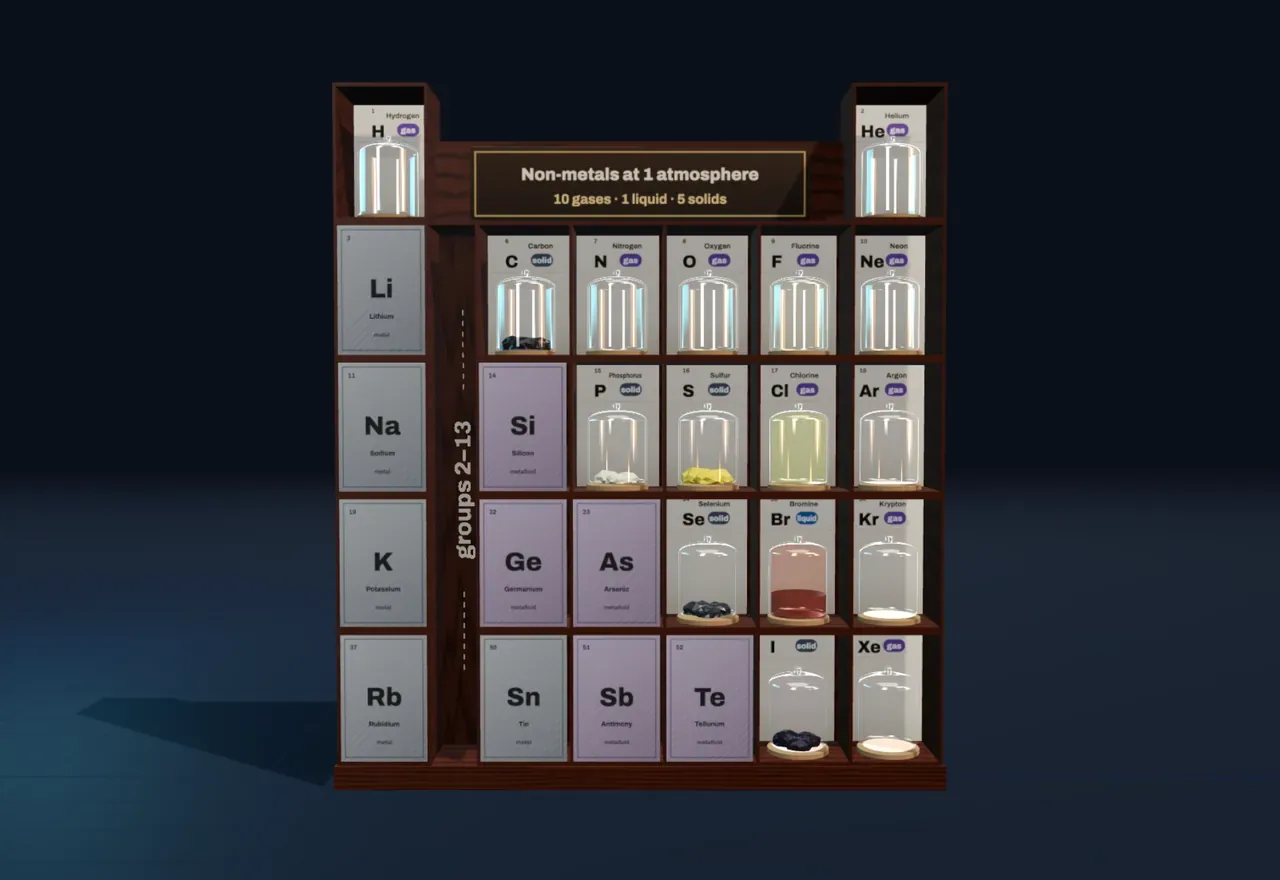
The Scene shows a display cabinet laid out like the top right corner of the periodic table, and every non-metal cell holds a sealed ampoule of the element itself. The metal and metalloid cells are closed, only to mark where they sit. Temperature is at Room, 293 K.
Count how many of the sixteen ampoules hold a gas.
Step 2 of 5
Strong inside, weak between
Show the molecules is on Molecules. The noble gases are single atoms, with a full outer shell. Hydrogen, nitrogen, oxygen and the halogens are pairs of atoms that share electrons. White phosphorus is a pyramid of four atoms, P₄, and sulfur a ring of eight, S₈.
The bond inside each molecule is strong. The pull between separate molecules is weak, and melting and boiling only have to overcome that. Predict what happens to the molecules when you heat the cabinet to Red heat, 1000 K.
Step 3 of 5
Down the halogens
The weak pull between molecules grows with the number of electrons in a molecule, so big, heavy molecules cling together more. The Scene is at Liquid air, 75 K, and in the halogen column only fluorine is liquid: chlorine, bromine and iodine are frozen.
At room temperature fluorine and chlorine are gases, and bromine is the only non-metal that is liquid. Predict what iodine will be.
Step 4 of 5
Liquid air
The noble gases climb the same way: helium boils at 4 K and xenon only at 165 K. Nitrogen boils at 77 K and oxygen at 90 K.
Predict: how many of the ampoules will still hold a gas at 75 K, the temperature of Liquid air?
Step 5 of 5
Carbon, the exception
The Scene is at Red heat, with Show the molecules on Molecules. Almost everything is a gas by now, but carbon stays solid. In graphite each carbon atom is bonded to three others in flat sheets, and every sheet is in effect one giant molecule.
Non-metals share other habits too: as solids they are brittle and usually dull, and they conduct electricity and heat poorly, because their electrons are held in bonds or full shells. In reactions they tend to gain or share electrons, where metals tend to give them away.
Loading the interactive version…
Loading the interactive version…
Each step sets up the Scene for you, and a control marked “fixed” stays put for that step.
Practice · Calculate
At room temperature, how many of the sixteen ampoules hold a gas?
Practice · Calculate
At room temperature, how many of the sixteen ampoules hold a gas?
Practice · Predict, then look
Heat the cabinet to Red heat, 1000 K. What happens to molecules such as N₂, Cl₂ and S₈?
Practice · Predict, then look
Heat the cabinet to Red heat, 1000 K. What happens to molecules such as N₂, Cl₂ and S₈?
Practice · Predict, then look
At room temperature fluorine and chlorine are gases and bromine is a liquid. What will iodine, I₂, below them in the column, be?
Practice · Predict, then look
At room temperature fluorine and chlorine are gases and bromine is a liquid. What will iodine, I₂, below them in the column, be?
Practice · Predict, then look
Cool the cabinet to 75 K, Liquid air. How many of the sixteen ampoules will still hold a gas?
Practice · Predict, then look
Cool the cabinet to 75 K, Liquid air. How many of the sixteen ampoules will still hold a gas?
Practice · Choose
At 1000 K almost every non-metal is a gas, but carbon stays solid up to about 3900 K. Why?
Practice · Choose
At 1000 K almost every non-metal is a gas, but carbon stays solid up to about 3900 K. Why?
Lesson complete. Every practice question here is done.