The ten columns in the middle of the table: d electrons, ions of more than one charge, and why copper solutions are blue while zinc's are colourless. Ligand-field splitting, the colour left when white light loses one colour, and what ammonia changes.
Step 1 of 6 · d electrons
Step 1 of 6
d electrons
The transition metals fill the ten columns in the middle of the table. In the fourth row, after potassium and calcium, the next electrons go not into the outer shell but into an inner subshell, 3d, which has room for ten. From scandium to zinc, each element adds one electron to 3d. An iron atom, for example, has electrons: like argon, two in the outer shell, 4s, and six in 3d.
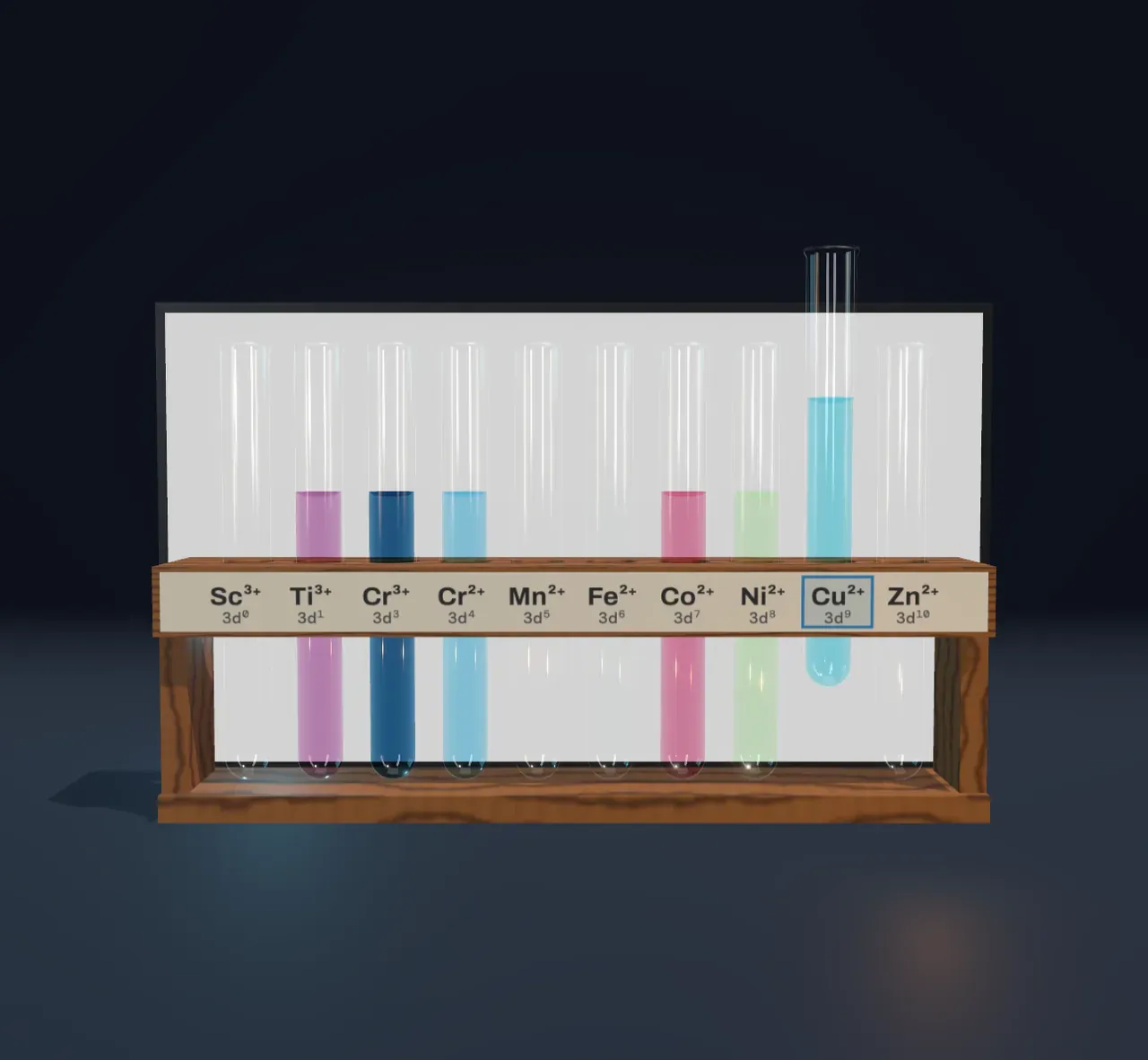
When a transition-metal atom becomes an ion, it gives up its two 4s electrons first, and only then any d electrons. The rack in the Scene shows a tube of Fe²⁺ solution. How many d electrons does this ion have?
Step 2 of 6
Several charges
Sodium gives up one electron easily, but a second would have to come from a full inner shell, which costs about nine times as much. So sodium has only Na⁺. Transition metals are different: iron forms both Fe²⁺ and Fe³⁺. Rust is iron(III), and the iron in your blood is mostly iron(II).
The rack holds chromium twice. Switch Metal ion between Cr³⁺ and Cr²⁺: three d electrons give a deep blue, and four a sky blue. One electron more changes the colour.
Step 3 of 6
Taking out a colour
A metal ion in water is never alone: six water molecules surround it, and they are called ligands. Two of the five d orbitals point straight at the ligands and are pushed up in energy, and three point between them and sink. The gap between the two levels is the ligand-field splitting, Δ.
When white light passes through the solution, photons whose energy equals Δ lift an electron to the upper level and are absorbed. Every other colour passes through, and the eye sees what is left. The Scene shows Ti³⁺: it absorbs blue-green light, at 493 nm, leaving red and violet. The chart beside the Scene shows what is taken out and what you see.
Step 4 of 6
Colourless ions
Zoom to the d orbitals is at d orbitals. Choose Sc³⁺, Zn²⁺ and Mn²⁺, and watch the photon. Colour needs an electron that can jump the gap. Manganese(II) is a special case: each of its five d electrons has an orbital of its own, all with the same spin, so it absorbs only a trace, and its salts are the palest pink.
Step 5 of 6
Ammonia moves the band
Ammonia binds to the ion through a nitrogen lone pair, which pushes on the d orbitals harder than water’s oxygen does. Swap the waters for ammonia and Δ grows by about a quarter. The Scene shows Cu²⁺ in water, pale blue. Predict where the absorption band moves when all six ligands are ammonia.
Step 6 of 6
A bigger gap
A photon’s energy is fixed by its wavelength: photons of 790 nm carry about 151 kJ per mole of photons. Read Δ for copper in water on the chart, and work out what it becomes when all the ligands are ammonia.
Loading the interactive version…
Loading the interactive version…
Each step sets up the Scene for you, and a control marked “fixed” stays put for that step.
Practice · Calculate
An iron atom has electrons: like argon, two in 4s and six in 3d. How many d electrons does the Fe²⁺ ion have?
Practice · Calculate
An iron atom has electrons: like argon, two in 4s and six in 3d. How many d electrons does the Fe²⁺ ion have?
Practice · Choose
Why does iron form both Fe²⁺ and Fe³⁺, while sodium forms only Na⁺?
Practice · Choose
Why does iron form both Fe²⁺ and Fe³⁺, while sodium forms only Na⁺?
Practice · Choose
Ti³⁺ absorbs blue-green light and looks purple. Another solution absorbs mostly yellow light. What colour does it look?
Practice · Choose
Ti³⁺ absorbs blue-green light and looks purple. Another solution absorbs mostly yellow light. What colour does it look?
Practice · Choose
Solutions of which ions are colourless? Choose all that apply.
Practice · Choose
Solutions of which ions are colourless? Choose all that apply.
Practice · Predict, then look
Swap all six waters round Cu²⁺ for ammonia, and Δ grows by a quarter. Where does the absorption band move?
Practice · Predict, then look
Swap all six waters round Cu²⁺ for ammonia, and Δ grows by a quarter. Where does the absorption band move?
Practice · Calculate
Read Δ for Cu²⁺ in water on the chart. Ammonia makes Δ a quarter bigger. What will Δ be when all six ligands are ammonia?
Practice · Calculate
Read Δ for Cu²⁺ in water on the chart. Ammonia makes Δ a quarter bigger. What will Δ be when all six ligands are ammonia?
Lesson complete. Every practice question here is done.