The metals in the middle
The transition metals fill the ten columns in the middle of the periodic table, the d-block. The first row runs from scandium to zinc and includes iron, nickel and copper, the metals that bridges, wires and coins are made of. Their atoms are filling the 3d subshell: each step along the row adds one more electron to it.
Two things set these metals apart from the alkali metals on the left of the table. Most of them form ions of more than one charge, and their compounds are often brightly coloured. Both come from those d electrons.
One metal, several charges
Sodium gives up one electron easily. Taking a second one would mean breaking into a full inner shell, and that costs about nine times as much energy, so sodium only ever forms Na⁺.
A transition metal’s outer 4s electrons and its 3d electrons have similar energies. Iron loses its two 4s electrons to become Fe²⁺, and losing one 3d electron more, to make Fe³⁺, costs only about twice as much again. Both ions are common: rust is iron(III), and the iron in your blood is mostly iron(II). Chromium forms Cr²⁺, Cr³⁺ and, in chromates, the +6 state. Manganese goes all the way from +2 to +7.
Swapping between charges means gaining or losing electrons, which is why these metals turn up wherever electrons have to be passed along: in batteries and electrochemistry, in enzymes, and in industrial catalysts.
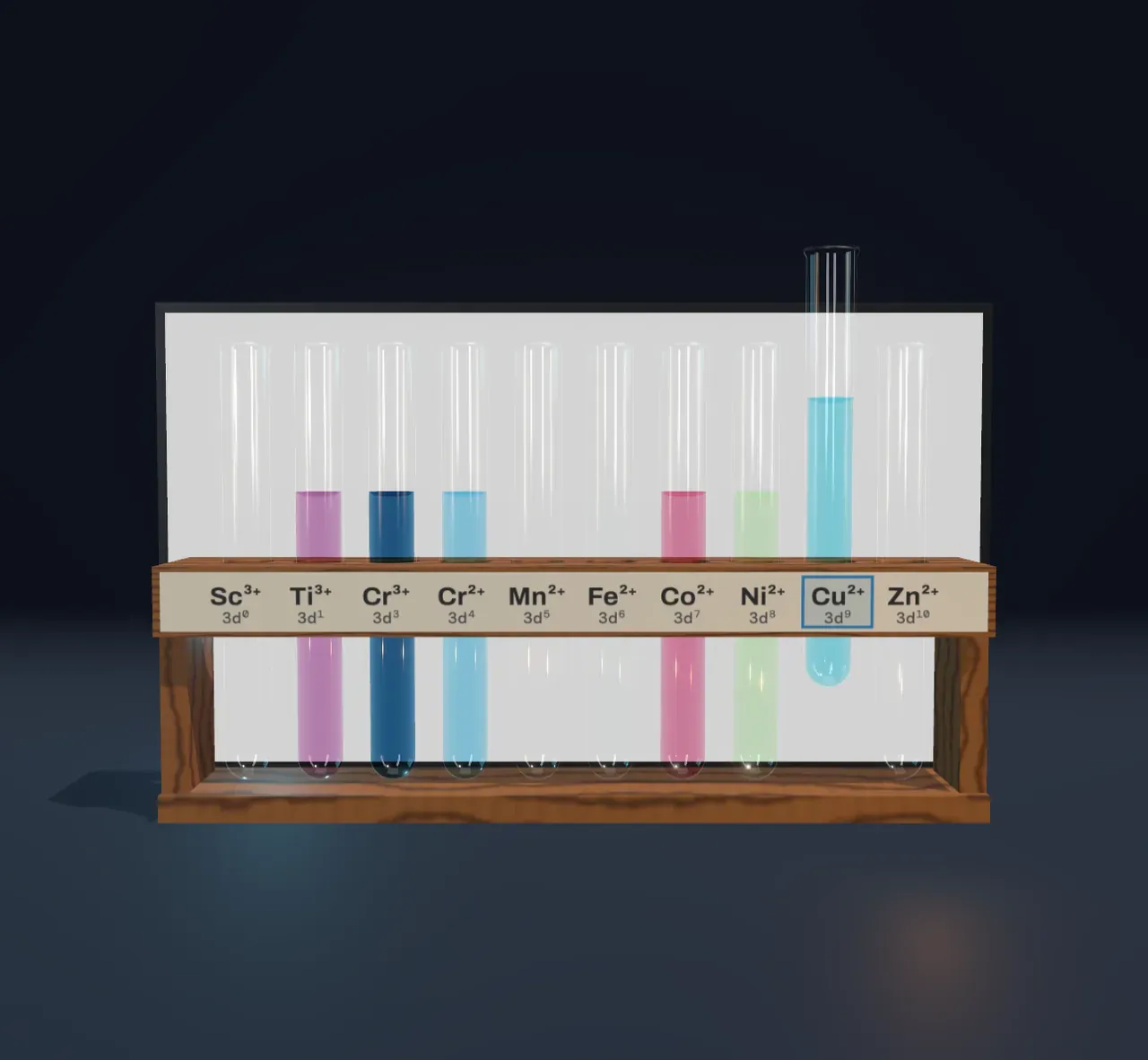
The rack in the Scene holds chromium twice. Cr³⁺, with three d electrons, is a deep blue; Cr²⁺, with four, is sky blue. One electron more changes the colour.
Six neighbours, five orbitals
A metal ion in water is never alone. Six water molecules crowd round it, oxygen end in, at the corners of an octahedron. Molecules or ions bound to a metal this way are called ligands.
The ion’s five d orbitals point in different directions. Two of them point straight at the ligands; the other three point into the gaps between them. The ligands’ electrons repel an electron in the two that point at them more strongly, so those two orbitals rise in energy and the three that point away sink. The five orbitals, which had the same energy in a bare ion, split into two levels a gap apart. That gap is called the ligand-field splitting, Δ.
Try it: slide Zoom to the d orbitals to the middle. The six waters stand round the copper ion, with the two amber orbitals pointing at them and the three blue ones pointing between. Then slide on to d orbitals and watch the five sort themselves into two levels.
Taking one colour out of white light
For these ions Δ is between about 100 and 300 kilojoules per mole. That is the energy of photons of visible or near-infrared light, as the energy of a photon is fixed by its wavelength (Atomic spectra explains why).
When white light passes through the tube, photons whose energy matches the gap can lift an electron from the lower level to the upper one. Those photons are absorbed. The electron soon drops back and gives its energy to the water as a tiny amount of heat, not as light. Every other colour passes straight through, and the eye sees what is left.
Titanium(III) has Δ ≈ 243 kJ/mol, the energy of a photon of 493 nm, blue-green light. Take blue-green out of white light and the red and violet that remain look purple. Copper(II) in water absorbs most strongly at about 790 nm, just past the red end of the spectrum, and its band reaches into the red and orange. With red taken out, the solution looks pale blue.
The chart beside the Scene shows how strongly the chosen tube absorbs each wavelength, the light it takes out and the colour that is left.
Why some are colourless
The colour needs an electron that can jump the gap. Scandium(III) has lost all its d electrons, so there is nothing to lift, and its salts are white. Zinc(II) has all ten: both levels are full and an electron has nowhere to go. Zinc salts are white too.
Manganese(II) is the odd one. It has five d electrons, one in each orbital, all spinning the same way. To move up, an electron would have to join one already there, and two electrons can share an orbital only if their spins point opposite ways. Light very rarely flips a spin, so Mn²⁺ absorbs only a trace, and its salts are the palest pink.
Try it: choose Sc³⁺, Zn²⁺ and Mn²⁺ with Zoom to the d orbitals at d orbitals. The photon passes through every time.
Ligands change the colour
Ammonia binds through a nitrogen atom whose lone pair pushes harder on the d orbitals than water’s oxygen does. Swap the waters for ammonia and Δ grows by about a quarter, so every band moves to shorter wavelengths and every colour shifts. Pale blue copper(II) turns deep royal blue, a classic test for copper. Green nickel(II) turns blue.
Chemists rank ligands by how far they split the d orbitals, from chloride (less than water) through ammonia to cyanide, which splits them about 1.7 times as far as water.
Try it: choose Cu²⁺ and step Ammonia ligands from 0, all water, up to 6, all ammonia. The absorption band slides out of the infrared into the orange, and the tube deepens.
What this model leaves out
The colours come from measured absorption bands of each ion surrounded by six waters, rounded, at one concentration, through 1.5 cm of solution, under an even white light; a screen can only approximate them. Ammonia is assumed to shift every band in proportion to Δ, by a chemists’ rule of thumb (each ammonia counts as 1.25 waters). Real shifts differ a little.
The energy ladder shows one electron jumping. In ions with between two and eight d electrons the electrons also repel each other, which gives them extra bands; the chart includes them, but the ladder does not show where they come from. Copper(II), chromium(II) and titanium(III) are also slightly stretched out of shape, which broadens their bands. Real copper(II) holds only four ammonias strongly.
In a real lab, adding ammonia to several of these ions gives a hydroxide precipitate rather than an ammonia complex, iron(II) slowly turns brown in air as it becomes iron(III), and chromium(II) does so within minutes. Not every colour comes from d electrons either: purple permanganate and orange dichromate have none, and are coloured because an electron jumps from the oxygen to the metal. Ions with four ligands split their orbitals in a different pattern: dry cobalt chloride paper is blue because its cobalt holds four chlorides, and it turns pink when damp, as six waters take their place.