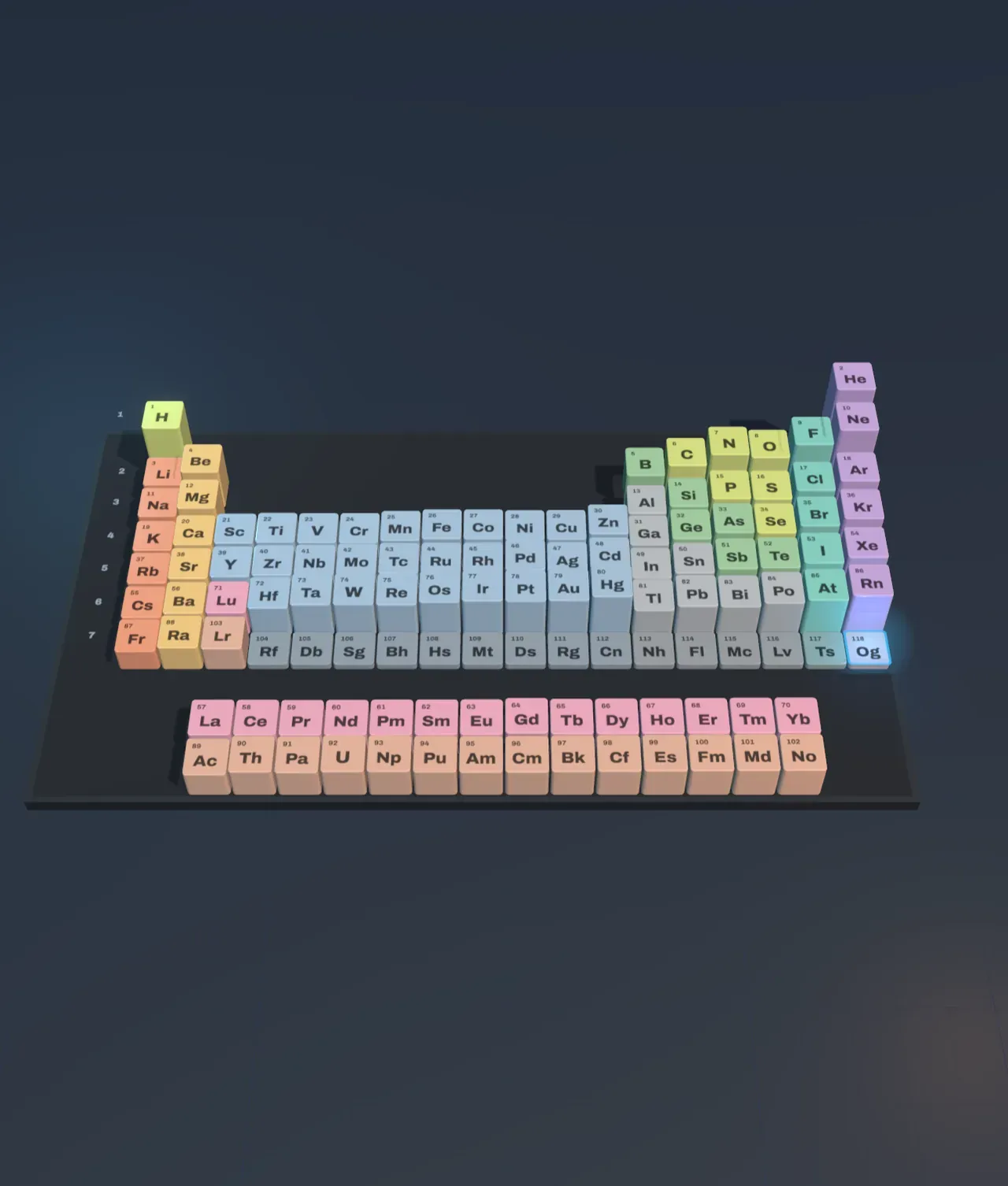
A table with a strange outline
Every chemistry classroom has the same poster: 118 squares in a lopsided shape, a tall column on the left, a tower on the right, a dip in the middle and two loose rows parked underneath. The outline is not a design choice. Order the elements by their atomic number, the number of protons in the nucleus, and start a new row each time an element behaves like one you have seen before, and this is the shape you get.
Dmitri Mendeleev noticed the repeating pattern in 1869, before anyone knew about protons or electrons. He trusted it enough to leave gaps and predict the elements that should fill them: gallium and germanium turned up within twenty years, with the densities and melting points he had guessed. The pattern was right long before anyone could say why.
Rows end at the noble gases
The Scene opens with all 118 elements, each tile raised into a column as tall as its first ionisation energy: the energy needed to pull one electron off an atom. Look along any of the first six rows. The columns climb from left to right and the tallest stands at the right-hand end, on a noble gas: helium, neon, argon, krypton, xenon, radon. Then the next element, an alkali metal at the start of the next row, drops to a stub. Neon needs 2081 kJ/mol; sodium, one proton further on, needs 496.
Try it: set Atomic number to 1 and drag it up slowly. Each element adds a tile; watch the columns grow along a row and collapse as soon as a new row begins. The presets stop at the end of rows 2, 3, 4 and 6.
That collapse is the sign that a shell of electrons has just been completed. A full shell holds its electrons hard. The next electron has to start a new shell further out, where it is screened from the nucleus by every electron underneath, so it comes off easily. The Atoms Article shows those shells as layers of electron cloud.
Why the rows are 2, 8, 18 and 32 long
Each shell is made of subshells, named s, p, d and f, which hold 2, 6, 10 and 14 electrons. The first shell has only an s subshell, the second has s and p, the third adds d and the fourth adds f. Electrons go into the lowest-energy subshell with room left, and that order is not quite shell by shell: 4s fills before 3d, and 6s before 4f.
So the rows are:
- Row 1: 1s, two places, hydrogen and helium.
- Rows 2 and 3: an s and a p subshell, 2 + 6 = 8 places.
- Rows 4 and 5: s, then the d subshell of the shell below, then p: 2 + 10 + 6 = 18.
- Rows 6 and 7: the f subshell two shells down joins as well: 2 + 14 + 10 + 6 = 32.
The chart beside the Scene lays each row out as its subshells in that order and fills in a cell for every element you have added. Step Rearrange the table to Blocks and the tiles recolour by the subshell their last electron goes into: the s-block two columns wide on the left, the p-block six wide on the right, the d-block ten wide in the dip between them, and the f-block fourteen wide underneath. The outline of the table is these four widths stacked up.
The rows underneath
The two loose rows at the bottom belong inside rows 6 and 7. Printed in place, the table would be 32 columns wide and too long for a poster, so the f-block is cut out and set below. Step Rearrange the table to Long form and it lifts back in: the d- and p-blocks slide right to make room, and every row reads as its subshells in filling order. Nothing about the elements changes; only the paper they are printed on.
Why a column behaves alike
Elements in one column have the same arrangement of outer electrons, one shell further out each row down. Every alkali metal has a single s electron outside a full shell, so all of them give it up easily and react with water: see Alkali and alkaline earth metals. Every halogen is one electron short of a full p subshell and grabs one, while the noble gases next to them have nothing to gain: see Halogens and noble gases. The Non-metals cluster in the top right, where the outer electrons are held hardest, and Hydrogen, oxygen and nitrogen are the commonest gases among them.
The number of protons fixes the element; the number of neutrons does not appear in the table at all. Atoms of one element with different numbers of neutrons are isotopes of it, and they share a single square: see Isotopes. The same electron shells that set the table’s shape also set the colours each element glows when heated, which is how helium was found in the Sun before it was found on Earth: see Atomic spectra.
Other patterns that repeat
Switch Column height to Atom size. Now the alkali metals tower: each starts a new shell, so it is the largest atom of its row. Across a row, the atoms shrink, because every step adds a proton to the nucleus while the new electron joins the same shell and does little to screen it. The skyline is the ionisation one turned upside down: what is small holds its electrons hard.
Melting point shows a different rhythm. The highest columns stand in the middle of a row, where atoms can share the most electrons with their neighbours: carbon in row 2, which turns straight to gas at about 3640 °C, and tungsten in row 6, which melts at 3422 °C, higher than any other metal. The noble gases and the halogens, which barely bond to each other, sit at the bottom.
What this model leaves out
The column heights are measured values, rounded, and drawn to one scale per property. Atom size is the covalent radius, half the distance between two bonded atoms of that element; for helium and neon, which form no bonds, it is an estimate. Nobody has measured the ionisation energy of any element after lawrencium (103) or melted anything past einsteinium (99), because they have only been made a few atoms at a time and most last seconds or less; astatine and francium are too radioactive to gather in bulk either. Where a value is missing the tile stays flat and greyed, and from element 104 on the chemistry itself is a prediction.
The filling order is a rule of thumb. About twenty elements break it: chromium and copper, for example, move an electron from 4s into 3d, because a half-full or full d subshell is especially stable. The tiles follow the rule, while the electron configuration printed under the chart gives the measured one.
Chemists still argue about a few places. Hydrogen has one s electron like the alkali metals but is a gas that behaves like none of them. Helium has a full 1s subshell, s-block by its electrons, but sits over the noble gases because it behaves like one: in the Blocks view it is the one s-coloured tile on the right. This table puts lutetium and lawrencium in column 3 and starts the f-block at lanthanum and actinium, the arrangement an IUPAC project recommended in 2021; many printed tables do it the other way round.