How electrons settle into shells, how to write the arrangement, why the outer shell decides the chemistry, and how the shells build the rows and columns of the periodic table.
Step 1 of 5 · Filling the shells
Step 1 of 5
Filling the shells
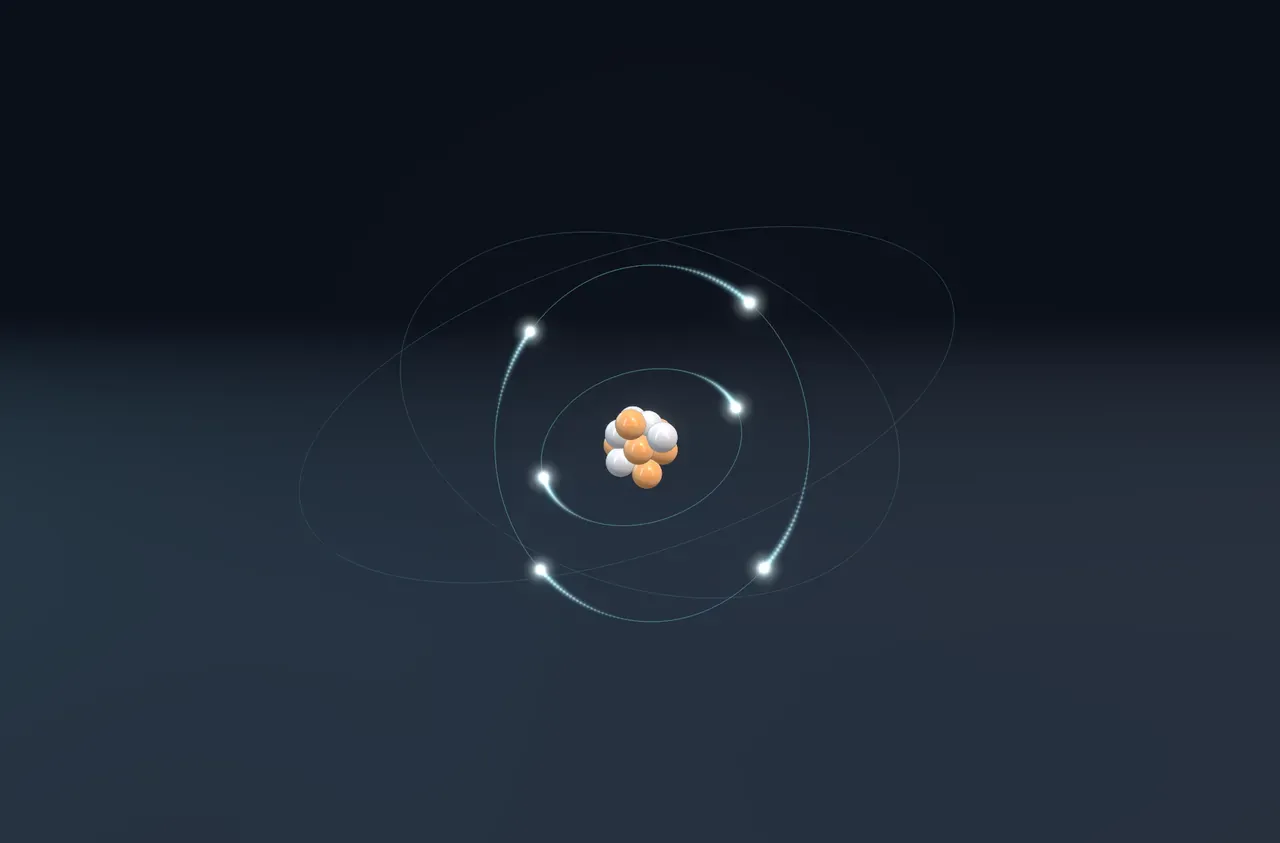
An atom’s electrons are not scattered at random: they sit in shells, one outside another. The first shell, nearest the nucleus, has room for only two electrons, and the second for eight. For the first elements, up to calcium, the third shell also fills with eight, and then a fourth shell starts. Electrons fill the inner shell first, and move on to the next only once it is full.
The arrangement is written as a list of numbers from the inside out. Neon, , in the Scene, has 2,8: two shells, both full. Sodium, , has 2,8,1. Change Protons and count the electrons on each ring.
Step 2 of 5
The outer electrons
When atoms meet, they touch at their outer shells. So an element’s chemistry is decided mainly by the number of electrons in its outer shell, the last shell with electrons in it. The inner electrons are hidden underneath.
The Scene shows phosphorus, , with the protons locked. How many electrons does its outer shell hold?
Step 3 of 5
A full shell
Neon has a full outer shell, and so does helium, with two electrons. These atoms hardly react at all: they have no spare electron to give and no free place to take one. They are the noble gases.
The Scene shows neon. Predict where the extra electron goes when you add one proton, then look.
Step 4 of 5
Rows and columns
Now the periodic table can be read as a map of shells. Each row, or period, starts a new shell: hydrogen and helium have one shell, the elements of the second row two, the third row three. Along a row, each element adds one electron to the outer shell.
Each column, or group, collects the elements with the same number of outer electrons. In the 18-column table, groups 1 and 2 have one and two outer electrons, and groups 13 to 18 have three to eight: the group number minus ten. The columns between belong to the transition metals, which come later.
The Scene shows fluorine: second row, seven outer electrons, group 17. Find the element below it in the table.
Step 5 of 5
Families
Elements in the same group have similar properties, which is why groups are also called families. Lithium, sodium and potassium, and more below them in the table, are the alkali metals of group 1: each has a single outer electron, and they all give it up easily and react violently with water. The halogens of group 17, fluorine, chlorine, bromine and iodine, are each one electron short of a full shell, and they all snatch electrons.
The Scene shows lithium, 2,1.
Loading the interactive version…
Loading the interactive version…
Each step sets up the Scene for you, and a control marked “fixed” stays put for that step.
Practice · Choose
What is the electron arrangement of magnesium, ?
Practice · Choose
What is the electron arrangement of magnesium, ?
Practice · Calculate
The Scene shows phosphorus, . How many electrons are in its outer shell?
Practice · Calculate
The Scene shows phosphorus, . How many electrons are in its outer shell?
Practice · Predict, then look
Neon in the Scene is 2,8: two full shells. Add one proton, and with it an electron. Where does the new electron go?
Practice · Predict, then look
Neon in the Scene is 2,8: two full shells. Add one proton, and with it an electron. Where does the new electron go?
Practice · Reach the target
The Scene shows fluorine: second row, seven outer electrons, group 17. Change Protons until you reach the element below it in the table, in the third row and the same group, then press Check.
Practice · Reach the target
The Scene shows fluorine: second row, seven outer electrons, group 17. Change Protons until you reach the element below it in the table, in the third row and the same group, then press Check.
Practice · Choose
Which of these elements is most like sodium, , in its chemistry?
Practice · Choose
Which of these elements is most like sodium, , in its chemistry?
Lesson complete. Every practice question here is done.