Reading the periodic table: row and group, metals and non-metals, and the two key trends, atom size and ionisation energy, along a row and down a group, and why they run in opposite directions.
Step 1 of 6 · Reading the table
Step 1 of 6
Reading the table
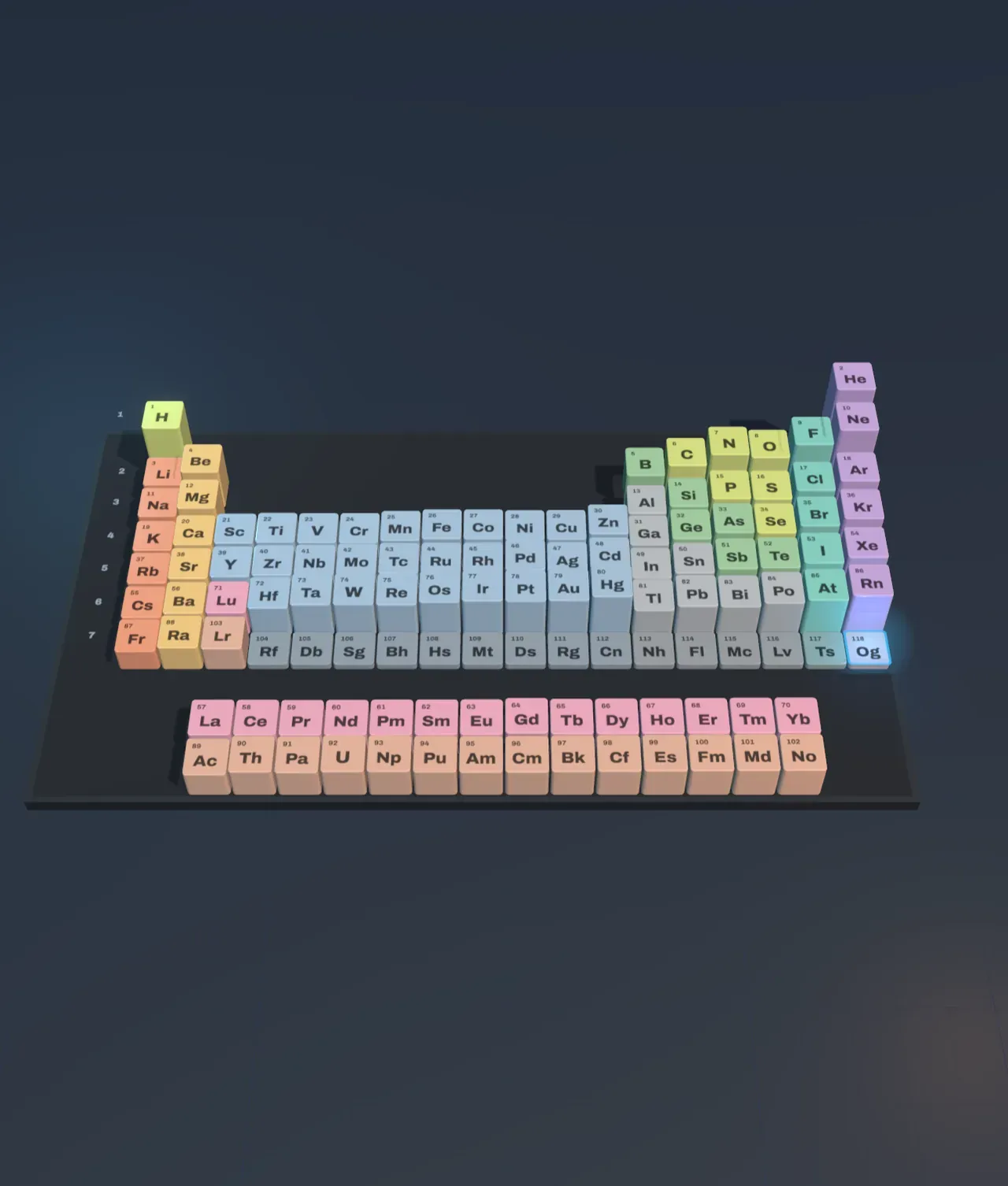
The Scene shows the periodic table as a model: a tile for each element, printed with its atomic number and symbol. Atomic number sets how far the table is filled, and the latest element is framed in blue. Right now it is filled up to sodium: two whole rows, with sodium opening the third.
Each element’s place is set by two numbers: its row (period), which is the number of shells, and its column (group), which sets the number of outer electrons. Find the element in the fourth row and group 2.
Step 2 of 6
Metals and non-metals
The colours show families. Nearly three quarters of the elements are metals: they are shiny, conduct electricity and heat, and tend to give electrons away. They fill the whole left side and the middle. The non-metals, such as oxygen, nitrogen, sulfur and the halogens, sit in the top right corner and tend to take or share electrons. Between them runs a “staircase” of metalloids, such as silicon.
A rule of thumb: the further left and down an element is, the more metallic it is.
Step 3 of 6
Atom size along a row
Column height now shows Atom size: its radius in picometres, 1 pm = 10⁻¹² m. From lithium to neon, and from sodium to argon, each element adds a proton to the nucleus and an electron to the same outer shell.
Predict what happens to atom size along the third row, then look.
Step 4 of 6
Atom size down a group
Why atoms shrink along a row: at each step the nucleus is more positive, and it pulls the same outer shell harder inwards. Down a group things are different: each row adds a whole shell, further from the nucleus, and the inner shells shield part of the nucleus’s pull. So atoms grow down a group.
Lithium’s radius is 128 pm, and sodium’s, one row below, 166 pm. Predict the size of a potassium atom, in the fourth row.
Step 5 of 6
Pulling an electron off
Ionisation energy is the energy needed to pull the outermost electron off a single atom, measured in kilojoules per mole of atoms, kJ/mol (the mole has a Unit of its own, later). An atom whose outer electron is far from the nucleus and shielded gives it up easily; a small atom, which holds its electrons close and hard, gives them up reluctantly.
So ionisation energy runs the opposite way to atom size: it rises along a row and falls down a group. The Scene shows every row up to argon, with the columns showing ionisation energy.
Step 6 of 6
The peaks
The ridge of columns has peaks and valleys. The peaks are the noble gases: a full shell, a small atom, electrons held tight. The valleys are the alkali metals, whose single electron starts a new shell. The two trends, size and ionisation, are two faces of one cause: how hard the nucleus pulls on the outer shell.
Use Atomic number to find the element of the third row from which it is hardest to pull an electron.
Loading the interactive version…
Loading the interactive version…
Each step sets up the Scene for you, and a control marked “fixed” stays put for that step.
Practice · Reach the target
Change Atomic number until the latest element in the table is the one in the fourth row and group 2, then press Check.
Practice · Reach the target
Change Atomic number until the latest element in the table is the one in the fourth row and group 2, then press Check.
Practice · Choose
Which of these third-row elements is a metal?
Practice · Choose
Which of these third-row elements is a metal?
Practice · Predict, then look
From sodium to argon, each element adds a proton to the nucleus and an electron to the outer shell. What happens to atom size along the third row?
Practice · Predict, then look
From sodium to argon, each element adds a proton to the nucleus and an electron to the outer shell. What happens to atom size along the third row?
Practice · Predict, then look
Lithium’s radius is 128 pm, and sodium’s, one row below, 166 pm. Predict the size of a potassium atom, one row below sodium.
Practice · Predict, then look
Lithium’s radius is 128 pm, and sodium’s, one row below, 166 pm. Predict the size of a potassium atom, one row below sodium.
Practice · Choose
From which atom is it easiest to pull one electron off?
Practice · Choose
From which atom is it easiest to pull one electron off?
Practice · Reach the target
Change Atomic number until the latest element in the table is the third-row element with the highest ionisation energy, then press Check.
Practice · Reach the target
Change Atomic number until the latest element in the table is the third-row element with the highest ionisation energy, then press Check.
Lesson complete. Every practice question here is done.