The elements on the table's staircase: silicon shines like a metal yet shatters like glass, and conducts better the warmer it gets. What the band gap explains, and why arsenic and antimony behave like metals.
Step 1 of 5 · Shiny but brittle
Step 1 of 5
Shiny but brittle
In the last Lesson we saw a zigzag line running between the metals and the non-metals on the table, like a staircase, from boron down to tellurium. The elements that sit on it are called metalloids. The usual six are boron, silicon, germanium, arsenic, antimony and tellurium, and they are neither metals nor non-metals but something in between.
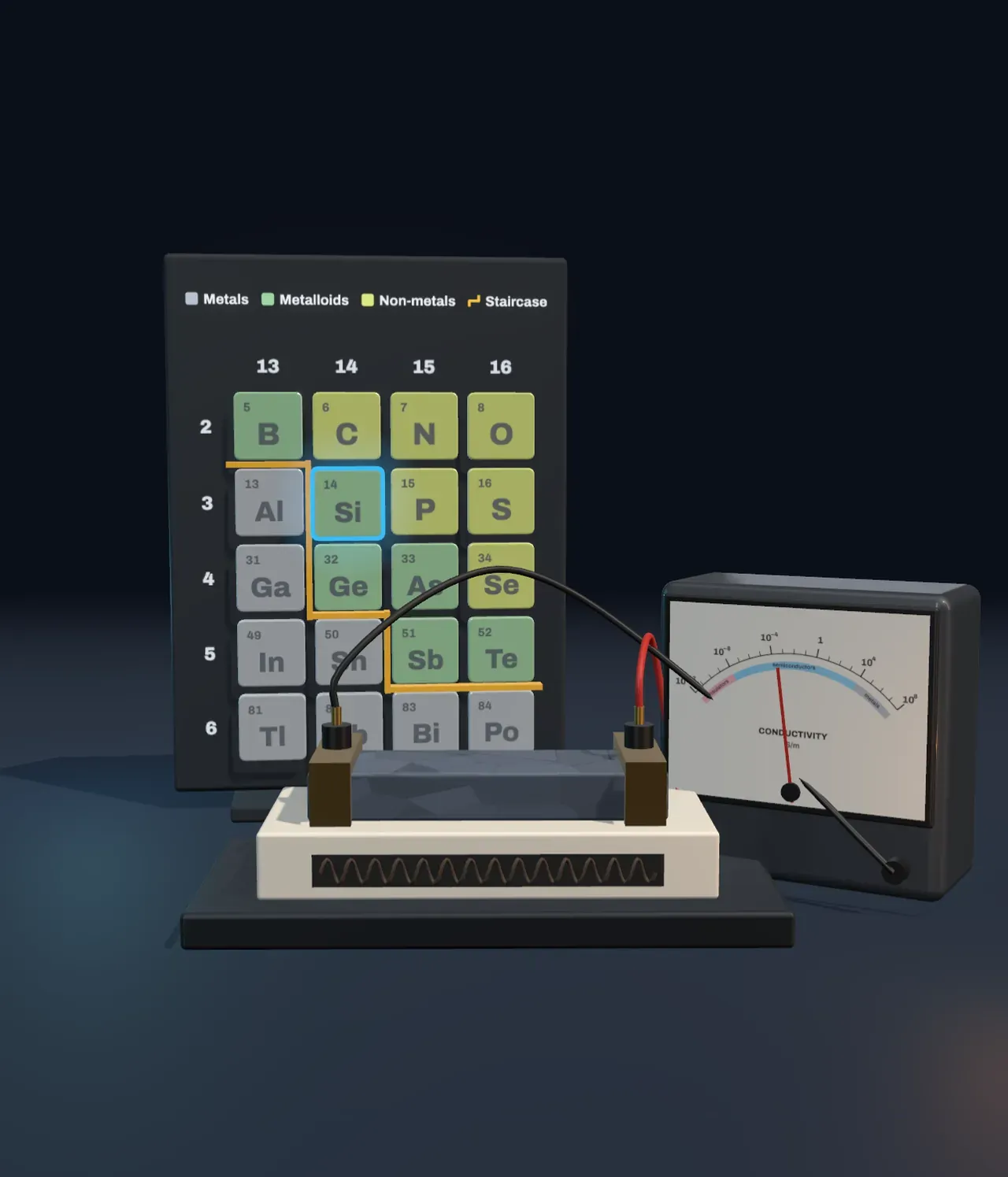
The Scene shows a bar of Silicon on a stage, wired to a meter. Silicon has the grey shine of a metal. Predict what happens when a lump of silicon is struck with a hammer, then look inside at its bonds.
Step 2 of 5
Warming silicon
A metal conducts because it holds a sea of free electrons. In silicon almost every outer electron is held in a bond between two atoms. Freeing an electron from its bond takes a minimum energy called the band gap: 1.1 eV for silicon. At room temperature very few electrons get that much energy from heat, so silicon conducts hundreds of billions of times less well than aluminium.
Watch the needle and the reading under the chart. Predict what happens when you heat the bar from Room to Hot plate.
Step 3 of 5
One siemens per metre
Conductivity is measured in S/m, siemens per metre: the bigger the number, the better the material conducts. Aluminium conducts about 3.8 × 10⁷ S/m, and pure silicon at room temperature only about 0.0003 S/m.
Each electron heat sets free can carry current, and the place it left behind is a hole, a bond one electron short, which carries current too. The hotter the bar, the more electrons are freed. Use Temperature to find how hot the bar must be to conduct about 1 S/m.
Step 4 of 5
Two that behave like metals
Now the Scene shows Arsenic. The meter jumps to millions of siemens per metre, nearly as high as aluminium. Arsenic and antimony have no band gap: their bands overlap slightly, so a small, fixed number of electrons is always free, about one for every two hundred atoms. They are called semimetals.
Predict what happens to arsenic’s conductivity when you heat it from Room to Hot plate.
Step 5 of 5
Down group 14
Zoom to the bonds is at Bonds, and the Scene shows Germanium. Diamond, silicon and germanium have exactly the same structure: each atom shares a pair of electrons with each of four neighbours. Switch between Diamond, Silicon and Germanium, and compare the needle and the band gap under the chart: 5.5, 1.1 and 0.7 eV.
Down the group the atoms get bigger, and their outer electrons sit farther from the nucleus. Diamond is an insulator, silicon and germanium are semiconductors, and tin and lead below them are already metals. This in-between nature is what makes metalloids useful: adding a few atoms per million of boron or arsenic to silicon raises its conductivity a millionfold, and that is how transistors and solar cells are made.
Loading the interactive version…
Loading the interactive version…
Each step sets up the Scene for you, and a control marked “fixed” stays put for that step.
Practice · Predict, then look
Silicon has the grey shine of a metal. What happens when a lump of silicon is struck with a hammer?
Practice · Predict, then look
Silicon has the grey shine of a metal. What happens when a lump of silicon is struck with a hammer?
Practice · Predict, then look
Heat the silicon bar from Room, 300 K, to Hot plate, 600 K. What happens to its conductivity?
Practice · Predict, then look
Heat the silicon bar from Room, 300 K, to Hot plate, 600 K. What happens to its conductivity?
Practice · Reach the target
Change Temperature until the silicon bar conducts about 1 S/m, then press Check.
Practice · Reach the target
Change Temperature until the silicon bar conducts about 1 S/m, then press Check.
Practice · Predict, then look
Heat the arsenic bar from Room to Hot plate. What happens to its conductivity?
Practice · Predict, then look
Heat the arsenic bar from Room to Hot plate. What happens to its conductivity?
Practice · Choose
Germanium and silicon have exactly the same network, four bonds per atom. Why does germanium conduct thousands of times better at room temperature?
Practice · Choose
Germanium and silicon have exactly the same network, four bonds per atom. Why does germanium conduct thousands of times better at room temperature?
Lesson complete. Every practice question here is done.