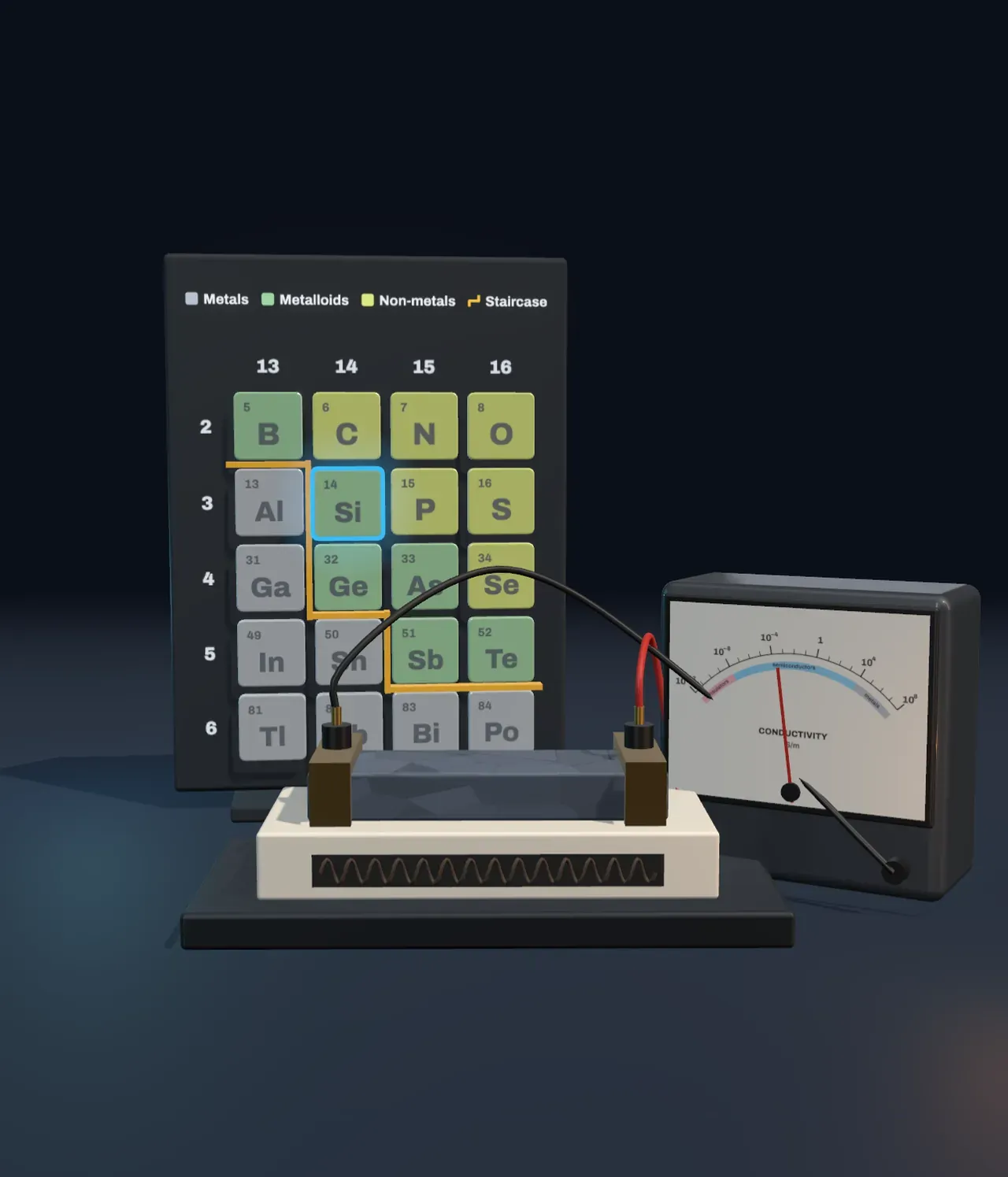
On the staircase
Most elements are plainly metals: shiny, bendable, good at carrying heat and current. A few in the top right corner of the periodic table are plainly non-metals: gases, or dull, crumbly solids that hardly conduct at all. Between them, many tables draw a zigzag line like a staircase, from boron down to tellurium and polonium.
The elements that sit along that line are called metalloids. The usual six are boron, silicon, germanium, arsenic, antimony and tellurium. They are neither one thing nor the other. Silicon has the grey shine of a metal, yet a lump of it shatters when struck. Its electronegativity, how strongly an atom pulls on shared electrons, is about 1.9, between aluminium’s 1.6 and phosphorus’s 2.2, and the same is true of the others. Their oxides tend to sit in the middle too, reacting weakly with both acids and bases.
Which elements count is not fixed. Some chemists add polonium, astatine, selenium or carbon, and some leave out boron or tellurium. The board in the Scene marks the six that almost every list includes.
Shiny but brittle
A metal shines because its free electrons answer light of every colour and send it straight back. Silicon has no free electrons to speak of, but it does have a small band gap: the energy needed to free an electron from its bond is 1.1 electronvolts, less than the 1.7 to 3.1 electronvolts carried by photons of visible light. Every visible colour can therefore free an electron, so silicon absorbs all of them in a thin skin, and a material that absorbs light that strongly also reflects a good share of it. The result looks like a metal. Infrared light, whose photons carry less than the gap, passes straight through, which is why germanium, with a still smaller gap, is used for the lenses of heat cameras.
Diamond has the same crystal structure as silicon but a gap of 5.5 electronvolts, more than any visible photon carries. Light goes through it, and diamond is clear.
The brittleness comes from the bonds. Choose Bonds under Zoom to the bonds. Each silicon atom shares a pair of electrons with each of four neighbours, and those bonds point in fixed directions. In a metal, rows of atoms can slide past each other in the sea of electrons and the metal bends. Push a row of silicon atoms sideways and the bonds have to break, so the crystal cracks instead.
Conducting better when hot
Put the bar between the clamps and the meter shows how well it carries current. Aluminium reads about 38 million siemens per metre; pure silicon at room temperature reads about 0.0003, a hundred billion times less. Diamond does not move the needle off its stop.
What sets the metalloids apart shows when the temperature changes. Heating a metal makes its atoms shake harder, and they get in the way of the free electrons, so aluminium conducts a little worse. Heating silicon shakes electrons out of their bonds, and each one freed can carry current. The number of freed electrons climbs steeply with temperature, so silicon at 400 K conducts more than two hundred times better than at room temperature. Each freed electron leaves a bond one electron short, a hole, and holes carry current too.
Try it: choose Silicon and step through Liquid nitrogen, Room and Hot plate. The needle lifts off its bottom stop and climbs past ten siemens per metre. Then choose Aluminium and do the same: the needle edges the other way.
The chart beside the Scene plots all eight bars at once. Boron, silicon, germanium and tellurium climb; the smaller the gap, the higher the line starts. Conductors, insulators and semiconductors explains the band gap in detail.
Two that behave like metals
Arsenic and antimony break the pattern. Choose either and the meter reads millions of siemens per metre, nearly as high as aluminium, and heating makes it fall. They are semimetals: their bands overlap very slightly, so a small, fixed number of electrons is always free, about one for every two hundred atoms in arsenic. With no gap to cross, heat cannot free more, and it only makes the atoms get in the way.
Their crystals show why they are in between anyway. Each atom bonds to just three neighbours, in puckered sheets, and the sheets hold one another only weakly. Like silicon, arsenic and antimony are brittle and crumble rather than bend.
Down the staircase, toward the metals
The staircase runs diagonally because two trends meet. Going down a group, atoms get bigger and their outer electrons sit farther from the nucleus, so they are held less tightly. Going across a period, the opposite happens. Elements on the diagonal end up with similar grips.
Group 14 shows the change down a single column. Carbon as diamond, silicon and germanium all have the same structure of four bonds per atom, but the gap shrinks as the atoms grow: 5.5, 1.1 and 0.7 electronvolts. Below germanium, grey tin has the same structure with no gap at all, and ordinary white tin and lead are metals.
Try it: choose Diamond, then Silicon, then Germanium, with Zoom to the bonds at Bonds. The network is the same each time. The meter and the chart show how much easier it becomes to free an electron.
Useful because in between
Being in between makes metalloids useful. Silicon’s conductivity can be raised a millionfold by adding a few atoms per million of boron or arsenic, and exactly where those atoms go decides where current can flow. That is how the transistors in electronics and the panels in solar cells are made. Germanium made the first transistors. Boron goes into heat-resistant glass and hard ceramics, antimony hardens the lead in car batteries, and tellurium is half of the cadmium telluride in some solar panels.
What this model leaves out
Each bar’s conductivity comes from a simple formula fitted to one room-temperature value. For the semiconductors, the free electrons follow the band gap at room temperature, ignoring how the gap narrows as the crystal warms, and their mobility falls in a fixed way with temperature. For aluminium, arsenic and antimony, resistance grows in proportion to temperature above a few tens of kelvin. Boron’s conduction really runs through defects in its complicated crystal, and the model treats it as a plain semiconductor with a typical measured value.
The bars are assumed perfectly pure. Real silicon always holds some impurities, and when it is cold they, not heat, supply most of its free electrons, so a real cold bar conducts far better than the meter shows. Diamond’s real conductivity is set by its impurities too, and is far above the pure value the model gives, though still off the bottom of the meter.
The crystals are small clusters. Boron’s real structure joins its twelve-atom clusters in a specific pattern that the Scene simplifies to one bond between each neighbouring pair, and each cluster is drawn at a size that fits the bench, not to scale with the others.