Three kinds of solid
A copper wire carries current easily. The plastic coat round it, or a diamond, hardly carries any at all: a centimetre cube of diamond resists current more than a billion billion times as strongly as the same cube of copper. Silicon, the material of computer chips and solar cells, sits in between, and does something odd. Warm it up and it conducts better, while a warm copper wire conducts a little worse.
The difference is not in how many electrons a solid has. Every atom brings plenty. It is in whether any of them are free to move.
Electrons held in bonds
In a silicon crystal each atom shares its four outer electrons with its four neighbours, two electrons to each bond. Those electrons are held in place. Push on them with a battery and they cannot drift along, because every place they could move to is already taken.
To carry current, an electron has to be shaken loose. The crystal can do that itself: its atoms are always shaking, harder the hotter it is, and now and then a shake is violent enough to break an electron out of its bond. That free electron wanders through the crystal and can carry current. The bond it left is short of one electron, and that gap, a hole, can be filled by an electron from the next bond along, which leaves a hole there instead. So the hole wanders too, and behaves like a positive charge.
Energy bands and the gap
Physicists draw the same thing by energy. An isolated atom’s electrons sit on a few sharp energy levels. Pack billions of atoms into a crystal and each level spreads into a band: a range of energies with room for a fixed number of electrons.
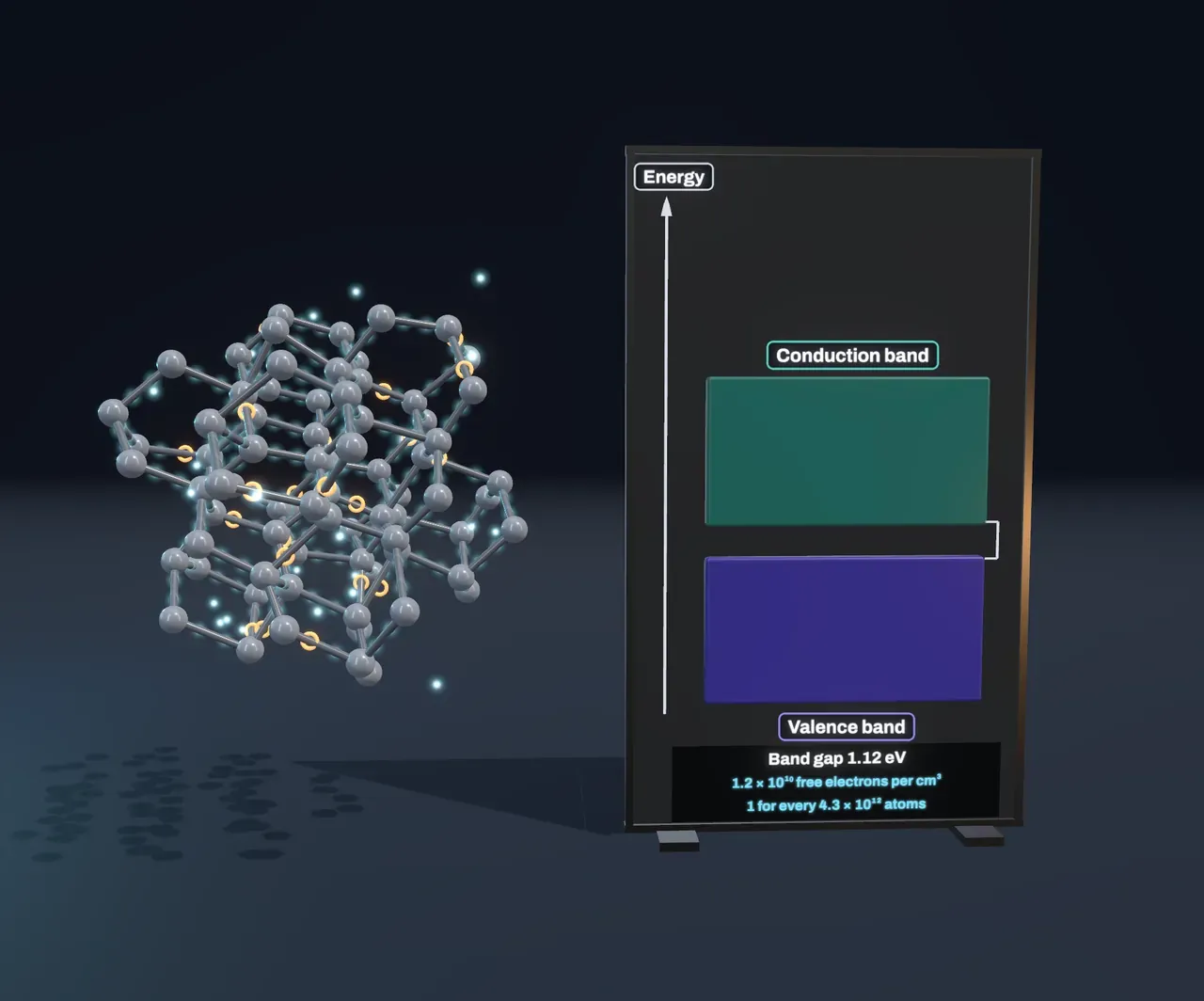
In silicon the electrons in bonds exactly fill one band, the valence band. The next band up, the conduction band, is empty, and between them lies the band gap: a range of energies no electron in the crystal can have. Freeing an electron from its bond is the same event as lifting it from the top of the valence band to the bottom of the conduction band. It costs at least the gap’s energy, 1.12 electronvolts for silicon.
An electron in a full band cannot carry current, however hard you push, because there is no empty level for it to move into. An electron in a nearly empty band can, and so can the hole it left behind in the full band.
Heat does the lifting
The atoms’ shaking supplies the energy. At room temperature the typical shake carries about 0.026 electronvolts, more than forty times less than silicon’s gap. Only rare, unusually violent shakes free an electron, and the chance of one falls off exponentially with the size of the gap. In pure silicon at room temperature, fewer than one bond in ten trillion is broken at any moment.
That chance climbs steeply with temperature. Warm silicon from room temperature to the boiling point of water and its free electrons multiply about a hundred times. That is why a semiconductor conducts better when it is warm.
Try it: choose Silicon for Band gap, then step Temperature from Liquid nitrogen to Room to Red hot and watch the readout under the bands. Then choose On under Show the energy levels and watch each freed electron jump the gap as its bond breaks.
Conductors, semiconductors and insulators
The size of the gap sorts solids into three kinds.
- In a conductor there is no gap where it matters: the band holding the outermost electrons is only partly full, or two bands overlap. Electrons always have empty levels just above them, so they move whenever pushed, at any temperature. A metal has about one free electron for every atom.
- In a semiconductor the gap is small, up to roughly 4 electronvolts. A few electrons are lifted across by heat, or by light, as in a solar cell. Germanium, with 0.66 electronvolts, has thousands of times more free electrons than silicon at room temperature.
- In an insulator the gap is wide. Diamond’s is 5.5 electronvolts, and at room temperature a diamond the size of the Earth would hold only a handful of free electrons.
The line between semiconductor and insulator is a convention. Diamond can be made to conduct by adding impurities, and so can silicon, which is how almost every chip is made: a trace of phosphorus or boron supplies far more free electrons or holes than heat ever does.
Heat helps a metal much less. Its free electrons are already there, and a hotter, more violently shaking lattice scatters them more, so a metal’s resistance rises gently as it warms. A semiconductor’s falls steeply.
What this model leaves out
The crystal is always drawn with silicon’s diamond-shaped arrangement of bonds, which diamond and germanium share but metals do not. Every gap is computed with silicon’s other properties, so the germanium and diamond numbers are good to within a factor of a few, not exactly. The gap of a real crystal shrinks a little as it warms; here it stays fixed.
A metal is drawn as two overlapping bands, the simplest textbook picture. In a real metal like copper the free electrons come from a band that is only half full, so no holes are left behind in bonds.
The free electrons are drawn on a compressed scale, so the picture can show both silicon’s one in a trillion and a metal’s one per atom. Nothing pushes the electrons one way, so no current flows: the Scene shows what is free to carry current, not the current itself, and leaves out how often the free electrons scatter.