Lesson 6 of 6
Conductors, insulators and semiconductors.
Why copper conducts, diamond does not, and silicon sits in between: energy bands and the gap between them, heat lifting electrons across the gap and leaving holes, and why a semiconductor conducts better when it is warm.
Step 1 of 6 · Bands of levels
Step 1 of 6
Bands of levels
A current is charge on the move, and in solids the charge is carried by electrons. But why do they flow easily in a copper wire, and hardly at all in diamond?
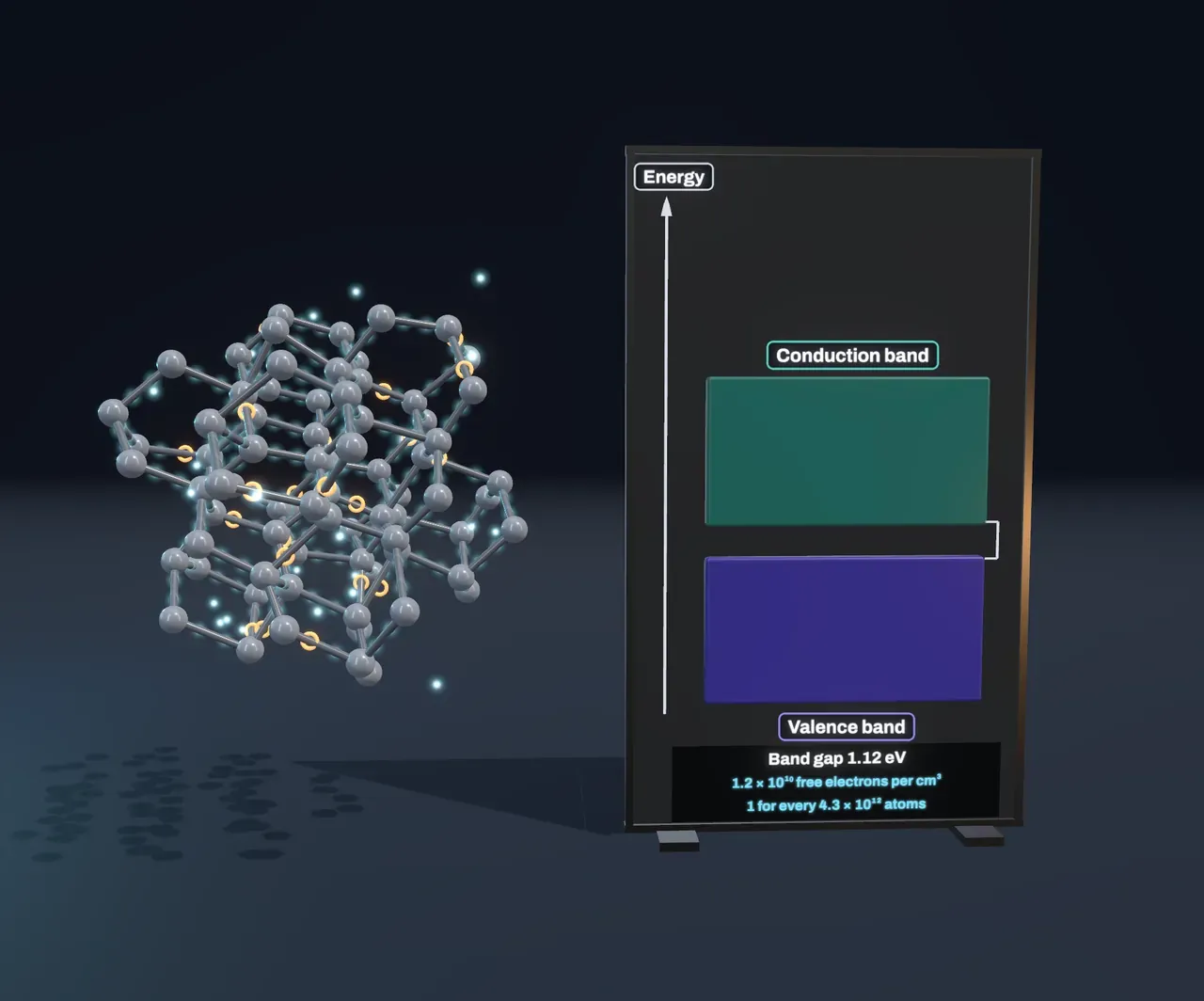
The answer is in the energy levels. In a single atom an electron has only certain levels. In a crystal billions of atoms sit close together, and their levels spread into bands: many closely packed levels, with gaps between them. In silicon, diamond and germanium the bonding electrons fill the valence band completely. Above it, across the Band gap, lies the empty conduction band. Show the energy levels draws the electrons at their energies. Here Band gap is set to Metal.
Step 2 of 6
The thermal shaking
As a material warms up, the atoms in the crystal shake harder. Most of the time the shakes are small, but now and then a very large one breaks a bond and lifts an electron across the gap. The electron becomes a free electron in the conduction band, and where it was it leaves a hole: an empty place in the valence band, which can also move and conduct. Band gap is fixed on Silicon, 1.12 eV, and Temperature is fixed.
Step 3 of 6
Warm silicon
How many large enough shakes are there? The share of electrons that heat lifts across the gap depends on the ratio between the gap and the energy of the shaking:
That is an exponential, and the exponent is large: for silicon at 300 K, . So a small change in temperature changes a lot. Band gap is fixed. Predict, then look at the number on the board.
Step 4 of 6
The size of the gap
A material with a small gap is a semiconductor: it has a few free electrons, and their number depends on heat. Germanium, 0.66 eV, conducts better than silicon, because its gap is smaller. Temperature is fixed at Room. Change Band gap and look for the gap that gives a hundred times silicon’s electrons.
Step 5 of 6
Insulators
A material whose gap is wide, above about 4 eV, is called an insulator. In Diamond the gap is 5.47 eV, and at room temperature you could wait forever for a free electron: a diamond the size of the Earth would hold only a handful. Band gap is fixed. Predict what will happen when we heat it a lot.
Step 6 of 6
A cold metal
A Metal has no gap at all: the bands overlap, and it has free electrons at any temperature. What heat does do in a metal is add shaking, and the electrons bump more into the shaking atoms. So a metal’s resistance rises as it warms up, and a semiconductor’s falls.
Try it: after checking, choose Silicon and lower Temperature to Liquid nitrogen. Almost all the free electrons vanish, and silicon becomes nearly an insulator. The chips in a phone are made of silicon, with a tiny amount of other atoms added to set how many free electrons it has.
Loading the interactive version…
Loading the interactive version…
Each step sets up the Scene for you, and a control marked “fixed” stays put for that step.
Practice · Choose
In a Metal the bands overlap: the conduction band starts below the top of the valence band. Why does a metal conduct?
Practice · Choose
In a Metal the bands overlap: the conduction band starts below the top of the valence band. Why does a metal conduct?
Practice · Calculate
The atoms in the crystal shake, and the typical energy of the shaking is , with k = 8.62 × 10⁻⁵ eV/K. What is at Room temperature, 300 K?
Practice · Calculate
The atoms in the crystal shake, and the typical energy of the shaking is , with k = 8.62 × 10⁻⁵ eV/K. What is at Room temperature, 300 K?
Practice · Predict, then look
Silicon at 300 K has about free electrons in every cubic centimetre. We warm it to 373 K, the temperature of boiling water. What will happen to the number of free electrons?
Practice · Predict, then look
Silicon at 300 K has about free electrons in every cubic centimetre. We warm it to 373 K, the temperature of boiling water. What will happen to the number of free electrons?
Practice · Reach the target
Temperature is fixed at 300 K. Change Band gap until the crystal has free electrons per cubic centimetre, a hundred times more than silicon, and press Check.
Practice · Reach the target
Temperature is fixed at 300 K. Change Band gap until the crystal has free electrons per cubic centimetre, a hundred times more than silicon, and press Check.
Practice · Predict, then look
Diamond has a gap of 5.47 eV, and at room temperature it has almost no free electrons. We heat it to 1000 K, Red hot. What will happen?
Practice · Predict, then look
Diamond has a gap of 5.47 eV, and at room temperature it has almost no free electrons. We heat it to 1000 K, Red hot. What will happen?
Practice · Choose
We cool the Metal to Liquid nitrogen, 77 K. What happens to its number of free electrons?
Practice · Choose
We cool the Metal to Liquid nitrogen, 77 K. What happens to its number of free electrons?
Lesson complete. Every practice question here is done.