Electricity from light
A solar cell is a thin slice of silicon with metal on both faces. Put it in sunlight and wire its two faces together through a bulb, and a current flows, with nothing burning, turning or wearing out. The energy comes from the light itself, one photon at a time.
Two kinds of silicon
Pure silicon conducts electricity poorly, because each atom’s outer electrons are locked into bonds with its neighbours. Add a trace of phosphorus and you get n-type silicon, with a few spare electrons free to wander. Add a trace of boron instead and you get p-type silicon, with a few gaps in the bonds. Those gaps, called holes, move about too, as neighbouring electrons hop in to fill them, and they behave like positive charges.
A solar cell is a thin n-type layer on top of a thick p-type base. Where the two meet, wandering electrons fill nearby holes, leaving the n side slightly positive and the p side slightly negative. That boundary, the junction, holds a built-in electric field. Any free electron that reaches it is swept up to the n side; any hole is swept down to the p side.
What a photon does
A photon of sunlight with enough energy can knock an electron out of its bond, leaving a hole behind: an electron–hole pair. Left alone, the two would soon find each other again and the energy would end as a little warmth. But a pair freed near the junction is pulled apart. Electrons collect in the n layer at the top, holes in the base. The only way for the electrons to get back to the holes is out through the silver fingers on the front, round the circuit, and in through the aluminium on the back. That journey is the current, and the bulb takes energy from it on the way.
More light, more current
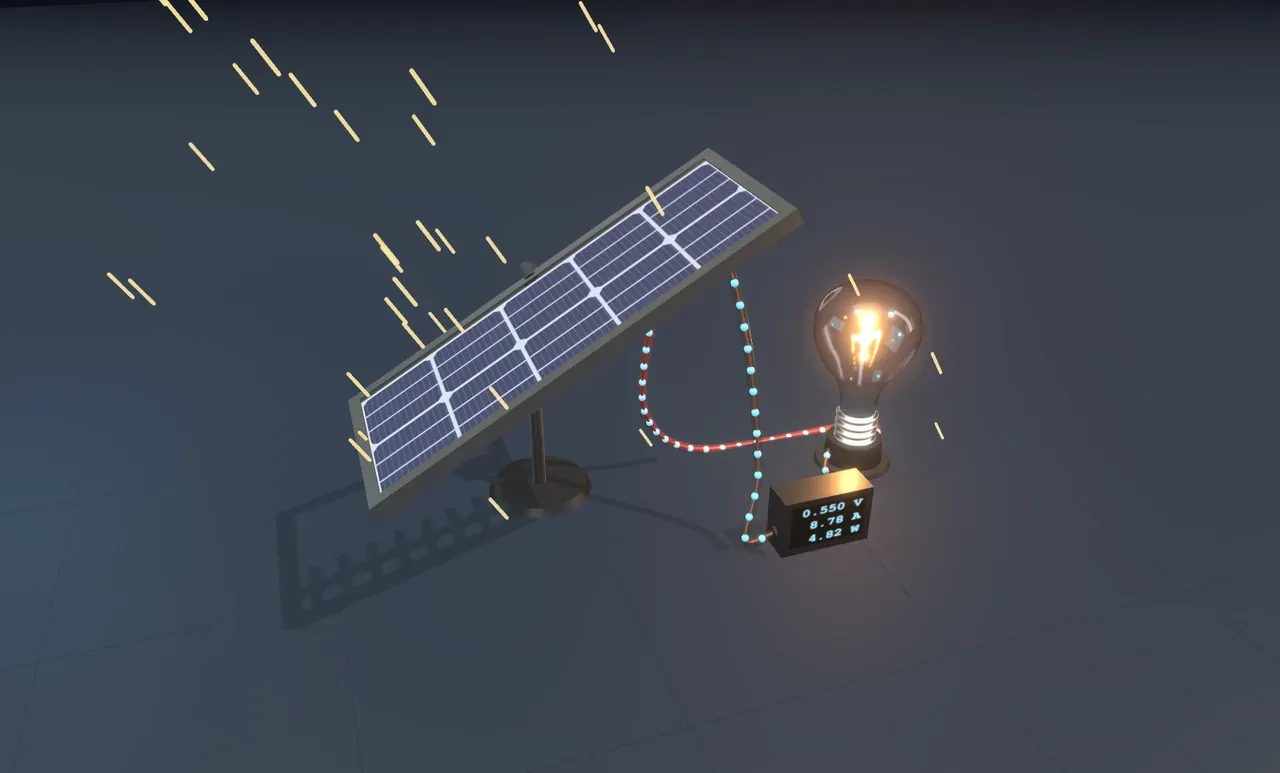
Each absorbed photon frees at most one pair, so the current rises in step with the light. One cell in full sun gives about 9 amps; on an overcast day it gives a sixth of that or less.
The voltage behaves quite differently. It comes from how strongly the junction’s two sides are charged, and that grows only with the logarithm of the light: halving the sunlight lowers it by about 20 thousandths of a volt. So a cell gives roughly half a volt whether the sky is bright or grey, and the power, voltage times current, falls nearly as fast as the light. Panels join dozens of cells in a row to add their half volts together.
Try it: slide Sunlight to 150 W/m², an overcast sky, then up to 1000 W/m², full sun, and compare the three numbers on the meter. Then set Angle to the Sun to 60° and watch how many photons miss.
Facing the Sun
A beam of sunlight has a fixed width. Turn the panel away from the Sun and the same beam is spread over more panel, so each cell catches less. The light falling on each square metre scales with the cosine of the angle: at 60° it halves, and edge-on it is nothing. That is why panels are tilted towards the Sun, and why some turn to follow it through the day.
What this model leaves out
The cut-away is a magnified slice through one cell, which is why it reaches far below the panel. A real cell is about a fifth of a millimetre thick, and its n-type layer is several hundred times thinner than that.
The cell is ideal: no heating, which in summer lowers a real cell’s voltage; no light reflected at steep angles; no shade from the fingers; no losses in its wires. The cell turns about a fifth of the light into electricity, as good silicon cells do. Photons with too little energy pass straight through, and those with too much give up the extra as warmth, so most of the rest is lost. Photons and carriers are drawn far fewer, larger and slower than they are.