A silicon cell turns light into electricity with no fuel and no moving parts. What a photon does at the junction, why the current follows the light and the voltage hardly does, how much of the light becomes electricity, and why panels are tilted towards the Sun.
Step 1 of 7 · Light in, current out
Step 1 of 7
Light in, current out
In the Unit on electricity we saw that a current is charge moving round a closed circuit, and that it needs a source to push it. In a solar panel the source is the light itself. Zoom to the junction is at Junction: a slice of one cell, with a thin layer of n-type silicon on top and a thick p-type base below. Where they meet, the junction, there is a built-in electric field.
Step 2 of 7
Half the light
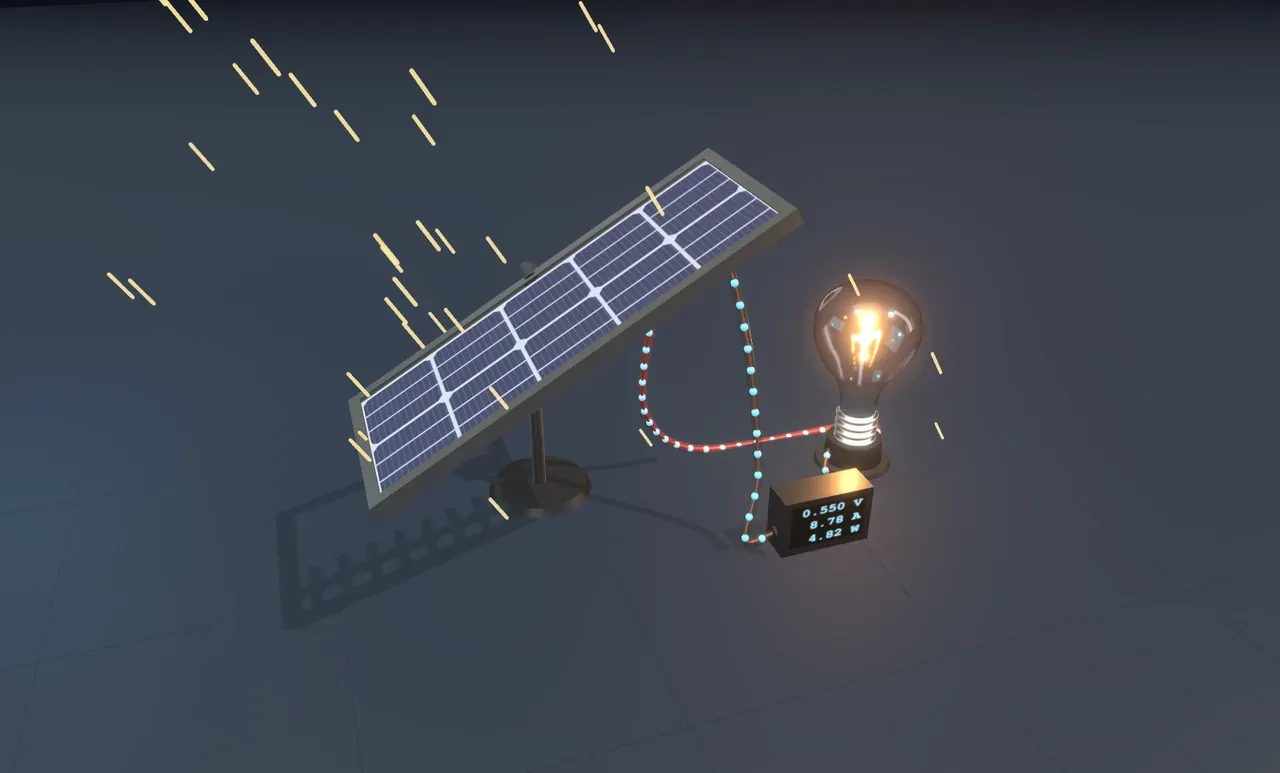
Choose Panel under Zoom to the junction, and look at the meter beside the bulb: it shows the voltage, the current and the power of one cell. Angle to the Sun is locked, so the panel faces straight at the Sun.
Step 3 of 7
How much of the light becomes electricity
A cell’s efficiency is the share of the light power falling on it that becomes electrical power:
The light power falling on the cell is the strength of the light, in watts per square metre, times the cell’s area. The electrical power is . Both controls are locked.
Step 4 of 7
Where the rest goes
Choose Junction under Zoom to the junction again, and watch the photons: not all of them free a pair, and not all the energy of a photon that does free one reaches the circuit.
Step 5 of 7
Tilted away from the Sun
A beam of sunlight has a fixed width. Tilt the panel, and the same beam spreads over a larger area, so each square metre gets less. If is the angle between the way the panel faces and the direction of the Sun, the light on each square metre is
Both controls are locked, with Angle to the Sun at 60°.
Step 6 of 7
Half the power
Sunlight is locked at 1000 W/m², and Angle to the Sun is free. The power the cell gives depends on the light it catches, but not only on that: the voltage, as you saw, drops a little when the light weakens.
Step 7 of 7
The photocurrent
With the two terminals joined directly, every electron–hole pair the light makes flows round the circuit. That current, the short-circuit current, counts the photons.
Loading the interactive version…
Loading the interactive version…
Each step sets up the Scene for you, and a control marked “fixed” stays put for that step.
Practice · Choose
The panel faces the Sun, and Zoom to the junction is at Junction. What happens when a photon of sunlight is absorbed in the silicon near the junction?
Practice · Choose
The panel faces the Sun, and Zoom to the junction is at Junction. What happens when a photon of sunlight is absorbed in the silicon near the junction?
Practice · Predict, then look
The cell is in full sun. Sunlight is turned down to half, 500 W/m². What will happen to the cell’s current and voltage?
Practice · Predict, then look
The cell is in full sun. Sunlight is turned down to half, 500 W/m². What will happen to the cell’s current and voltage?
Practice · Calculate
One cell is a square 156 mm across, about 0.0244 m², and Sunlight gives 1000 W/m² on a panel facing it. Read the cell’s voltage and current off the meter. What percentage of the light falling on the cell becomes electrical power?
Practice · Calculate
One cell is a square 156 mm across, about 0.0244 m², and Sunlight gives 1000 W/m² on a panel facing it. Read the cell’s voltage and current off the meter. What percentage of the light falling on the cell becomes electrical power?
Practice · Choose
About four fifths of the light energy falling on the cell does not become electricity. Where does most of it go?
Practice · Choose
About four fifths of the light energy falling on the cell does not become electricity. Where does most of it go?
Practice · Calculate
Angle to the Sun is 60°: the panel is tilted away from the rays. How much light power now falls on one cell, 0.0244 m² in area?
Practice · Calculate
Angle to the Sun is 60°: the panel is tilted away from the rays. How much light power now falls on one cell, 0.0244 m² in area?
Practice · Reach the target
Facing the Sun, the cell gives about 4.8 W. Turn Angle to the Sun until it gives half that, about 2.4 W on the meter, and press Check.
Practice · Reach the target
Facing the Sun, the cell gives about 4.8 W. Turn Angle to the Sun until it gives half that, about 2.4 W on the meter, and press Check.
Practice · Calculate
Facing the Sun, with the cell’s two terminals joined to each other, a short-circuit current of 9.27 A flows. The Angle to the Sun is now locked at 60°. What is the short-circuit current?
Practice · Calculate
Facing the Sun, with the cell’s two terminals joined to each other, a short-circuit current of 9.27 A flows. The Angle to the Sun is now locked at 60°. What is the short-circuit current?
Lesson complete. Every practice question here is done.