A switch with no moving parts, turned on by a small voltage. The gate that draws no current, the threshold, the square law, why a half-on transistor heats up, and why computers work in only two states.
Step 1 of 9 · Three legs
Step 1 of 9
Three legs
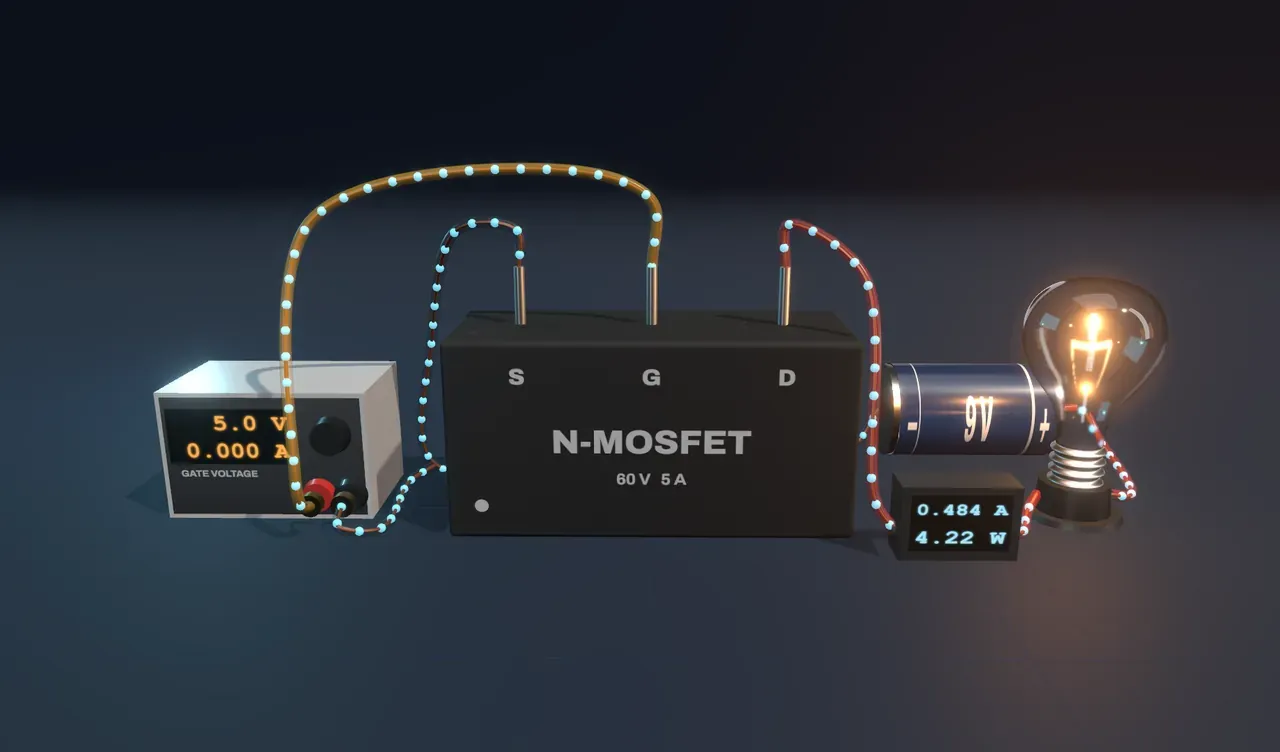
In the Scene an MOSFET transistor joins an 18 Ω bulb to a 9 V battery. It has three legs: the bulb’s current flows between the source and the drain, and the third leg, the gate, is wired to a separate voltage supply, whose meter shows the voltage and the current it gives. At a Gate voltage of 5 V the bulb is lit.
Step 2 of 9
The threshold
Between source and drain lies p-type silicon, with almost no free electrons. A positive voltage on the gate draws electrons to the surface beneath it. Only past a certain voltage, the threshold, here 1.5 V, do enough electrons gather to make a thin n-type sheet, the channel, joining source to drain.
Step 3 of 9
The square law
Zoom to the channel is at Channel, and Gate voltage is right at the threshold. Just above the threshold the channel is thin, and the transistor itself limits the current:
Here is the gate voltage, the threshold, and a constant of the transistor. Notice that the channel is thinner at the drain end.
Step 4 of 9
Halfway
The bulb and the transistor are in series, so the battery’s voltage is shared between them: whatever does not fall across the bulb, , falls across the transistor, . And power is always current times voltage. Gate voltage is locked.
Step 5 of 9
Fully on
Raise Gate voltage, and the channel thickens. But the current cannot grow for ever: even if the transistor were a perfect wire, the bulb and the battery alone would allow at most ampere.
Step 6 of 9
Zeros and ones
A switch that one voltage turns on can turn on the gate of the next switch, and that is how logic gates are built, and from them a processor. A modern processor has billions of transistors, and each of them switches billions of times a second.
Step 7 of 9
How bright when it is on
A good switch takes almost nothing for itself. Let us check how much of the battery’s power reaches the bulb.
Step 8 of 9
The voltage across the switch
The bulb and the transistor are in series, and they share the battery’s 9 volts.
Step 9 of 9
A tap, not a switch
Under Zoom to the channel you see how open the channel is. When it is only partly open, the transistor itself decides how much current flows.
Loading the interactive version…
Loading the interactive version…
Each step sets up the Scene for you, and a control marked “fixed” stays put for that step.
Practice · Choose
Gate voltage is 5 V, and the bulb is lit: almost half an ampere flows through it. How much current flows into the gate itself?
Practice · Choose
Gate voltage is 5 V, and the bulb is lit: almost half an ampere flows through it. How much current flows into the gate itself?
Practice · Predict, then look
Gate voltage is at zero, and the bulb is dark. It is raised to 1 V, two thirds of the 1.5 V threshold. What will the bulb do?
Practice · Predict, then look
Gate voltage is at zero, and the bulb is dark. It is raised to 1 V, two thirds of the 1.5 V threshold. What will the bulb do?
Practice · Predict, then look
Gate voltage is right at the threshold, 1.5 V. With above the threshold but the transistor still limiting the current, with . What will the current be at 2 V, in milliamperes?
Practice · Predict, then look
Gate voltage is right at the threshold, 1.5 V. With above the threshold but the transistor still limiting the current, with . What will the current be at 2 V, in milliamperes?
Practice · Calculate
Gate voltage is 2.5 V, and the meter shows a current of 0.25 A. The bulb is 18 Ω and the battery 9 V. How much power heats the transistor itself?
Practice · Calculate
Gate voltage is 2.5 V, and the meter shows a current of 0.25 A. The bulb is 18 Ω and the battery 9 V. How much power heats the transistor itself?
Practice · Predict, then look
Gate voltage is 3 V, and the current is about 0.45 A. It is raised to 5 V, so the voltage above the threshold grows from 1.5 to 3.5 V. How much will the current grow?
Practice · Predict, then look
Gate voltage is 3 V, and the current is about 0.45 A. It is raised to 5 V, so the voltage above the threshold grows from 1.5 to 3.5 V. How much will the current grow?
Practice · Choose
In a processor, every transistor is almost always fully on or fully off, and never stays halfway. Why?
Practice · Choose
In a processor, every transistor is almost always fully on or fully off, and never stays halfway. Why?
Practice · Calculate
Gate voltage is at 5 V, and the transistor is fully on: only 0.29 V is left across it. The battery is 9 V, and the bulb 18 Ω. What power does the bulb take?
Practice · Calculate
Gate voltage is at 5 V, and the transistor is fully on: only 0.29 V is left across it. The battery is 9 V, and the bulb 18 Ω. What power does the bulb take?
Practice · Calculate
Gate voltage is locked at 3 V, and a current of 0.453 A flows through the bulb, 18 Ω. The battery is 9 V. What is the voltage across the transistor, drain to source?
Practice · Calculate
Gate voltage is locked at 3 V, and a current of 0.453 A flows through the bulb, 18 Ω. The battery is 9 V. What is the voltage across the transistor, drain to source?
Practice · Reach the target
Gate voltage is at 5 V, and the transistor is fully on: the bulb sets the current. Change the gate voltage until the transistor limits the current, only partly on and warming up, and press Check.
Practice · Reach the target
Gate voltage is at 5 V, and the transistor is fully on: the bulb sets the current. Change the gate voltage until the transistor limits the current, only partly on and warming up, and press Check.
Lesson complete. Every practice question here is done.