How a message is written on a radio wave, and why it weakens on the way. Carriers and modulation, the inverse-square law in decibels, why FM is cleaner than AM and what it costs, and the cliff of digital broadcasting.
Step 1 of 7 · A carrier
Step 1 of 7
A carrier
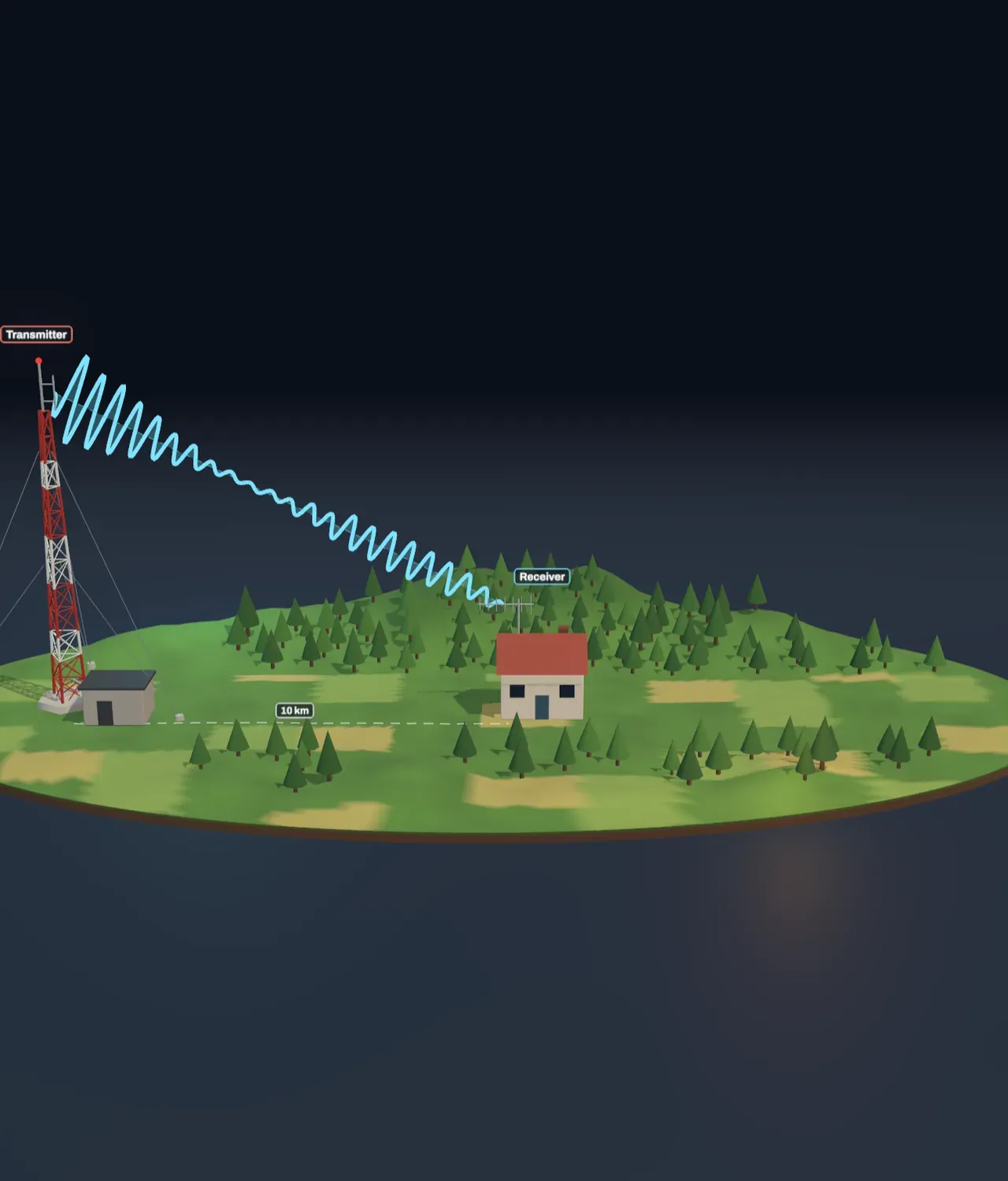
In the Unit on waves we saw that a wave carries energy without carrying matter. A radio wave carries information too. The transmitter makes a wave at a fixed frequency, the carrier, and changes it to follow the message. Such a change is called modulation. Decode the signal is at Message, and the charts beside the Scene show the message, the transmitted wave, what reaches the house and what the receiver decodes.
Step 2 of 7
Weaker every kilometre
A radio wave spreads out in every direction, and its power is shared over the area of a sphere, . So the power reaching the house falls like . Meanwhile the receiver always hears the same noise. What matters is the signal-to-noise ratio, measured in decibels:
The logarithm turns multiplying into adding: a ratio times smaller is 20 dB less. Distance is locked.
Step 3 of 7
From decibels to a ratio
Decibels are handy for working out, because you add and subtract them, but it is easy to forget how big each one is. To get from decibels back to a ratio, undo the logarithm:
Step 4 of 7
AM against FM
In AM the tone changes the wave’s height, so any noise that changes the height passes straight into the tone. In FM the height is constant and the tone changes the frequency. Distance is locked at 10 km, and Modulation is free.
Step 5 of 7
The price of FM
FM’s cleanness is not free. To write the tone in large swings of frequency, the wave needs a wider band of frequencies, and each station takes a bigger slice of the spectrum. Modulation is locked on FM.
Step 6 of 7
The digital cliff
In digital radio the receiver only has to decide, for each bit, which of two symbols arrived. Modulation is locked on Digital, and the last chart shows the decoded bits and the error rate.
Step 7 of 7
On the edge of the cliff
Real digital systems add error-correcting bits: a code that lets the receiver find and fix wrong bits, as long as there are not too many of them. Distance is free.
Loading the interactive version…
Loading the interactive version…
Each step sets up the Scene for you, and a control marked “fixed” stays put for that step.
Practice · Choose
Decode the signal is at Message. Under Modulation pick FM. In the chart of the transmitted wave, which feature of the carrier changes with the tone?
Practice · Choose
Decode the signal is at Message. Under Modulation pick FM. In the chart of the transmitted wave, which feature of the carrier changes with the tone?
Practice · Calculate
At 1 km the signal arrives 40 dB above the receiver’s noise, and its power falls like while the noise stays the same. The house’s Distance is 10 km. What is the signal-to-noise ratio there, in decibels?
Practice · Calculate
At 1 km the signal arrives 40 dB above the receiver’s noise, and its power falls like while the noise stays the same. The house’s Distance is 10 km. What is the signal-to-noise ratio there, in decibels?
Practice · Calculate
At 10 km the signal arrives 20 dB above the noise. How many times bigger is the signal’s power than the noise’s?
Practice · Calculate
At 10 km the signal arrives 20 dB above the noise. How many times bigger is the signal’s power than the noise’s?
Practice · Predict, then look
The same mast, the same power and the same distance, 10 km, with Modulation on AM. It is switched to FM. What will happen to the decoded tone?
Practice · Predict, then look
The same mast, the same power and the same distance, 10 km, with Modulation on AM. It is switched to FM. What will happen to the decoded tone?
Practice · Calculate
The tone takes up a band of frequencies wide. AM needs . The Scene’s FM swings the frequency by up to each way, and by Carson’s rule it needs . How many does FM need?
Practice · Calculate
The tone takes up a band of frequencies wide. AM needs . The Scene’s FM swings the frequency by up to each way, and by Carson’s rule it needs . How many does FM need?
Practice · Predict, then look
Modulation is digital, and the house is at 30 km: about one bit in a million arrives wrong. It is moved out to 60 km, twice as far. What will happen to the bit error rate?
Practice · Predict, then look
Modulation is digital, and the house is at 30 km: about one bit in a million arrives wrong. It is moved out to 60 km, twice as far. What will happen to the bit error rate?
Practice · Reach the target
A good digital radio can correct about one wrong bit in a thousand, but no more. Move the house out with Distance until just one bit in a thousand arrives wrong, and press Check.
Practice · Reach the target
A good digital radio can correct about one wrong bit in a thousand, but no more. Move the house out with Distance until just one bit in a thousand arrives wrong, and press Check.
Lesson complete. Every practice question here is done.