Riding on a carrier
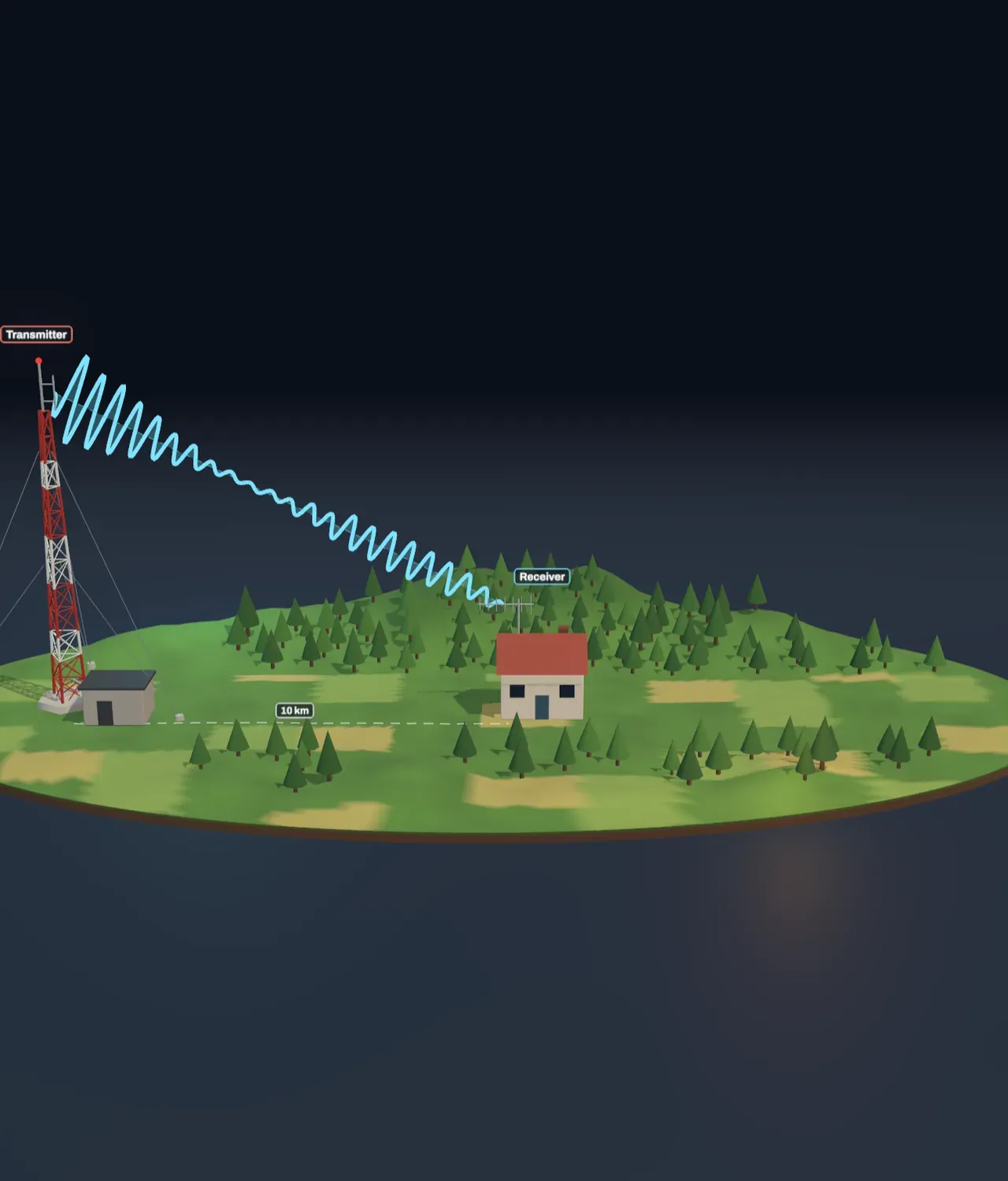
A voice carries a few tens of metres. A radio wave can cross a continent. So to send sound far, a transmitter makes a radio wave at one steady frequency, the carrier, and changes it in step with the message. A steady carrier on its own says nothing; the information is in the changes, and making them is called modulation. The receiver’s job is to undo them.
Three ways to write on a wave
AM (amplitude modulation) makes the carrier’s strength follow the sound: loud moments make tall waves, quiet ones short waves. FM (frequency modulation) keeps the strength fixed and instead squeezes the waves together or spreads them apart as the sound rises and falls. Digital radio first turns the message into bits, then switches the carrier between a few fixed symbols. The scene uses the simplest set, two: a 1 sends the wave one way up, a 0 sends it flipped over, so the bits show as sudden reversals in the wave.
Weaker with every kilometre
A radio wave spreads out as it travels, so its power is shared over a wider and wider area. Twice as far away, the receiver catches only a quarter of the power. Meanwhile the receiver always hears a faint hiss of noise: the jiggling of electrons in its own circuits, radio crackle from lightning and machinery, and the glow of the sky itself. What matters is the signal-to-noise ratio, usually given in decibels: every 10 dB is a factor of ten in power, and each doubling of distance costs 6 dB.
Try it: with Modulation on AM, slide Distance from 5 km to 100 km and then choose Message under Decode the signal. Switch to FM and Digital at the same distances and compare the decoded message in the charts beside the scene.
Three ways to fail
AM fails gradually. Noise adds straight onto the wave’s height, and the height is the message, so the hiss in the sound grows steadily as the signal weakens. Far away the tone is still faintly there, under a roar.
FM holds on, then breaks. The receiver reads only how fast the wave’s crests arrive, not how tall they are, so a little noise barely moves the message. That makes FM sound cleaner than AM from the same transmitter, at the cost of a wider slice of the radio spectrum. But once the noise is nearly as strong as the carrier, it now and then knocks the wave’s timing a whole cycle out, and each slip is a click. Past this threshold the sound breaks up quickly.
Digital is perfect, then falls off a cliff. The receiver only has to decide which symbol arrived. A bit is wrong only when noise pushes it all the way across the decision line, and big noise spikes are rare: the chance falls away like the tail of a bell curve. So the bit error rate drops from one in a hundred to one in ten million over only about seven decibels. Real systems add error-correcting codes that mend scattered mistakes, which sharpens the cliff even more: a digital station plays flawlessly until, a little further on, it stops altogether.
What this model leaves out
The scene sends one tone or two letters over a straight, clear path. Real links lose signal to hills, buildings and rain, and reflections arrive slightly late and interfere, making the signal fade in and out as you move. The noise is modelled as the textbook kind, smooth and random, added at the receiver, while real interference comes in bursts. Modern phones and Wi-Fi use dozens of symbols at once on thousands of carriers, and error correction, none of which is shown. The carrier and the travelling wave are slowed and stretched enormously so the eye can follow them, and the wave’s height along the way is drawn on a compressed scale.