How a phone knows where it is without transmitting anything. Distance from time, trilateration with spheres, why a microsecond of clock error is worth hundreds of metres, why a fourth satellite is needed, and why without relativity GPS would be kilometres out every day.
Step 1 of 7 · Listening
Step 1 of 7
Listening
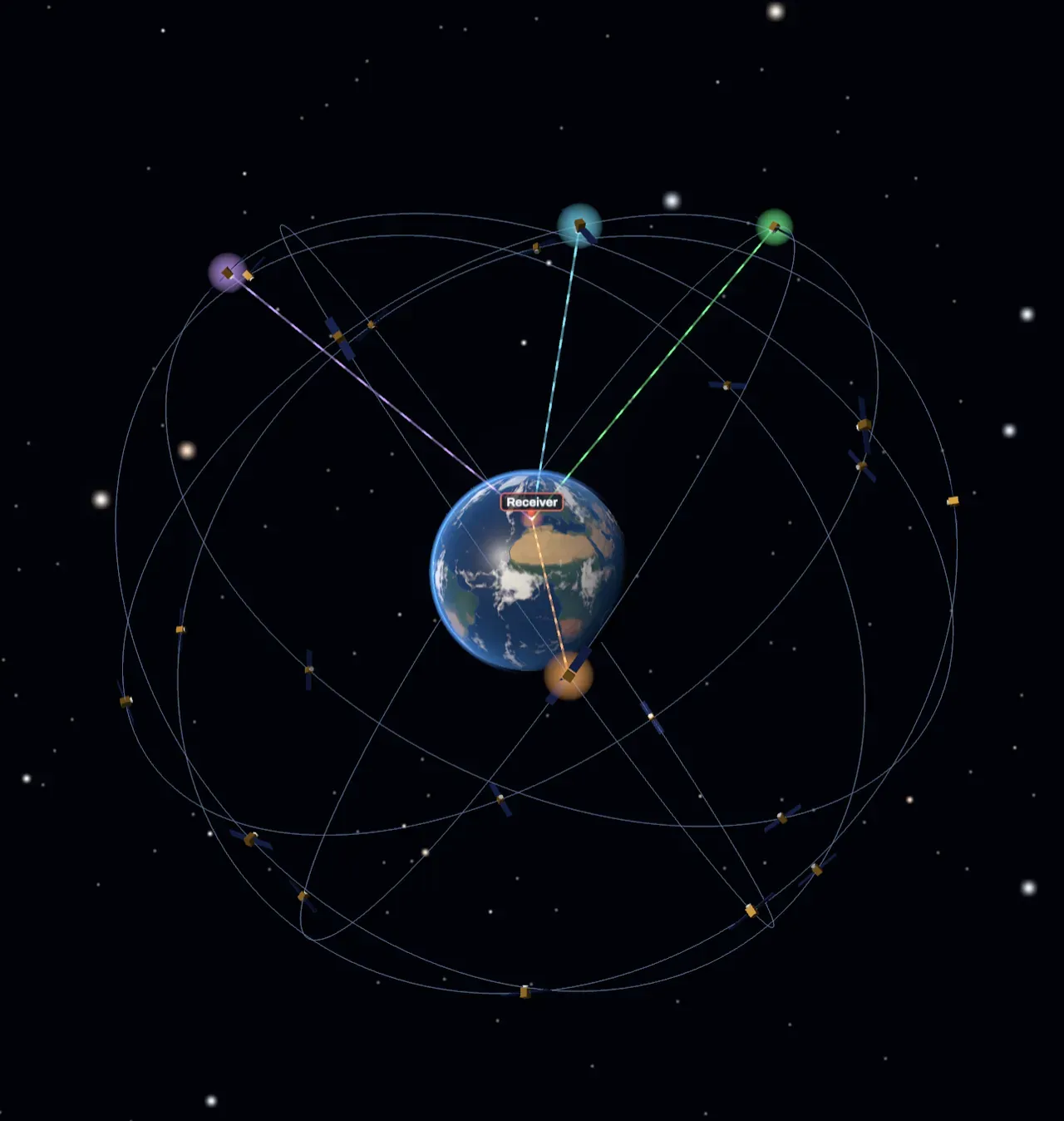
In the Unit on orbits we saw how a satellite stays in orbit. About thirty GPS satellites circle the Earth about 20,000 km up, each carrying atomic clocks. In the Scene the constellation is frozen at one moment, and the receiver is marked by a red pin on the ground.
Step 2 of 7
Distance from time
Radio waves travel at the speed of light, . If the receiver knows when a signal left the satellite and when it arrived, it knows how long the signal was on the way, and so the distance:
The list beside the Scene shows, for each satellite the receiver uses, the signal’s travel time and the range that comes from it.
Step 3 of 7
Spheres
One range says only that the receiver is on a sphere round the satellite. Show the timing spheres is On, and the map beside the Scene shows where each sphere meets the ground. Satellites used is on 2, and Receiver clock error is locked at 0 µs.
Step 4 of 7
The receiver’s clock
GPS satellites carry atomic clocks, but a phone has a cheap quartz crystal, which can easily be off by a millisecond. The receiver times everything on its own clock, so any error in it becomes an error in distance. Satellites used is locked.
Step 5 of 7
Three satellites and a fast clock
With a perfect clock, three satellites would be enough. But the clock here runs fast, and every range is too long by the same amount. Both controls are locked.
Step 6 of 7
The fourth satellite
A position takes three numbers, and the clock one more. Each satellite gives one equation. Receiver clock error is locked at 0.1 ms, and Satellites used is free.
Step 7 of 7
Relativity in your pocket
The satellites’ clocks have a problem of their own. By relativity, a clock in weaker gravity ticks faster, and a clock moving fast ticks slower. In a GPS orbit the weaker gravity wins, and the clock gains on a clock on the ground. The line at the foot of the list beside the Scene spells out both effects.
Loading the interactive version…
Loading the interactive version…
Each step sets up the Scene for you, and a control marked “fixed” stays put for that step.
Practice · Choose
A phone finds where it is with the GPS satellites. What does it transmit to them?
Practice · Choose
A phone finds where it is with the GPS satellites. What does it transmit to them?
Practice · Calculate
A GPS satellite straight overhead is about 20,200 km away. How long does its signal take to reach you, in milliseconds? Then compare with the time for the first satellite in the list beside the Scene, the highest in the sky.
Practice · Calculate
A GPS satellite straight overhead is about 20,200 km away. How long does its signal take to reach you, in milliseconds? Then compare with the time for the first satellite in the list beside the Scene, the highest in the sky.
Practice · Predict, then look
With one satellite the receiver is somewhere on a sphere, and with two on a circle. The receiver’s clock is exact. Where can it be with three satellites?
Practice · Predict, then look
With one satellite the receiver is somewhere on a sphere, and with two on a circle. The receiver’s clock is exact. Where can it be with three satellites?
Practice · Predict, then look
The Receiver clock error is zero. If the clock runs 250 µs fast, a quarter of a millisecond, by how many kilometres will every range come out too long?
Practice · Predict, then look
The Receiver clock error is zero. If the clock runs 250 µs fast, a quarter of a millisecond, by how many kilometres will every range come out too long?
Practice · Predict, then look
Three satellites, and the clock runs 100 µs fast, so every range is about 30 km too long. The receiver trusts its clock. How far from the true place will the position it works out be?
Practice · Predict, then look
Three satellites, and the clock runs 100 µs fast, so every range is about 30 km too long. The receiver trusts its clock. How far from the true place will the position it works out be?
Practice · Predict, then look
The same clock, 100 µs fast. A fourth satellite is added. What will happen to the computed position?
Practice · Predict, then look
The same clock, 100 µs fast. A fourth satellite is added. What will happen to the computed position?
Practice · Calculate
By relativity, a clock in a GPS orbit gains about 38.5 µs a day on a clock on the ground. If nobody corrected for it, by how many kilometres would every range drift each day?
Practice · Calculate
By relativity, a clock in a GPS orbit gains about 38.5 µs a day on a clock on the ground. If nobody corrected for it, by how many kilometres would every range drift each day?
Lesson complete. Every practice question here is done.