Listening, not asking
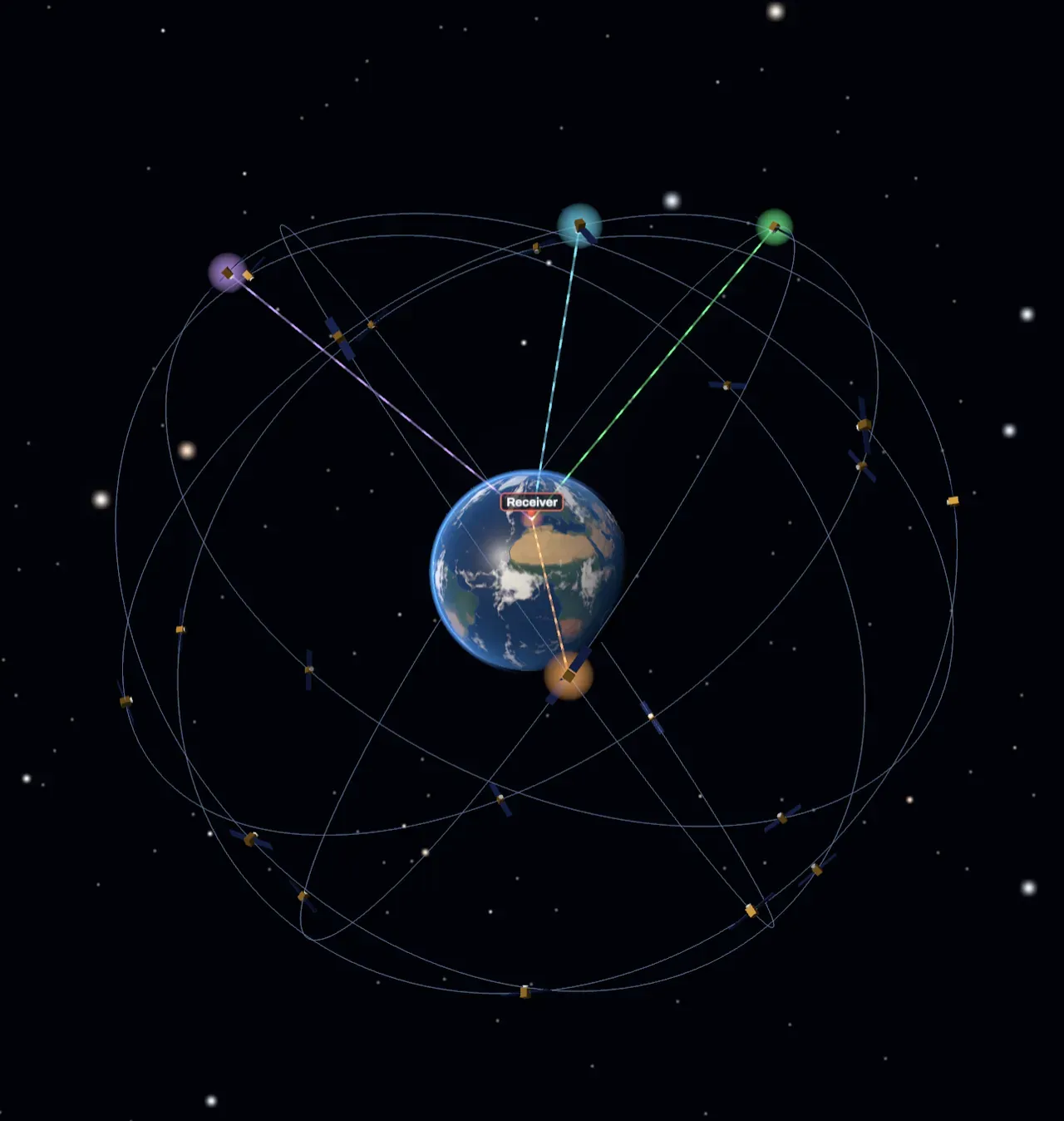
A phone or a car’s navigation box never transmits anything to the GPS satellites. It only listens. Each of the thirty or so satellites carries atomic clocks and broadcasts, over and over, the time on its clock and where it is. That is all a receiver needs.
Radio waves travel at the speed of light, about 300,000 kilometres a second. If a signal stamped with one time arrives a little later, the difference is how long it was on its way, and the gap times the speed of light is the distance to the satellite, its range. The satellites orbit about 20,000 kilometres above the ground, so the signal takes roughly 70 thousandths of a second to arrive. The precision this needs is startling: light covers 30 centimetres in one billionth of a second, so a clock error of a single nanosecond is a ranging error of a ruler’s length.
Spheres in space
One range on its own says little. If you are 20,350 kilometres from a satellite, you could be anywhere on a sphere of that radius around it. A second satellite gives a second sphere, and two spheres that cross meet in a circle. A third sphere cuts that circle at just two points. One is usually near the ground and the other is far out in space, so the receiver can throw that one away.
Finding a position by where distances cross is called trilateration. Surveyors did it with tapes and chains long before satellites; GPS does it with time.
Try it: set Satellites used to 1, 2 and then 3, and choose On under Show the timing spheres. Watch the coloured circles on the ground, where each sphere meets the Earth, close in on the red pin.
The fourth satellite
Three ranges would be enough if the receiver’s clock were perfect, but it is not. A phone has a cheap quartz crystal, not an atomic clock, and it can easily be a thousandth of a second out. If the receiver’s clock runs fast, every signal seems to arrive late, so every range comes out too long, and all by the same amount. With three satellites the spheres then cross in the wrong place, hundreds of kilometres off.
The trick is to treat the clock error as one more unknown. Position needs three numbers and the clock one more, so four ranges are enough to solve for all four at once. Only one point and one clock correction make all four spheres meet. That is why a receiver needs at least four satellites in view, and why your phone, once it has a fix, also knows the time to within a millionth of a second. Extra satellites beyond four make the answer steadier, especially when they are spread widely across the sky.
Relativity in your pocket
The satellites’ clocks have a problem of their own. Einstein’s relativity says that a clock in weaker gravity runs faster, and a clock moving fast runs slower. Up in orbit, gravity is about a seventeenth as strong as at the ground, which makes a satellite’s clock gain about 45.7 millionths of a second a day. Its orbital speed, nearly 3.9 kilometres a second, makes it lose about 7.2. The net gain is about 38 microseconds a day.
That sounds tiny, but multiplied by the speed of light it is about 11 kilometres of range every day. So the clocks are adjusted before launch. Each is set to tick at 10.22999999543 million times a second on the ground, so that in orbit it ticks at exactly 10.23 million. Receivers make one more small correction because the orbits are not perfect circles.
What this model leaves out
The constellation is frozen at a single moment, though real satellites take about 12 hours per orbit and the Earth turns beneath them. The satellites are drawn enormously enlarged. Real receivers do not intersect spheres directly but solve the same equations by repeated refinement, as this model does for four or more satellites. Here every error except the receiver’s clock is left out: the air’s charged upper layer and its water vapour slow the signal by a few metres’ worth, satellite positions and clocks are known only to about a metre, and signals reflecting off buildings arrive late. The 11 kilometres a day is how fast every range would drift if no one allowed for relativity. How much of that would land in the position depends on how the satellites’ clocks drifted against each other, since a drift shared by all of them looks just like a receiver clock error and a fourth satellite would absorb it.