How a collider pushes protons, bends them into a ring and records what is made when they collide. Cavities and magnets, the bending radius from p = qBρ, the trade-off between magnets and tunnel, why the protons hardly speed up, and what the detector sees.
Step 1 of 6 · Push and bend
Step 1 of 6
Push and bend
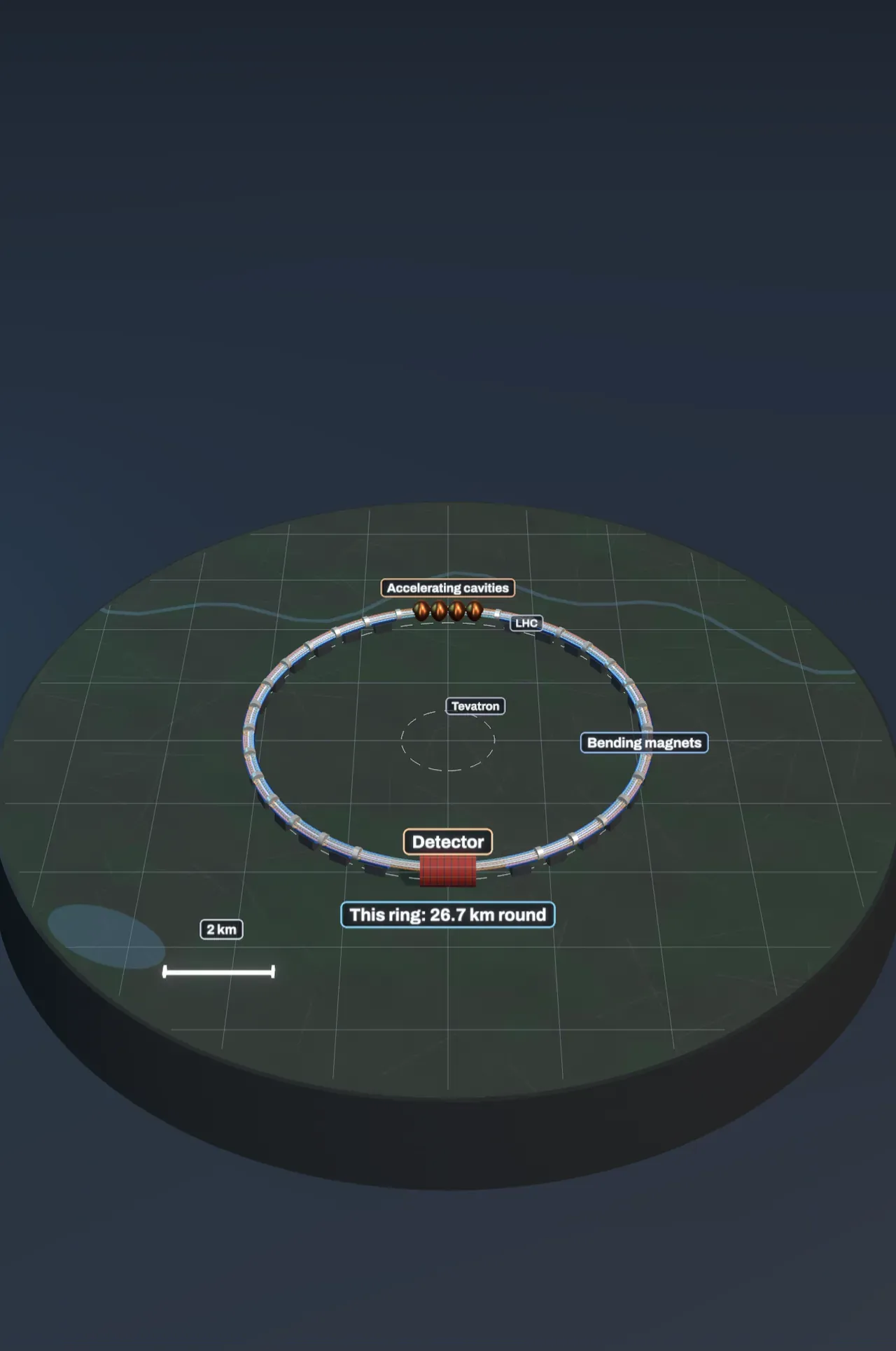
A collider does two different things to a beam of protons: it adds energy to it, and it holds it on a circle so that it comes back to the same place again and again. In the Unit on magnetism we saw that a magnetic force on a moving charge is at right angles to its motion. In the Scene, a ring of magnets on a map, and the readings beside the Scene show the size of the ring, the protons’ speed and how many laps they make.
Step 2 of 6
The bending radius
The magnetic force supplies the centripetal force that holds the proton on a circle of radius . That gives a simple link between the momentum , the field and the bending radius:
For a proton moving at almost the speed of light the momentum is in proportion to the energy, which gives a handy rule: the energy in TeV is about , with in tesla and in kilometres. Both controls are locked.
Step 3 of 6
More energy
The great discoveries of particle physics came from machines with higher energy. Magnet strength is locked, and Beam energy is free.
Step 4 of 6
Magnets or tunnel
Iron-cored electromagnets stop getting stronger around 2 T. Beyond that it takes superconducting coils, which carry enormous currents with no resistance, but only when chilled by liquid helium. Beam energy is locked, and Magnet strength is on Iron magnet.
Step 5 of 6
Almost the speed of light
By relativity, a proton’s energy is , where is its rest energy and . When is large, is very close to , and the gap between them is about . Beam energy is on LHC at injection.
Step 6 of 6
What the detector sees
A detector wraps the collision point in layers, and each layer catches a different kind of particle: the Silicon tracker records the tracks of charged particles, the Crystal calorimeter stops photons and electrons, the Brass calorimeter stops hadrons, and muons cross everything as far as the iron. Choose an event under The collision makes, and drag Zoom to a collision to Particles recorded.
Loading the interactive version…
Loading the interactive version…
Each step sets up the Scene for you, and a control marked “fixed” stays put for that step.
Practice · Choose
Protons enter the LHC ring at 0.45 TeV and leave it at 7 TeV. What gives them the energy?
Practice · Choose
Protons enter the LHC ring at 0.45 TeV and leave it at 7 TeV. What gives them the energy?
Practice · Calculate
Beam energy 7 TeV and Magnet strength 8.33 T, as in the LHC. For a proton, the energy in TeV is about , with in tesla and in kilometres. What is the bending radius ?
Practice · Calculate
Beam energy 7 TeV and Magnet strength 8.33 T, as in the LHC. For a proton, the energy in TeV is about , with in tesla and in kilometres. What is the bending radius ?
Practice · Predict, then look
Magnet strength is locked at 8.33 T. Beam energy is doubled from 7 to 14 TeV. What will happen to the size of ring needed?
Practice · Predict, then look
Magnet strength is locked at 8.33 T. Beam energy is doubled from 7 to 14 TeV. What will happen to the size of ring needed?
Practice · Reach the target
Beam energy is locked at 7 TeV, and Magnet strength is on Iron magnet. With magnets like that, the ring would be more than 100 km round. Find the magnet strength that fits the ring into a tunnel 40 km round, and press Check.
Practice · Reach the target
Beam energy is locked at 7 TeV, and Magnet strength is on Iron magnet. With magnets like that, the ring would be more than 100 km round. Find the magnet strength that fits the ring into a tunnel 40 km round, and press Check.
Practice · Predict, then look
Beam energy is on LHC at injection, 0.45 TeV. It is raised to 7 TeV, 15.5 times as much. What will happen to the protons’ speed?
Practice · Predict, then look
Beam energy is on LHC at injection, 0.45 TeV. It is raised to 7 TeV, 15.5 times as much. What will happen to the protons’ speed?
Practice · Choose
Under The collision makes pick Higgs boson → two photons, and move Zoom to a collision to Particles recorded. Two particles leave no track in the silicon tracker, and stop in the crystals. What are they?
Practice · Choose
Under The collision makes pick Higgs boson → two photons, and move Zoom to a collision to Particles recorded. Two particles leave no track in the silicon tracker, and stop in the crystals. What are they?
Lesson complete. Every practice question here is done.