Smashing things to make new ones
To find out what something is made of, you can break it open. Particle physicists go further: they slam particles together so hard that the energy of the crash turns into new particles that were not there before. Einstein’s says that mass is a form of energy, so a collision with enough energy can make particles far heavier than the ones that went in. The Higgs boson, with about 133 times the mass of a proton, and the top quark, about 184 times, have only ever been made this way.
Most of those particles last a tiny fraction of a second before they decay into lighter ones. A collider is a machine for making such collisions over and over, billions of times a second, and a detector is the camera that records what flies out. The particles themselves are described in particle physics and the Standard Model; this Article is about the machines.
Pushing with electric fields
A charged particle speeds up in an electric field, the way a ball speeds up rolling downhill. Old accelerators used one big voltage. Modern ones use radio-frequency cavities: hollow copper or niobium chambers in which an electric field swings back and forth hundreds of millions of times a second. A bunch of protons arrives just as the field points forward, gets a push, and has left before the field turns round.
In a straight line the push would end when the cavities run out. Bend the beam round into a ring and it comes back to the same cavities on every lap. The LHC’s cavities give each proton only about half a million electronvolts per lap, but the protons go round more than 11,000 times a second. In about twenty minutes they climb from 0.45 to 6.8 trillion electronvolts (TeV).
Almost none of that energy goes into speed. Even at 0.45 TeV a proton moves at 99.9998% of the speed of light, and by 7 TeV it is only about 3 metres a second slower than light. As special relativity explains, nothing with mass can reach the speed of light, so the extra energy shows up as momentum instead: a 7 TeV proton carries about 7,500 times the energy it has at rest.
Try it: step Beam energy from LHC at injection to LHC and watch the readings beside the Scene. The protons’ shortfall from the speed of light drops from about 650 metres a second to under 3.
Bending with magnets
To keep a beam on a circle you need a sideways force, and a magnetic field provides it. As in charged particles in magnetic fields, the field pushes a moving charge at right angles to its motion, so it turns without speeding up or slowing down. The radius of the turn is set by the particle’s momentum , its charge and the field :
For a proton this comes to a handy rule: the energy in TeV is about 0.3 times the field in tesla times the bending radius in kilometres. Double the energy and you need double the field or double the radius.
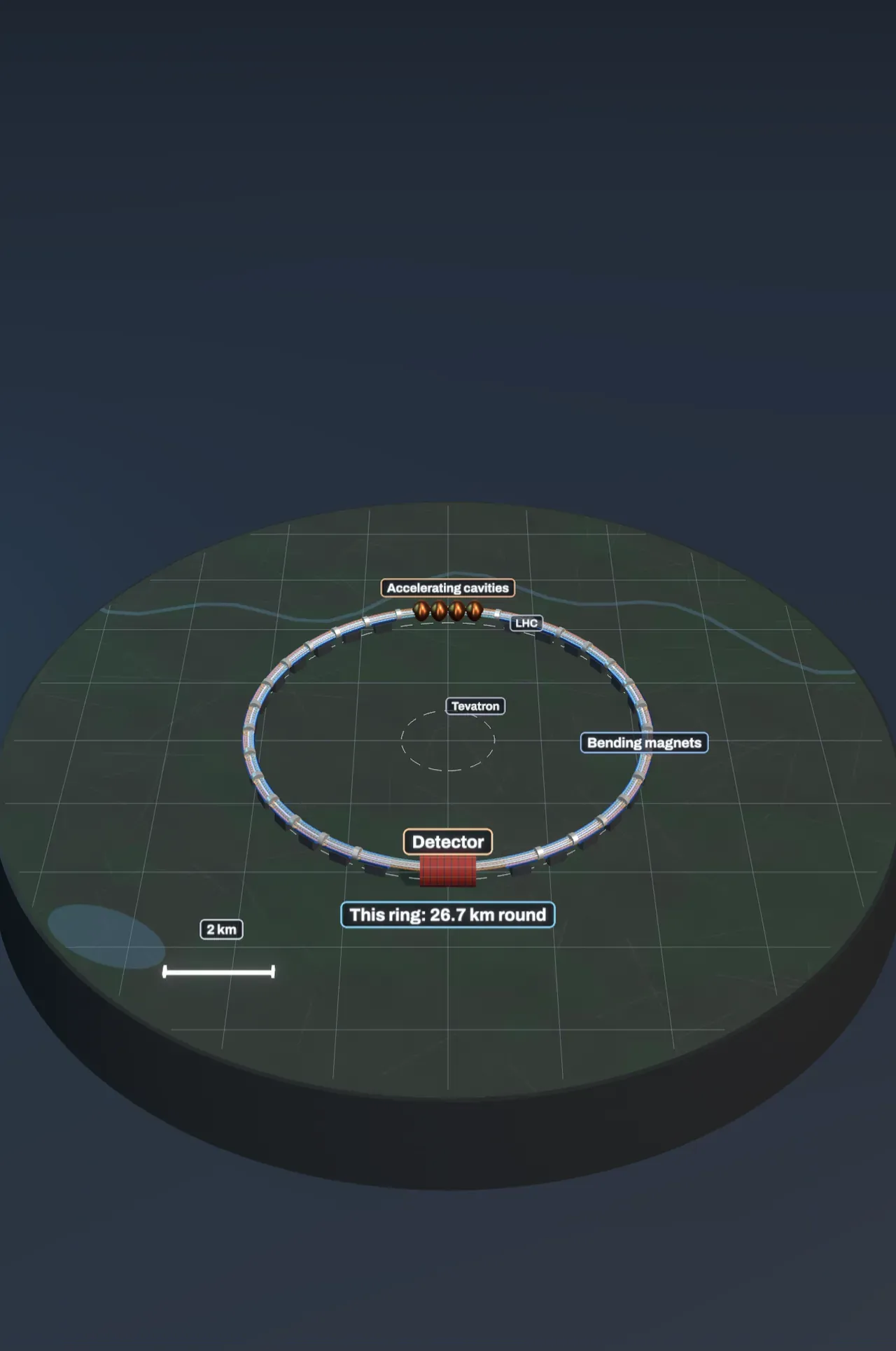
The LHC’s bending magnets reach 8.33 tesla, more than a hundred thousand times the Earth’s field, so 7 TeV protons need a bending radius of 2.8 kilometres. The magnets fill only about two-thirds of the tunnel, with the rest taken by magnets that focus the beam, cavities, detectors and straight sections, so the whole ring is 26.7 kilometres round.
Try it: keep Beam energy at LHC and set Magnet strength to Iron magnet. Ordinary electromagnets with iron cores stop getting stronger at about 2 tesla, and a 7 TeV ring built with them would be well over 100 kilometres round. Now try FCC (planned) on both sliders.
Superconducting magnets
Magnets stronger than iron allows need enormous currents: nearly 12,000 amperes in each LHC magnet. In copper, that much current would melt the wire. The LHC’s coils are instead wound from niobium–titanium, a superconductor, which carries current with no resistance at all once it is cold enough. Liquid helium keeps all 1,232 bending magnets at 1.9 degrees above absolute zero, colder than outer space.
Niobium–titanium runs out of steam at about 9 tesla. Stronger magnets use niobium–tin, which can reach about 16 tesla but is brittle and hard to wind; the first ones are now being installed to focus the LHC’s beams more tightly. The planned Future Circular Collider (FCC) would combine magnets like these with a tunnel about 91 kilometres round to reach up to about 50 TeV per beam. The same race for stronger superconducting magnets matters to fusion reactors, which use them to hold a hot plasma away from their walls.
A ring does not run at one energy. Protons come in from a smaller accelerator at 0.45 TeV and are sped up in place, so the field has to rise with their momentum to keep them on the same circle: the LHC’s magnets ramp from 0.54 to 8.33 tesla as the protons climb. A ring whose field follows its beam like this is called a synchrotron.
Try it: press LHC at injection and then set Magnet strength to 0.54 T. The ring is back to the LHC’s size.
The collision
Each LHC beam is not a steady stream but about 2,500 bunches, each a few centimetres long and holding about 100 billion protons. Where a detector sits, the two beams are steered into one pipe and squeezed to a fraction of the width of a hair, and bunches cross every 25 billionths of a second. Protons are mostly empty space, so in each crossing only a few dozen of them actually hit. That still makes about a billion collisions a second.
What actually collides are the quarks and gluons inside the protons, each carrying a share of its proton’s energy, so a collision rarely uses the full 14 TeV. Heavy particles are rare as a result. The chart beside the Scene shows how many collisions it takes, on average, to make each kind of event: at the LHC, about one collision in 600 billion makes a Higgs boson that decays into two photons, roughly one every ten minutes. Raising the energy makes heavy particles much more often, which is the main reason to build a bigger machine.
Try it: choose Top-quark pair for The collision makes and move Beam energy from Tevatron to FCC (planned). Top pairs go from a few a minute to hundreds a second.
The detector: layers like an onion
A detector such as CMS or ATLAS wraps the collision point in layers, each built to catch a different kind of particle. Drag Zoom to a collision to Particles recorded: the Scene zooms into the detector, cuts it open across the beam, and lets one collision play out.
- The silicon tracker is the inner layer: thin sheets of silicon, each split into millions of tiny sensors that register a charged particle as it passes. Joining the hits gives the particle’s track.
- A huge solenoid magnet surrounds the inner layers with a 3.8 tesla field along the beam, so every charged track curves. A tight curl means low momentum; a nearly straight track, high momentum. Which way it curls gives its charge.
- The electromagnetic calorimeter is made of dense crystals. Electrons and photons crash into them, shower into many lower-energy particles and stop, and the crystals glow with light in proportion to the energy.
- The hadronic calorimeter, of brass and plastic, stops protons, neutrons, pions and the other particles made of quarks.
- Muons go through all of that, and through the magnet’s iron yoke too. Chambers between the iron layers track them again on the way out.
- Neutrinos go through everything without a trace. A detector finds them only by bookkeeping: before the collision nothing moved sideways, so the sideways momenta of everything seen should add to zero. If they do not, something unseen carried off the difference.
Each kind of particle leaves its own pattern of marks. A photon has no track but lights up the crystals; an electron has a track that ends in the crystals; a muon has a track that goes on through the iron. Quarks and gluons never come out alone. Each makes a narrow spray of particles called a jet, which leaves many tracks and fills the brass calorimeter.
Try it: at Particles recorded, step through The collision makes. Two photons with no tracks, two muons through the iron, an electron facing nothing at all, and four jets with a muon and a missing neutrino are four very different-looking events.
From marks to discoveries
One collision proves little. A Higgs boson cannot be seen directly: physicists add up the energies and directions of its two photons to get the mass of whatever made them. Most pairs of photons come from ordinary processes and give masses spread over a wide range, but in 2012 the CMS and ATLAS experiments each found a small bump of extra pairs at 125 GeV: the Higgs boson.
Because only a tiny share of collisions are interesting, the detectors cannot keep them all. Fast electronics look at every crossing and keep only about one in 40,000, which is still about a gigabyte of data a second.
What this model leaves out
The ring is drawn as a plain circle with its bending magnets filling two-thirds of it, as in the LHC; real rings have different shares and longer straight sections, so the Tevatron, for example, was smaller than this model gives for its numbers. The map zooms out for bigger rings, and everything on the ring (magnets, cavities, beams and the detector) is drawn hundreds of times too large. Only a few bunches are shown, and they go round about a hundred thousand times slower than real ones.
The detector is a simplified CMS. Its inner layers are widened so the tracks can be read, every particle flies out in the plane of the cut, and only one collision is shown, where a real crossing has dozens on top of each other. The particles of each event are a typical example made up for the Scene, not a recorded event. How often each event happens uses approximate cross-sections for proton–proton collisions and assumes the LHC’s billion collisions a second at every energy. Electron colliders, such as the old LEP in the same tunnel, are limited by something else: electrons going round a bend shed energy as light, which the comparison above explains.