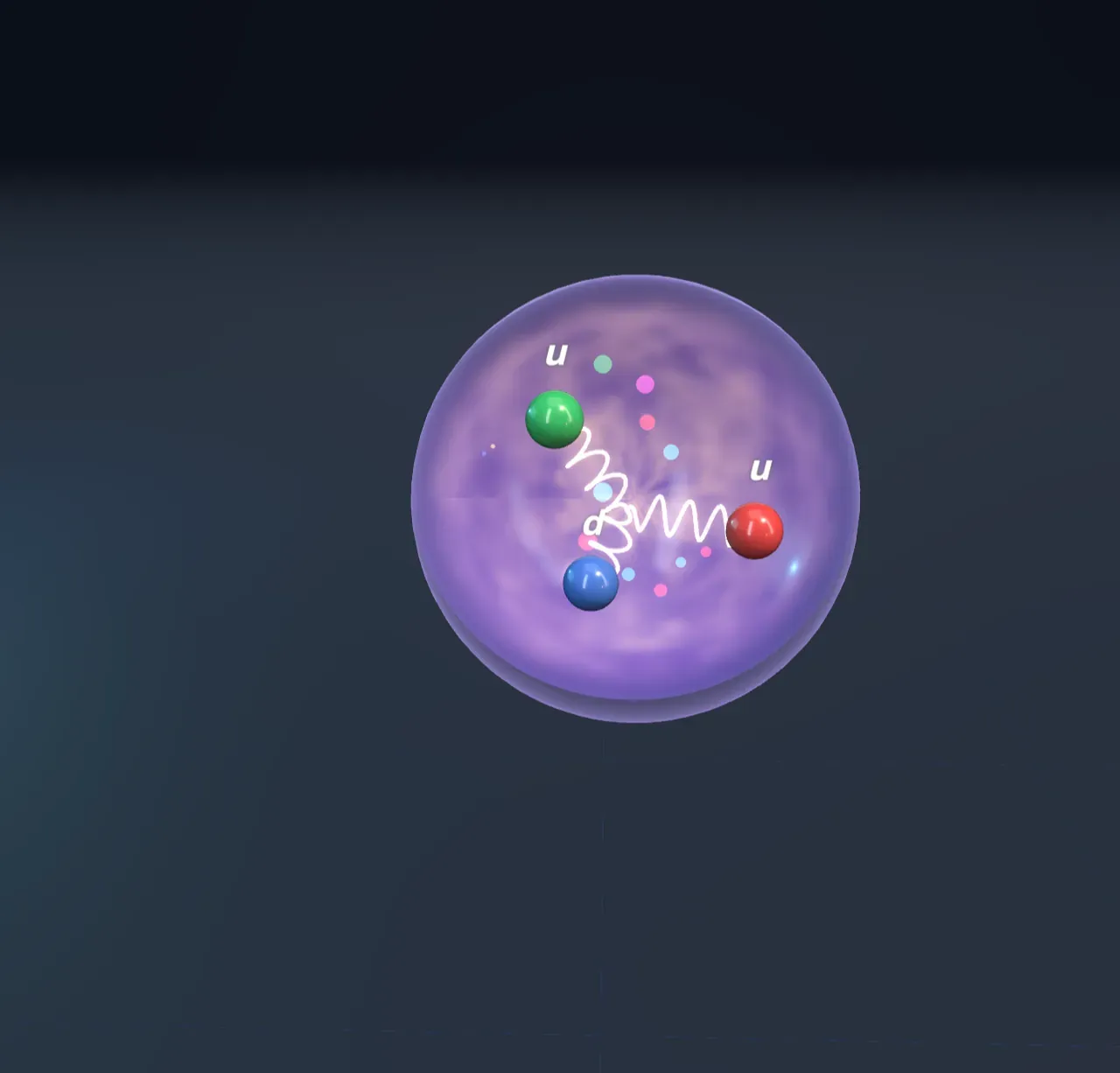
What a proton is made of
Every atom has a nucleus made of protons and neutrons. For a long time these looked like the smallest pieces of matter. They are not. A proton is a tiny bag, about 1.7 femtometres across, with three quarks inside: two up quarks and one down quark.
Quarks carry fractions of the electric charge an electron carries. An up quark has and a down quark . Add the proton’s three together and you get , exactly the proton’s charge. The readings beside the Scene do this sum for whichever particle you choose.
Try it: under Particle, choose Neutron. One up quark has become a down quark, and the sum in the readings now comes to 0. That one swap is the whole difference between a proton and a neutron.
Particles made of quarks are called hadrons. Those with three quarks, like the proton, neutron, lambda and omega, are baryons. Those with one quark and one antiquark (its antimatter partner, drawn with a bar over its letter) are mesons, like the pion and the J/psi.
Where the mass comes from
Look at the bar under the readings. A proton weighs 938 MeV (in the units particle physicists use for mass, mega-electronvolts divided by the speed of light squared). Its three quarks, weighed on their own, come to about 9 MeV. The gold sliver at the start of the bar is that 9 MeV: about 1 per cent.
The other 99 per cent is energy. The quarks race around inside the bag close to the speed of light, and the field of gluons that holds them together stores a great deal of energy. Einstein’s says energy has mass, and that energy is where almost all the proton’s mass comes from. Almost everything you can weigh, from a feather to a mountain, gets its mass this way.
Try it: choose J/psi. It is made of a charm quark and an anticharm quark, each about 270 times heavier than a down quark. Now the gold part of the bar fills 82 per cent: with heavy quarks, the quarks’ own mass is most of the total.
Colour and the glue
The force that holds quarks together is the strong force, and the charge it acts on is called colour. It has nothing to do with real colour; the name comes from a neat rule. Each quark carries one of three colour charges, called red, green and blue, and a hadron always has a mix that cancels out: one of each in a baryon, or a colour and its anticolour in a meson.
The strong force is carried by gluons, and gluons carry colour themselves. Watch the beads: every second or so, a bright spot runs along a spring from one quark to another, and the two swap colours. The colours keep changing, but there is always one of each.
The faint sparks that flicker inside the bag are sea quarks: pairs of a quark and an antiquark that the gluon field makes out of its own energy, and that vanish again moments later. A real proton is crowded with them.
You can’t pull a quark out
Electric and gravitational forces get weaker the further apart two things are. The strong force between quarks does not. Beyond a few tenths of a femtometre, the gluon field between them gathers into a narrow tube, and every extra bit of length adds the same energy, like a rubber band that never goes slack.
Try it: slide Pull a quark out to 1 fm. One up quark is dragged a femtometre away, and its tube stretches without getting thinner. The tag reads 0.9 GeV: the string holds about 0.9 GeV for every femtometre. That is a force of about 140,000 newtons, the weight of some 15 tonnes, acting on a single quark.
Keep pulling. At about 1.2 femtometres the tube holds enough energy to make new matter, and it snaps. The energy becomes a new quark and antiquark at the break. Slide it on to 1.5 fm: the pulled up quark leaves with the new anti-up quark as a new meson, a neutral pion (), and the new up quark takes its place in the proton. You pulled, and instead of a free quark you got a new particle.
This is confinement. No one has ever seen a quark on its own. When a particle collider knocks a quark out of a proton, it comes out as a spray of new hadrons, called a jet.
The Standard Model on one chart
Step Zoom out to the Standard Model to Matter particles. The proton shrinks into the corner and a chart rises in its place. Each ball is one of the basic particles of matter. Three things set its place:
- Height is mass, on a log scale: each line on the back wall is ten times heavier than the one below.
- Depth is electric charge, from at the back to at the front.
- Columns are generations, I, II and III.
The proton’s quarks are ringed: two up, one down. Thin lines run back to them from the proton in the corner. The quarks are purple. The green balls are leptons: the electron, its heavier cousins the muon and tau, and three neutrinos, ghostly particles with no charge that pass through the Earth almost untouched.
Three generations
Look along any row of the chart: the up, charm and top quarks, or the electron, muon and tau. Each row has one charge, and the three particles in it behave the same way in every force. Yet each generation is much heavier than the one before. The top quark is about 80,000 times heavier than the up quark, nearly as heavy as a whole gold atom.
Everything around you is made from the first generation alone: up and down quarks in protons and neutrons, and electrons around them. The heavier particles are made in cosmic-ray showers and in colliders and decay into lighter ones within a tiny fraction of a second. No one yet knows why there are exactly three generations, or why their masses are what they are.
The neutrinos sit right at the bottom. Their masses have never been measured, only bounded: an experiment in Karlsruhe called KATRIN showed in 2025 that the electron neutrino is lighter than 0.45 eV, less than a millionth of the electron’s mass, and neutrino oscillations show that at least one of them weighs about 0.05 eV or more. They are drawn faint at the upper limit.
The force carriers and the Higgs
Step Zoom out to the Standard Model to Standard Model. Four more balls rise on the right.
- The gluon (g) carries the strong force, and the photon () carries the electromagnetic force: light, electricity and magnetism. Both have no mass, so they rest on the floor below the scale.
- The W and Z carry the weak force, which lets one kind of quark turn into another in radioactive decay. They are about 85 to 100 times heavier than a proton, which is why the weak force reaches only a tiny distance. The W comes with a charge of or ; the chart shows .
- The Higgs boson (H), found at CERN in 2012 at 125 GeV, is a ripple in the Higgs field. Moving through that field is what gives the W, the Z, the quarks and the electron their own masses: the 1 per cent of the proton, but not the other 99.
With every kind of particle on it, the chart has 17 balls. That is the Standard Model. Each matter particle also has an antiparticle with the opposite charge, and there are eight gluons that differ only in their colours; the chart shows each kind once.
How we know
- The quark idea. In 1964 Murray Gell-Mann and, separately, George Zweig proposed quarks to explain the patterns in the dozens of hadrons found in the 1950s. The eightfold way, an earlier sorting of the hadrons found by Gell-Mann and, independently, by Yuval Ne’eman, had predicted a baryon with a charge of that would turn out to be three strange quarks; the omega minus () was found at Brookhaven in 1964 with almost exactly the predicted mass.
- Seeing inside. From 1968, electrons fired at protons at SLAC in California were sometimes knocked sharply aside, as if they had hit small hard points inside the proton. Those points were quarks.
- Charm. In November 1974 teams led by Burton Richter and Samuel Ting found the J/psi at the same time, a meson that only made sense as a charm quark and its antiquark. The bottom quark followed in 1977 and the top in 1995, at Fermilab.
- The bosons. The W and Z were found at CERN in 1983, and the Higgs boson at CERN’s Large Hadron Collider in 2012.
What this model leaves out
- Gravity. The Standard Model describes three of the four forces. Gravity is not part of it, and no one has found a theory of gravity that fits with it. Nor does it include the dark matter that astronomers see pulling on galaxies.
- Size and motion. Quarks are drawn as beads, but they have no size that any experiment can measure. Their paths inside the bag are a sketch; really they move close to the speed of light and do not have definite paths at all. The proton’s and pion’s sizes are measured; the others are drawn at estimated sizes.
- The sea. A real proton holds a constantly changing swarm of gluons and quark–antiquark pairs, far more than the few sparks shown. Which pairs appear, and how often, is a matter of chance.
- The string. The tube of constant thickness and its 0.9 GeV per femtometre come from calculations of the strong force on supercomputers and from the masses of heavy mesons. The snap at 1.2 femtometres is approximate, and a real string can break into an up, down or strange pair; the Scene always makes an up and an anti-up quark.
- Quark masses. A quark can never be weighed on its own, so the masses of the light quarks depend on how they are defined. The values shown are the standard ones, defined at a set energy, and are known to a few per cent.
- Colour. The red, green and blue are labels for a kind of charge, not real colours. The gluon running between two quarks is shown as one bright spot; a real gluon carries a colour and an anticolour.