Lesson 4 of 4
Particle physics and the Standard Model.
What is inside a proton: quarks and fractional charges, mass that is mostly energy, a gluon string that pulls with the weight of fifteen tonnes and snaps into a new particle, and the three generations of the Standard Model.
Step 1 of 6 · Quarks
Step 1 of 6
Quarks
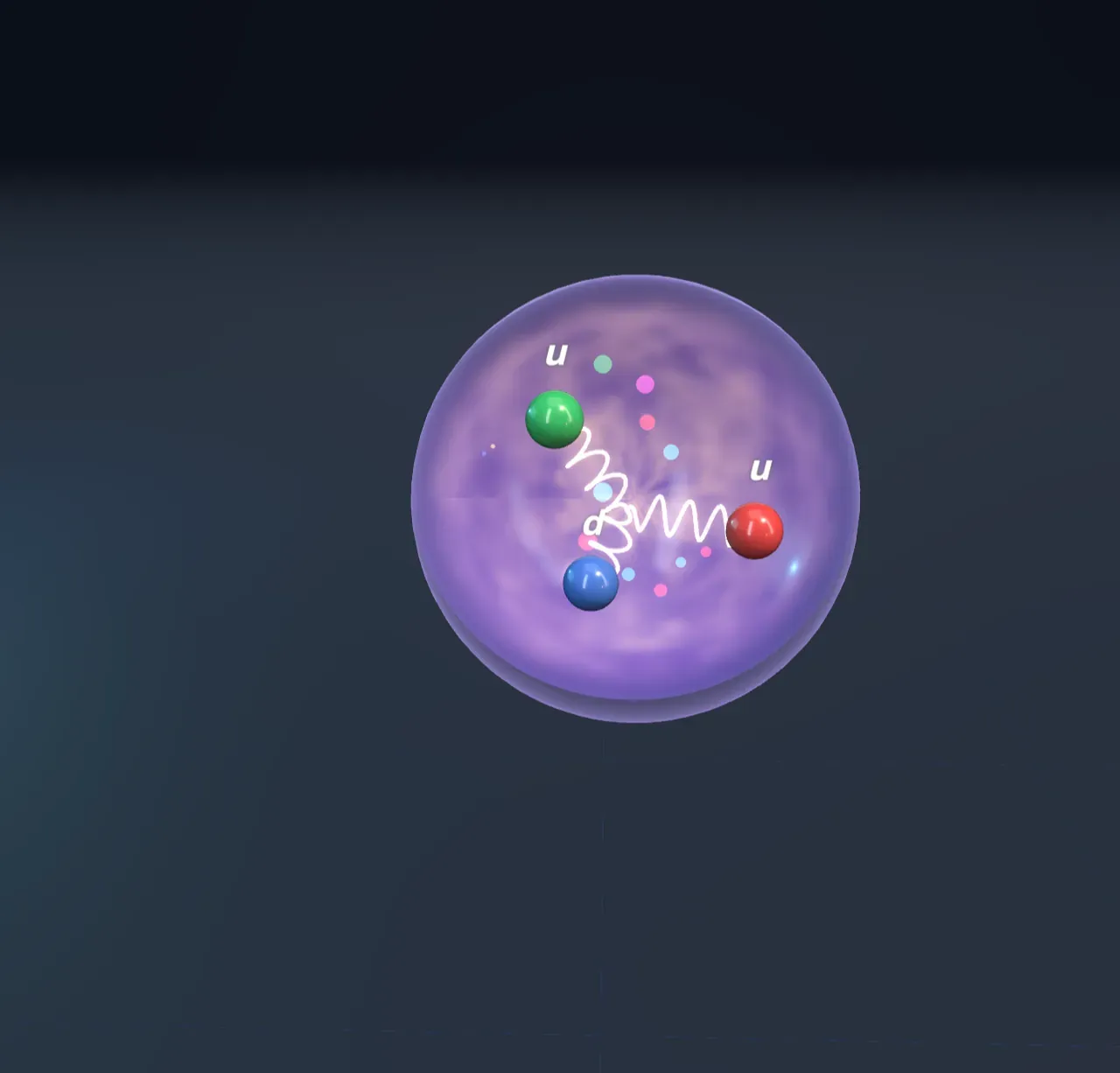
Every atom has a nucleus of protons and neutrons, and for a long time these looked like the smallest pieces of matter. They are not. A proton is a tiny bag, about 1.7 femtometres across, with three quarks inside: two up quarks and one down quark.
Quarks carry fractions of the electron’s charge: an up quark has and a down quark . In the proton: . The readings beside the Scene do this sum for whichever particle you choose under Particle. Particles made of quarks are called hadrons.
Step 2 of 6
Where the mass comes from
Look at the bar under the readings. A proton weighs 938 MeV, in the units particle physicists use for mass. The thin gold sliver at its start is the quarks’ own mass.
Step 3 of 6
Heavy quarks
There are six kinds of quark: up, down, strange, charm, bottom and top. The J/psi is a meson: one quark and one antiquark, its partner from antimatter. The proton, neutron, lambda and omega are baryons, three quarks each. Pull a quark out is fixed at rest.
Step 4 of 6
The string
The force that holds quarks together is the strong force, carried by gluons. Electric and gravitational forces weaken as two bodies move apart. The strong force between quarks does not: beyond a few tenths of a femtometre the gluon field gathers into a narrow tube, and every extra femtometre of it adds the same energy, like a rubber band that never goes slack. Here Pull a quark out is at 1 fm: an up quark is dragged a femtometre away, and the tag shows the energy in the tube.
Step 5 of 6
Keep pulling
When a particle collider knocks a quark out of a proton, the quark comes out as a jet, a spray of new hadrons. The Particle is fixed at Proton.
Step 6 of 6
The Standard Model
Zoom out to the Standard Model is at Standard Model: each ball is one of the elementary particles. Height is mass, on a log scale; depth is electric charge; and the columns are generations, I, II and III. The quarks are purple, and the leptons green: the electron, its heavier cousins the muon and tau, and three neutrinos. On the right are the force carriers, the gluon, photon, W and Z, and the Higgs boson, found at CERN in 2012. Seventeen balls in all: that is the Standard Model.
Loading the interactive version…
Loading the interactive version…
Each step sets up the Scene for you, and a control marked “fixed” stays put for that step.
Practice · Predict, then look
An up quark carries a charge of , and down and strange quarks each. The omega is made of three strange quarks. Predict: what is its charge, in units of the proton’s charge?
Practice · Predict, then look
An up quark carries a charge of , and down and strange quarks each. The omega is made of three strange quarks. Predict: what is its charge, in units of the proton’s charge?
Practice · Choose
A proton weighs 938 MeV, and its three quarks, each on its own, weigh about 9 MeV together. Where does the rest of the mass come from?
Practice · Choose
A proton weighs 938 MeV, and its three quarks, each on its own, weigh about 9 MeV together. Where does the rest of the mass come from?
Practice · Predict, then look
The J/psi is made of a charm quark and an anticharm quark, each hundreds of times heavier than a down quark. Predict: what share of the J/psi’s mass is the quarks’ own mass?
Practice · Predict, then look
The J/psi is made of a charm quark and an anticharm quark, each hundreds of times heavier than a down quark. Predict: what share of the J/psi’s mass is the quarks’ own mass?
Practice · Calculate
The quark is pulled one femtometre out, and the gluon field’s tube stores 0.9 GeV. How hard does it pull the quark back? 1 GeV = 1.602 × 10⁻¹⁰ J, and 1 fm = 10⁻¹⁵ m.
Practice · Calculate
The quark is pulled one femtometre out, and the gluon field’s tube stores 0.9 GeV. How hard does it pull the quark back? 1 GeV = 1.602 × 10⁻¹⁰ J, and 1 fm = 10⁻¹⁵ m.
Practice · Predict, then look
The quark is pulled further, to 1.5 fm. Predict what will happen.
Practice · Predict, then look
The quark is pulled further, to 1.5 fm. Predict what will happen.
Practice · Choose
Zoom out to the Standard Model is at Standard Model. Which matter particles is almost everything around you made of?
Practice · Choose
Zoom out to the Standard Model is at Standard Model. Which matter particles is almost everything around you made of?
Lesson complete. Every practice question here is done.