Two clocks made of light
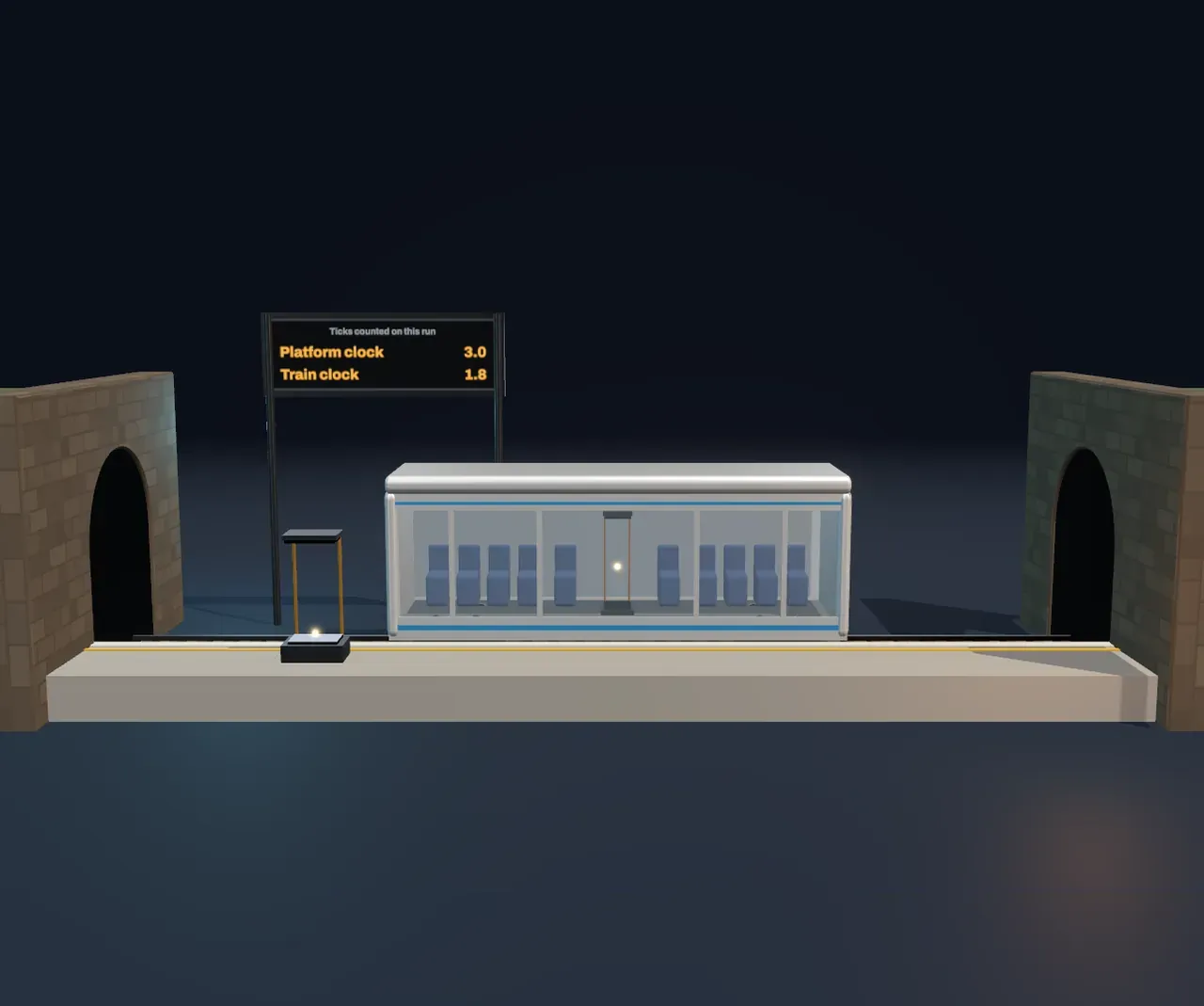
The simplest clock you can imagine is a flash of light bouncing between two mirrors, one above the other. Each time the flash comes back to the bottom mirror, the clock ticks. The scene has two of these light clocks, exactly alike: one stands on the station platform and one rides in the middle of a glass-sided train carriage.
When the train is stopped, both flashes go straight up and down together, and the board above the track counts the same number of ticks for each. Set the train moving and the two counts drift apart. The train’s clock falls behind. The faster the train, the further behind it falls. The board starts counting again each time the train comes out of the tunnel or you change its speed, and when you stop the train it waits at the platform.
Try it: slide Train speed from 0 c up through 0.5 c and 0.866 c, where γ = 2, to 0.995 c. Watch the two counts on the board, and watch the carriage itself get shorter as it goes faster.
The light takes the long way
Nothing is wrong with the train’s clock. To someone sitting on the train, its flash goes straight up and down, just as the platform’s does. The difference is in what the platform sees.
From the platform, the train moves on while the flash is between the mirrors. To hit the top mirror, the flash has to travel on a slant, and to come back down it slants again, so it zigzags along the track. A slanted path is longer than a straight one.
In 1905 Albert Einstein built a theory on two rules. The laws of physics are the same for everyone moving steadily, and light in empty space always moves at the same speed, c, about 300,000 kilometres a second, whoever measures it and however fast they are moving. So the train’s flash cannot speed up to cover its longer path. It must take longer. Every tick of the train’s clock, seen from the platform, takes more time than a tick of the platform’s clock.
Try it: step Show the Lorentz factor to Light paths. The train’s flash leaves a zigzag on the track behind it. Its last climb or fall is drawn as a right-angled triangle: the gap between the mirrors, L, the distance the train moved, v·t, and the slanted path the light took, c·t.
The Lorentz factor
Pythagoras finishes the job. For one trip between the mirrors, the slant, the gap and the distance moved make a right-angled triangle: (c·t)² = L² + (v·t)². On the platform clock the same trip takes t₀ = L/c. Put the two together and the train’s trip takes longer by a factor called the Lorentz factor, written γ (the Greek letter gamma):
At everyday speeds γ is so close to 1 that no one could notice: for an airliner it differs from 1 by less than one part in a trillion. At half the speed of light it is 1.15. At 0.87 c it is 2, and the train’s clock ticks once for every two ticks on the platform. As the speed nears c, γ climbs without limit. This slowing of moving clocks is called time dilation.
It is not only light clocks. Every clock on the train, every heartbeat and every chemical reaction keeps step with the light clock, or the passengers could tell they were moving by comparing them. Time itself passes more slowly on the train, as measured from the platform.
The same factor shortens the train. Measured from the platform, a moving object is γ times shorter along its direction of motion, while its height and width are unchanged. This is length contraction. The 20 metre carriage, at 0.8 c, measures 12 metres from the platform.
Try it: step Show the Lorentz factor on to Lorentz factor. A dashed outline shows the carriage’s length at rest around the shorter moving carriage, and the chart beside the Scene plots γ against speed with the train’s speed marked on the curve.
Whose clock is slow?
Relativity is symmetric. Passengers on the train are entitled to say they are at rest and the platform is moving backwards. To them, the platform’s flash zigzags, the platform’s clock runs slow, and the platform is shorter. Both are right, because they do not agree on which distant events happen at the same moment. That disagreement, the relativity of simultaneity, is what lets each side find the other’s clock slow without a contradiction.
It really happens
Muons are short-lived particles made when cosmic rays hit the top of the atmosphere, about 15 kilometres up. At rest a muon lasts about 2.2 microseconds on average, long enough to travel only about 660 metres even at nearly the speed of light. Yet plenty of them reach the ground. They move at about 0.995 c, where γ is about 10, so their clocks run ten times slow as measured from the ground, and they live long enough to arrive. From the muon’s point of view, the atmosphere is ten times thinner instead.
Particle accelerators keep particles going round for far longer than they would last at rest, and in 1971 atomic clocks flown round the world on airliners came back differing from clocks left on the ground by the tens to hundreds of billionths of a second that relativity predicted. The GPS satellites must correct for time dilation (and for the effect of gravity on time, from general relativity) or their positions would drift by kilometres a day.
What the model leaves out
The scene is drawn far from scale. Light moves at about 4 metres a second here instead of 300,000 kilometres a second, so you can follow it, and the train moves at the same slowed scale, so the ratio of their speeds is right. A real tick of a 2.4 metre light clock lasts 16 billionths of a second.
The scene shows where everything is at one moment of platform time, which is what the platform’s measurements mean. A camera on the platform would see something different, because light from the far end of the train takes longer to arrive: a fast-moving object photographed this way looks rotated rather than squashed. The board’s two counts are the platform’s view of both clocks; it does not show how the two ends of the train disagree about simultaneity. The train speeds up and slows down instantly when you move the slider, and the scene ignores what happens during acceleration, which special relativity can handle but this model does not.