A light clock on a fast train: the speed of light is the same for every observer, the Lorentz factor from Pythagoras, time dilation, length contraction, and muons that reach the ground.
Step 1 of 6 · Two light clocks
Step 1 of 6
Two light clocks
In 1905 Einstein built special relativity on two principles. The first: the laws of physics are the same for everyone moving at a constant velocity, and no experiment can tell who is “really” standing still. The second: the speed of light in a vacuum, , is the same for every observer, however fast they move.
The Scene has two identical light clocks: a flash of light bouncing between two mirrors, ticking each time it comes back down. One is on the platform and one is on the train. Train speed is 0, the train stands still, and the board counts the same number of ticks for both clocks. Move Train speed and watch the two counts.
Step 2 of 6
The slanted path
Seen from the platform, the train moves on while its flash goes up, so the flash travels on a slant. At Light paths, Show the Lorentz factor draws the triangle of half a tick: the gap between the mirrors , the distance the train has gone , and the slant the light has covered . By Pythagoras, . On the platform the same trip takes , and so
is the Lorentz factor. Train speed is locked at 0.6 c.
Step 3 of 6
Time dilation
Each tick of the train’s clock, as measured from the platform, lasts ticks of the platform clock. So while the platform clock counts ticks, the train clock counts only . This is time dilation. There is nothing special about light clocks: every clock on the train, the passengers’ hearts included, ticks at the same rate, or the passengers could find out that they are moving. Here Train speed is locked at 0.8 c.
Step 4 of 6
Length contraction
The same shortens the train. Measured from the platform, a moving body is times shorter along its direction of motion, and its height and width do not change. This is length contraction. The carriage is 20 m long at rest, so from the platform
Step 5 of 6
Whose clock is slow?
By the first principle, a passenger on the train may say that she is standing still and the platform is moving. From where she sits, her flash goes straight up and down, and her clock ticks as usual. What does she see when she looks at the platform clock?
Step 6 of 6
Muons
Muons are particles made about kilometres up, when cosmic rays strike the atmosphere. At rest a muon lives millionths of a second on average, and in that time, even at the speed of light, it covers only about 660 m. Yet many of them reach the ground. They move at about 0.995 c, which is the Train speed now. The chart beside the Scene shows at this speed: about .
As the speed approaches , grows without limit. That is why nothing with mass reaches the speed of light.
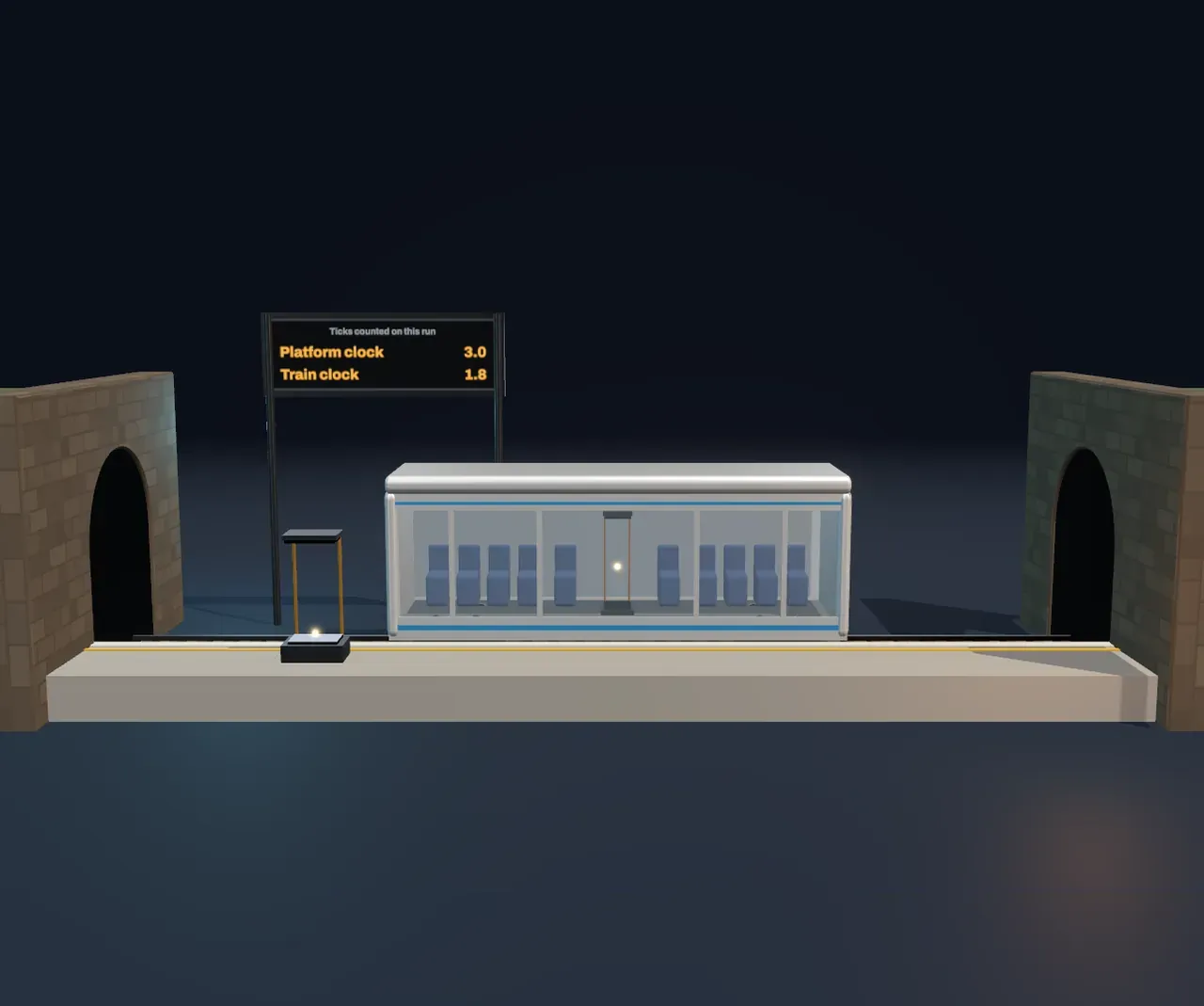
Loading the interactive version…
Loading the interactive version…
Each step sets up the Scene for you, and a control marked “fixed” stays put for that step.
Practice · Calculate
The train runs at 0.6 c. What is the Lorentz factor ?
Practice · Calculate
The train runs at 0.6 c. What is the Lorentz factor ?
Practice · Calculate
The train runs at 0.8 c. While the platform clock counts ticks, how many ticks does the train clock count?
Practice · Calculate
The train runs at 0.8 c. While the platform clock counts ticks, how many ticks does the train clock count?
Practice · Reach the target
Change Train speed so that the carriage, 20 m long at rest, measures 16 m from the platform, and press Check.
Practice · Reach the target
Change Train speed so that the carriage, 20 m long at rest, measures 16 m from the platform, and press Check.
Practice · Choose
A passenger on the train, at 0.8 c, compares her clock with the platform clock. What does she measure?
Practice · Choose
A passenger on the train, at 0.8 c, compares her clock with the platform clock. What does she measure?
Practice · Choose
At rest a muon lives 2.2 µs on average, and in that time it covers only about 660 m. Why do many of the muons made 15 km up reach the ground?
Practice · Choose
At rest a muon lives 2.2 µs on average, and in that time it covers only about 660 m. Why do many of the muons made 15 km up reach the ground?
Lesson complete. Every practice question here is done.