Below its critical temperature a material's resistance vanishes completely, and it keeps magnetic fields out: the Meissner effect, a floating magnet, why cold copper does not do it, and why YBCO and liquid nitrogen changed the picture.
Step 1 of 6 · Colder, and then zero
Step 1 of 6
Colder, and then zero
Every ordinary wire resists a current. The electrons that carry it bump into the shaking atoms and into flaws in the metal, and each bump turns some of their energy into heat. As it cools the atoms shake less and the resistance falls, but the flaws stay.
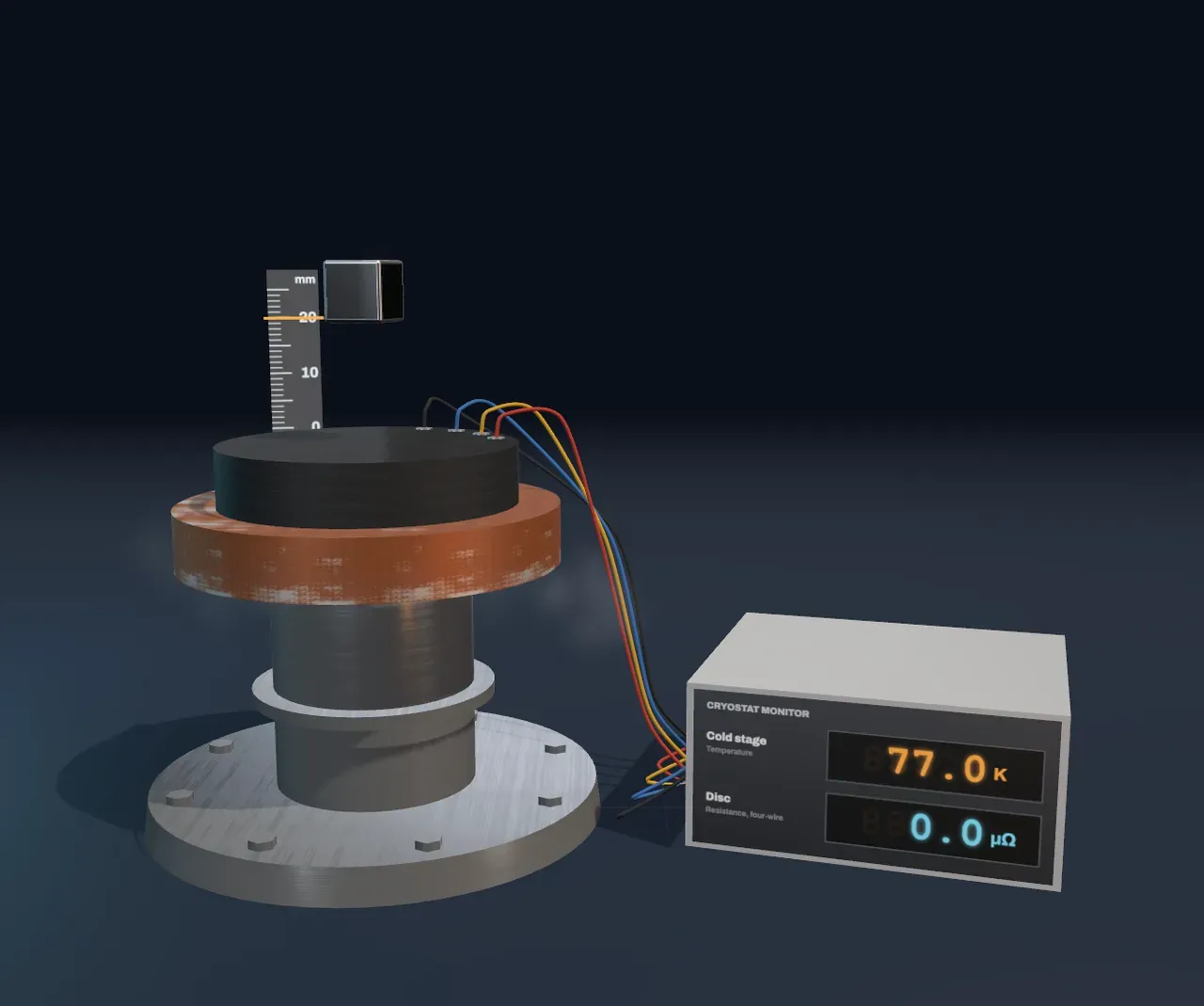
On the cold stage of a cryocooler sits a disc of YBCO, a ceramic of yttrium, barium, copper and oxygen. Above it hangs a small magnet, and a meter on the bench shows the disc’s temperature and resistance. Right now the Temperature is 100 K, too warm, and the magnet rests on the disc. Predict what will happen as we cool it.
Step 2 of 6
The Meissner effect
In Meissner and Ochsenfeld found the second half of the story: a superconductor keeps magnetic fields out. When a magnet comes near, currents start to flow on the superconductor’s surface. They meet no resistance, so they do not die away, and their field cancels the magnet’s inside the material. This is the Meissner effect. The currents repel the magnet, and it rises until the push equals its weight. With Show the field lines On the disc is cut in half, and you can see the lines squeezed around it.
Step 3 of 6
How high it floats
The disc does not keep out all of the field. How much it pushes out depends on the largest current it can carry without losing its superconductivity, and that current grows the colder it is. The clear gauge behind the magnet shows the gap between it and the disc in millimetres.
Step 4 of 6
Near the critical temperature
At 77 K the disc keeps out about three quarters of the field. Predict what will happen one degree below the critical temperature.
Try it: after checking, slide Temperature up to 90 K, nearly critical, and choose Off and On under Show the field lines in turn, to see how many of the lines get into the disc.
Step 5 of 6
Liquid nitrogen
For metals such as mercury and lead the explanation came in : a passing electron tugs the positive atoms slightly towards it, and that faint pull attracts a second electron. The two form a Cooper pair, and below the critical temperature all the pairs fall into one shared state, which a single flaw cannot upset. In ceramics like YBCO the electrons pair up too, but exactly what binds them is still being worked out.
Step 6 of 6
Colder still
Under Show the field lines you see how much of the field gets into the disc. At 77 K a few lines still pass through it.
Loading the interactive version…
Loading the interactive version…
Each step sets up the Scene for you, and a control marked “fixed” stays put for that step.
Practice · Predict, then look
The disc is at 100 K, and the meter shows a small resistance that falls in a straight line as the disc cools. What will happen to the resistance when we cool it to 77 K, the temperature of liquid nitrogen?
Practice · Predict, then look
The disc is at 100 K, and the meter shows a small resistance that falls in a straight line as the disc cools. What will happen to the resistance when we cool it to 77 K, the temperature of liquid nitrogen?
Practice · Choose
The lines in the cut show the magnet’s field kept out of the disc, with glowing currents running round it. If we swap it for a copper disc of the same size, cooled to the same temperature, will the magnet float?
Practice · Choose
The lines in the cut show the magnet’s field kept out of the disc, with glowing currents running round it. If we swap it for a copper disc of the same size, cooled to the same temperature, will the magnet float?
Practice · Reach the target
At 77 K the magnet floats about 20 mm above the disc, by the gauge behind it. Change the Temperature until the gap under the magnet is 15 mm, and press Check.
Practice · Reach the target
At 77 K the magnet floats about 20 mm above the disc, by the gauge behind it. Change the Temperature until the gap under the magnet is 15 mm, and press Check.
Practice · Predict, then look
We warm the disc to 91 K, one degree below the critical temperature. What will the meter show, and what will the magnet do?
Practice · Predict, then look
We warm the disc to 91 K, one degree below the critical temperature. What will the meter show, and what will the magnet do?
Practice · Choose
Kamerlingh Onnes discovered superconductivity in mercury in , at 4.2 K, cooled in liquid helium. Why was the discovery of YBCO in such a big step?
Practice · Choose
Kamerlingh Onnes discovered superconductivity in mercury in , at 4.2 K, cooled in liquid helium. Why was the discovery of YBCO in such a big step?
Practice · Predict, then look
At 77 K the disc is already superconducting, and it keeps out about 75% of the magnet’s field. Predict: what will happen to that share when we cool it to 50 K?
Practice · Predict, then look
At 77 K the disc is already superconducting, and it keeps out about 75% of the magnet’s field. Predict: what will happen to that share when we cool it to 50 K?
Lesson complete. Every practice question here is done.