Colder, and then nothing
Every ordinary wire resists the current through it. The electrons that carry the current keep bumping into the vibrating atoms of the metal and into flaws in it, and each bump turns some of their energy into heat. Cool a copper wire and its atoms vibrate less, so its resistance falls, but it never reaches zero: the flaws are still there.
In 1911 Heike Kamerlingh Onnes cooled mercury in liquid helium and watched its resistance do something else. At about 4.2 K, a little above absolute zero, it did not just get small. It vanished. He called the new state superconductivity, and the temperature where it starts the critical temperature, written .
A current that never stops
Zero resistance is not just very low resistance. Start a current flowing round a closed loop of superconductor and it keeps going with no battery at all, because nothing takes its energy away. Currents like this have been watched for years without any measurable fall.
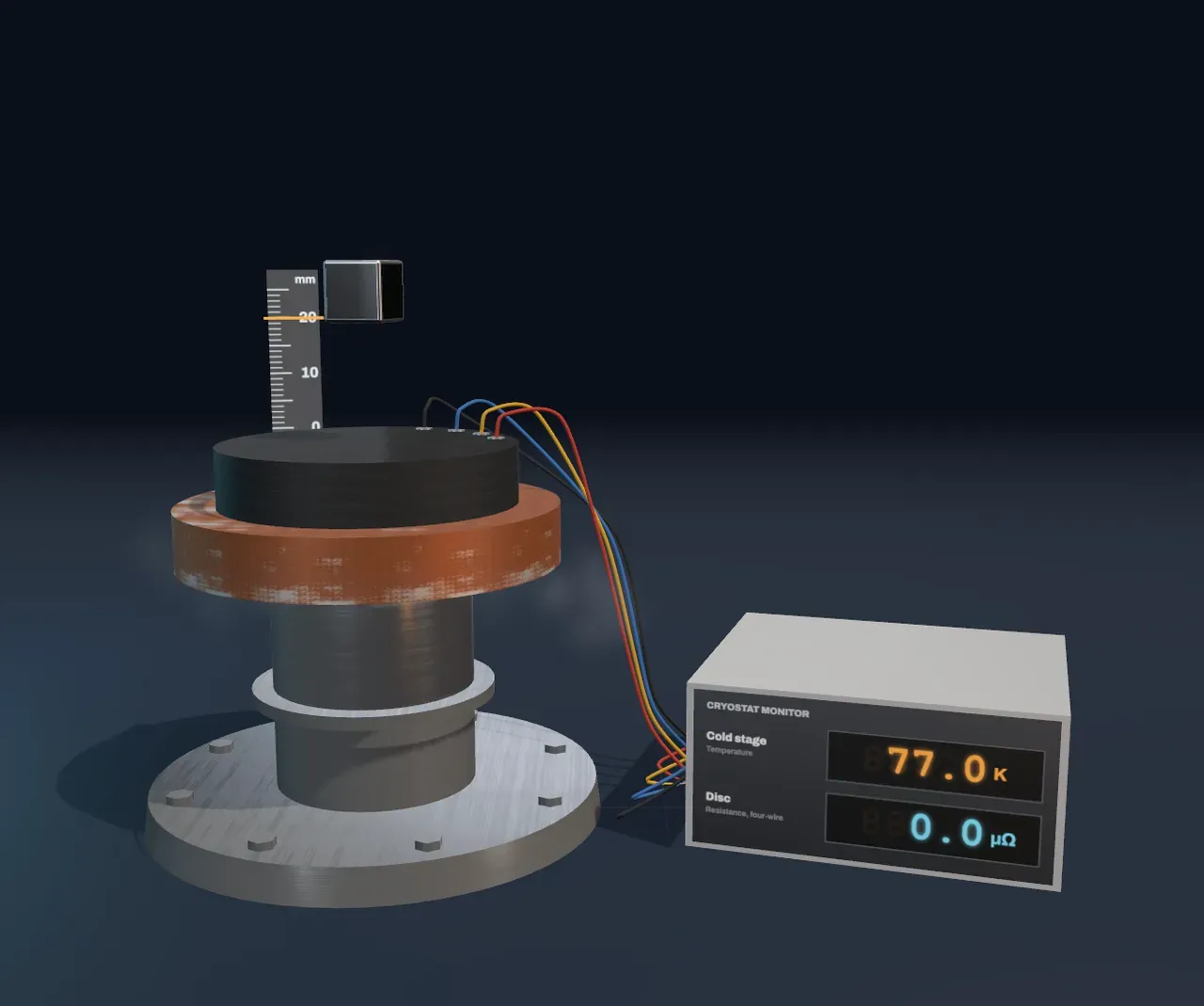
The disc in the scene is YBCO, a ceramic of yttrium, barium, copper and oxygen found in 1987. Its critical temperature is about 92 K, or −181 °C. That is warmer than liquid nitrogen, which boils at 77 K and is cheap and easy to handle, so YBCO made superconductivity something a school lab could try.
Try it: slide Temperature from 100 K down to 77 K, the temperature of liquid nitrogen, and watch the resistance on the meter. Above 92 K it falls steadily as the disc cools. At 92 K it drops straight to zero.
Pushing the field out
In 1933 Walther Meissner and Robert Ochsenfeld found the second half of the story. A superconductor does not only carry current freely: it keeps magnetic fields out. When a magnet comes near, currents start to flow round the surface of the superconductor. Because they meet no resistance they never die away, and they make a field of their own that cancels the magnet’s field inside the material. This is the Meissner effect.
An ordinary conductor cannot do this for long. Moving a magnet near copper does make currents flow, but resistance drains them within a moment, and the field soon passes straight through as if the copper were not there.
Why the magnet floats
The field the surface currents make points against the magnet’s own, like a second magnet hidden under the disc with its pole facing the same way. Like poles repel, so the disc pushes the magnet up. The closer the magnet, the harder the push, so the magnet rises until the push equals its weight and stops there, floating.
Choose On under Show the field lines to see it. Above 92 K the lines run straight through the disc. Below it they are squeezed between the magnet and the disc and bend around its edge, and the glowing currents run round the disc.
Not quite all of the field is kept out. Near the critical temperature the disc can only carry a small current before it stops superconducting, so it keeps out only part of the field, and the magnet floats lower. Colder, it can carry far more, and almost all of the field stays out. Set Temperature to 90 K, read the magnet’s height on the gauge behind it, and switch on Show the field lines to see more of the field get in.
Why the electrons stop bumping
In metals such as mercury, lead and niobium, the explanation came in 1957 from John Bardeen, Leon Cooper and Robert Schrieffer. A passing electron tugs the positive atoms of the metal slightly towards it, and that faint pucker attracts a second electron. The two become a Cooper pair. Below the critical temperature all the pairs fall into one shared, orderly state, and a single flaw cannot knock one pair out of step without disturbing all of them, so the current flows on untouched.
Ceramics like YBCO superconduct at far higher temperatures than that mechanism easily explains. Their electrons pair up too, but exactly what binds them is still being worked out.
Where it is used
Superconducting wire can carry huge currents with no heating, which makes the strongest electromagnets possible. Almost every hospital MRI scanner has a coil of niobium–titanium wire cooled in liquid helium, and its current runs for years. The Large Hadron Collider steers its particle beams with more than a thousand superconducting magnets. Superconducting maglev trains float on the push between magnets, and the most sensitive magnetic sensors, called SQUIDs, are superconducting rings.
What this model leaves out
- Threads of field. YBCO is a type II superconductor: a strong field gets in as thin threads, each carrying a fixed amount of magnetic flux, while the material around them still superconducts. Flaws in the ceramic pin those threads in place, which is why a real magnet over YBCO is locked at its height and even hangs underneath a disc turned upside down. The model draws the field kept out evenly instead.
- The order of cooling. Here only the temperature matters. A real disc cooled with the magnet already resting on it traps that field and hardly lifts the magnet.
- The sharpness of the drop. In a real ceramic the resistance falls to zero over about a kelvin, not at one exact temperature.
- Limits. A strong enough field or a large enough current also destroys superconductivity, even far below the critical temperature.
- The magnet is treated as a point at its centre when the field and its lift are worked out; a cube that close to the disc is pushed a little differently.