A beam that goes round in circles
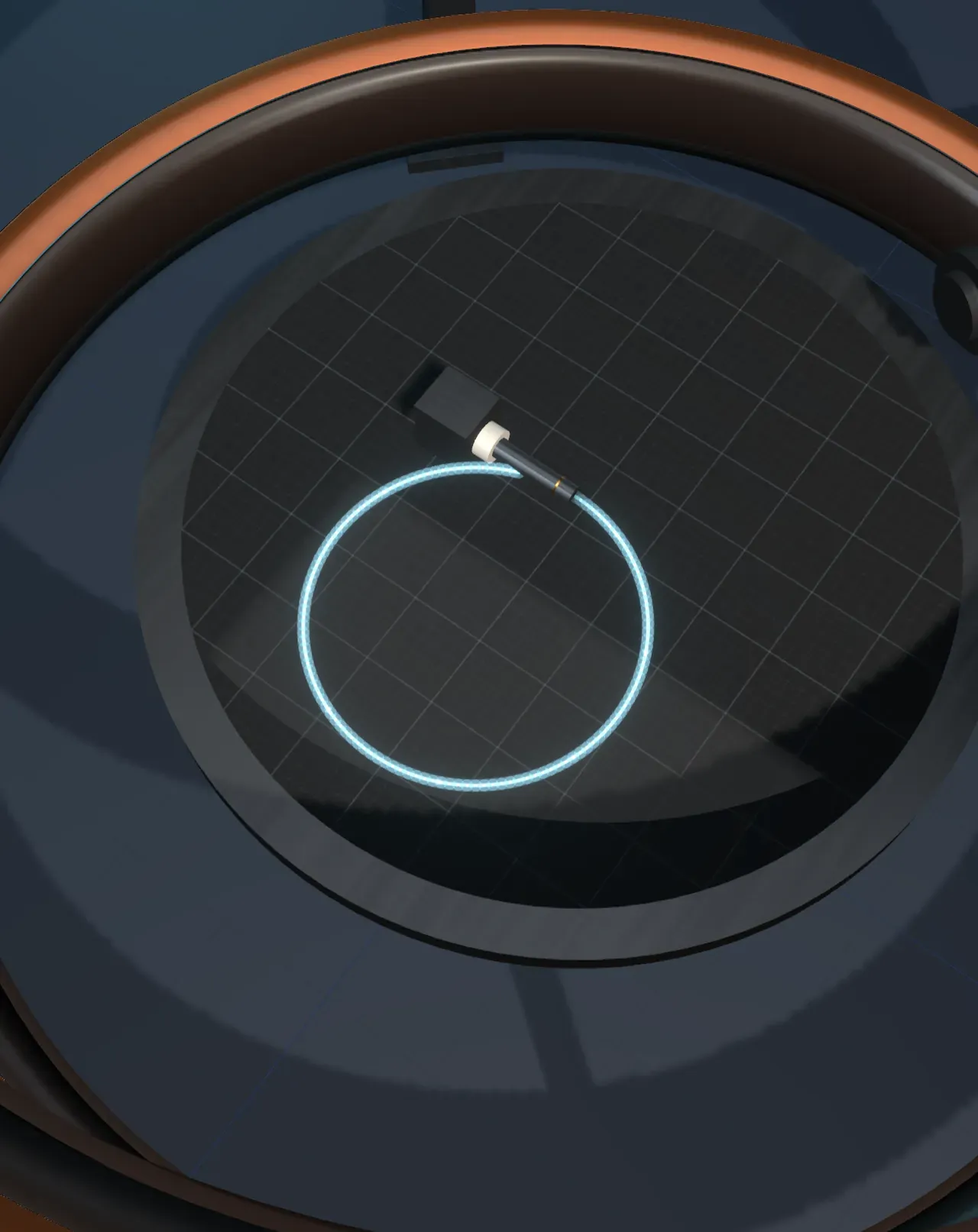
Fire a charged particle into a magnetic field and it does not carry straight on. In the scene a beam of neon ions leaves a small gun at 50 kilometres a second, crossing a field of 0.1 tesla that points straight up through the chamber. The beam bends sideways, keeps bending, and comes all the way round to where it started: a circle 21 cm across.
Nothing else is pushing the ions. The chamber is pumped empty of air, the ions are too light for gravity to matter, and there is no electric field. The magnetic field alone turns them.
The magnetic force
A magnetic field pushes on a charge only while the charge is moving, and only on the part of its motion that crosses the field. The force is
for a charge moving at speed straight across a field . For a neon ion at the start that is about 8 × 10⁻¹⁶ newtons, a tiny force, but the ion’s mass is tiny too.
The direction is the strange part. The force is at right angles both to the field and to the ion’s motion. Point the fingers of your right hand along the motion and curl them towards the field, and your thumb gives the force on a positive charge; on a negative charge it points the opposite way.
Because the force is always sideways, it never pushes the ion forward or holds it back. A magnetic field cannot change a particle’s speed or give it energy. All it can do is change the direction it travels.
Try it: step Build the spectrometer to Force. The green arrow is the ion’s velocity, blue is the field and orange is the force: it always points into the circle, at right angles to the other two.
Why a circle
A force that stays the same size and always acts at right angles to the motion is exactly what it takes to go round a circle at a steady speed, like a stone whirled on a string. The magnetic force supplies the pull towards the centre that circular motion needs, , so
Each part of that formula is something you can try. A faster ion is harder to turn, so its circle is wider: twice the speed, twice the radius. A stronger field turns it harder: twice the field, half the radius. And it depends on the ion only through its charge-to-mass ratio, : the more charge an ion carries for each kilogram of its mass, the tighter it turns.
Try it: choose Proton (H⁺). A proton has about twenty times the charge for its mass that a neon ion has, so at the same speed and field its circle is twenty times smaller, about a centimetre across. Turn Field strength down to 0.02 T and it opens out again.
Choose Chloride ion (Cl⁻) and the ion curves the other way, because its charge is negative. It is also heavier for its charge, so at the start its circle is too wide for the chamber and it hits the glass. A stronger field brings it back inside.
The time for one turn
How long does a turn take? The ion covers the circle’s circumference, , at speed :
The speed has cancelled out. A faster ion swings round a wider circle, but it covers the extra distance in exactly the time it saves by going faster. For a neon ion in 0.1 tesla a turn takes 13 millionths of a second, whatever its speed. That fact is what makes a cyclotron work: it gives particles a kick each half turn, and as they speed up they spiral outwards while keeping time with the kicks.
Try it: watch the ions go round, then drag Speed from 50 down to 25 km/s. The circle shrinks to half its size, but each ion still takes the same time to get back to the gun.
Spirals along the field
Only the part of the motion across the field feels any force. If the ion also moves along the field, that part is untouched, and the ion drifts along the field at a steady speed while it circles. The circle is stretched out into a helix, like a spring.
Try it: step Build the spectrometer to Helix. The gun tips up by 6°, so a tenth of the ion’s speed is along the field. The beam winds upwards, one loop every 7 cm, until it reaches the lid.
This is how charged particles from the Sun travel through Earth’s magnetic field. They spiral along the field lines towards the poles, where some reach the upper air and make it glow in the aurora.
Weighing atoms: the mass spectrometer
The formula can be turned round to weigh an ion: give it a known speed and charge in a known field, measure the radius, and the mass follows. That is a mass spectrometer. Before the ions reach the field they pass through a velocity selector, which only lets through ions at one speed, so every ion in the beam starts out the same. After half a turn each one has come back across the gun’s line, a distance to the side, and that is where a detector plate catches it.
Most elements are a mixture of isotopes: atoms with the same number of protons and electrons, and so the same chemistry, but different numbers of neutrons and so different masses. In a mass spectrometer the heavier isotopes swing wider and land further along the plate. Natural neon lands in three places: neon-20 at 20.7 cm, neon-21 at 21.8 cm and neon-22 at 22.8 cm, in the proportions 90.5%, 0.27% and 9.25%.
Try it: step Build the spectrometer to Mass spectrometer with Neon ion (Ne⁺). Three beams leave the gun together and land a centimetre apart. Try Chloride ion (Cl⁻) with Field strength at 0.2 T: chlorine is three parts chlorine-35 to one part chlorine-37.
This is how isotopes were discovered in an ordinary element. In 1913 J. J. Thomson sent neon ions through magnetic and electric fields and found two separate traces on his photographic plate, at masses 20 and 22. Today mass spectrometers date rocks and ancient bones, check athletes for banned drugs, and sniff out explosives in airport luggage.
What this model leaves out
The scene works the path out from for a perfectly uniform field. Real coils this size keep the field within about 3% across the chamber, weaker near the glass, so a real circle would be very slightly out of round. The ions do not interact with each other, and none are slowed by leftover gas in the chamber; in a real tube, a little gas is what makes a beam glow. The speeds here are all far below the speed of light, so the simple formulas are exact to better than a millionth.
Every ion in a beam is given exactly the same speed, as if the velocity selector were perfect, and each comes from the gun’s centre, so each isotope lands on a single line instead of a narrow band. The trail and the stream of ions are drawn to show the path; a real ion beam is invisible. The scene slows the motion so you can follow it, and slows light ions more than heavy ones, so a proton’s turn, really 35 times quicker than a chloride ion’s, is shown only about four times quicker.