Lesson 4 of 6
Charged particles in a magnetic field.
A charge moving through a magnetic field feels a force at right angles to its motion, so it moves on a circle: the radius mv/qB, a time per turn that does not depend on speed, the charge-to-mass ratio, and a mass spectrometer that sorts isotopes.
Step 1 of 6 · A moving charge
Step 1 of 6
A moving charge
We saw that a wire carrying a current feels a force in a magnetic field, at right angles to the current and to the field. A current is charges on the move, so a single moving charge feels such a force too:
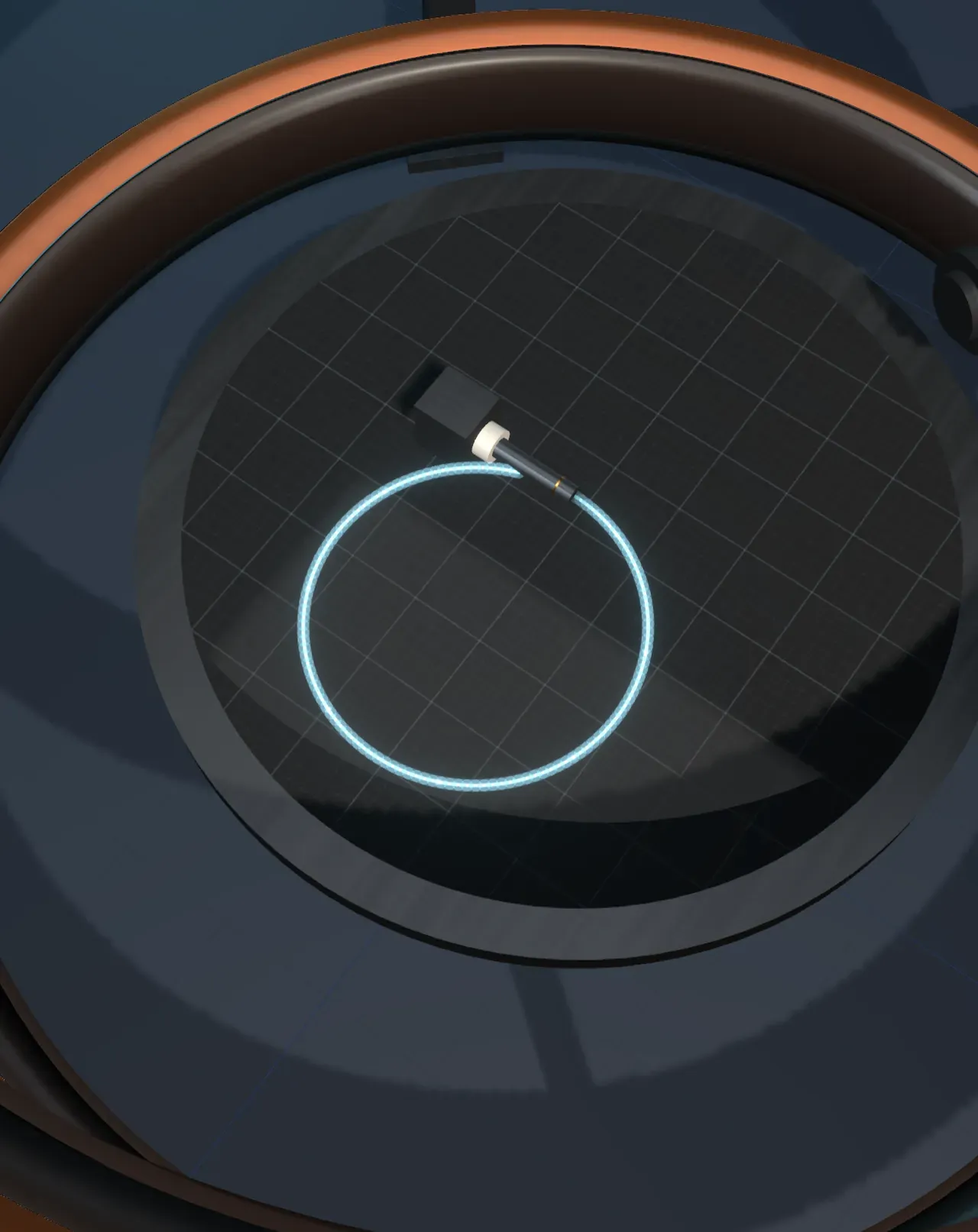
Here is the charge, the speed and the field, with the velocity at right angles to the field. Between the two coils there is a uniform field pointing up, and a gun at the centre of an airless glass chamber fires a Neon ion (Ne⁺) sideways. Its path glows.
Step 2 of 6
The radius
A force that is always at right angles to the motion is exactly what circular motion needs. So the magnetic force is the centripetal force:
Ion and Field strength are fixed. Predict what will happen to the radius when we double the Speed, then look.
Try it: after checking, set Speed back to 50 km/s. The circle shrinks back.
Step 3 of 6
The time for a turn
How long does the ion take to complete a turn? It covers a circumference of at speed . A bigger circle, but a faster ion too. Predict which of the two wins.
Step 4 of 6
A tighter circle
The radius depends on two things you can change here: Speed and Field strength. A stronger field pushes harder, and a slower ion is easier to bend. Only the Ion is fixed. Find a way to halve the radius.
Step 5 of 6
The charge-to-mass ratio
In the radius the mass and the charge appear only as the ratio . So at a given speed and field, the circle reveals a particle’s charge-to-mass ratio, not either one on its own. Here the gun fires a Proton (H⁺), and everything is fixed. Its circle is very tight: a proton is very light for its charge.
The sign of the charge matters too: a negative ion, such as chloride, is pushed the other way and goes round the circle in the opposite direction.
Step 6 of 6
A mass spectrometer
At Helix the gun tips up a little. The speed along the field feels no force, so the circle stretches into a helix. At Mass spectrometer, the last stage of Build the spectrometer, a detector plate stands across from the gun, and the gun fires the element’s natural mix of isotopes. Each ion lands on the plate after half a turn, from the gun. Predict which will land farthest out.
Loading the interactive version…
Loading the interactive version…
Each step sets up the Scene for you, and a control marked “fixed” stays put for that step.
Practice · Choose
The neon ion moves on a circle, and the magnetic field points straight up, between the coils. Which way does the magnetic force on the ion point, and what does it do to its speed?
Practice · Choose
The neon ion moves on a circle, and the magnetic field points straight up, between the coils. Which way does the magnetic force on the ion point, and what does it do to its speed?
Practice · Predict, then look
With Field strength at 0.2 T and Speed at 50 km/s, the neon ion circles with a radius of about 5.2 cm. What will the radius be if the speed doubles to 100 km/s?
Practice · Predict, then look
With Field strength at 0.2 T and Speed at 50 km/s, the neon ion circles with a radius of about 5.2 cm. What will the radius be if the speed doubles to 100 km/s?
Practice · Predict, then look
At 50 km/s the neon ion completes a turn in about 6.5 µs. What will happen to the time for one turn when the speed doubles to 100 km/s?
Practice · Predict, then look
At 50 km/s the neon ion completes a turn in about 6.5 µs. What will happen to the time for one turn when the speed doubles to 100 km/s?
Practice · Reach the target
The neon ion now circles with a radius of about 10.4 cm. Change Speed or Field strength until the radius halves, to about 5.2 cm, and press Check.
Practice · Reach the target
The neon ion now circles with a radius of about 10.4 cm. Change Speed or Field strength until the radius halves, to about 5.2 cm, and press Check.
Practice · Calculate
A proton at 50 km/s in a 0.1 T field circles with a radius of about 5.2 mm. An alpha particle has four times the mass and twice the charge. What will its circle’s radius be, at the same speed in the same field?
Practice · Calculate
A proton at 50 km/s in a 0.1 T field circles with a radius of about 5.2 mm. An alpha particle has four times the mass and twice the charge. What will its circle’s radius be, at the same speed in the same field?
Practice · Predict, then look
Neon has three isotopes: neon-20, neon-21 and neon-22. All have the same charge, and they leave the gun at the same speed. In the spectrometer each ion lands on the plate after half a turn. Which one will land farthest from the gun?
Practice · Predict, then look
Neon has three isotopes: neon-20, neon-21 and neon-22. All have the same charge, and they leave the gun at the same speed. In the spectrometer each ion lands on the plate after half a turn. Which one will land farthest from the gun?
Lesson complete. Every practice question here is done.