Splitting the heaviest atoms
Uranium is the heaviest element found in quantity in nature, and its nuclei are barely holding together. Its 92 protons all push on each other, held in only by the short-range strong force. In 1938 Otto Hahn and Fritz Strassmann found barium, a much lighter element, in uranium they had bombarded with neutrons. Lise Meitner and Otto Frisch worked out what had happened: the nucleus had split in two. They called it fission.
A neutron is the perfect key for this lock. It has no electric charge, so the nucleus does not push it away. When uranium-235 swallows one, it wobbles like a water drop, pinches in the middle and tears into two smaller nuclei, freeing two or three fresh neutrons.
Where the energy comes from
The pieces after a split weigh about a tenth of a percent less than the uranium nucleus and neutron that went in. That missing mass has become energy, in the amount given by Einstein’s E = mc². Because the speed of light squared is enormous, a tiny loss of mass is a great deal of energy: around 200 million electronvolts per split, millions of times more than any chemical reaction between two atoms. Fully splitting a kilogram of uranium-235 releases roughly as much energy as burning three thousand tonnes of coal.
The chain reaction
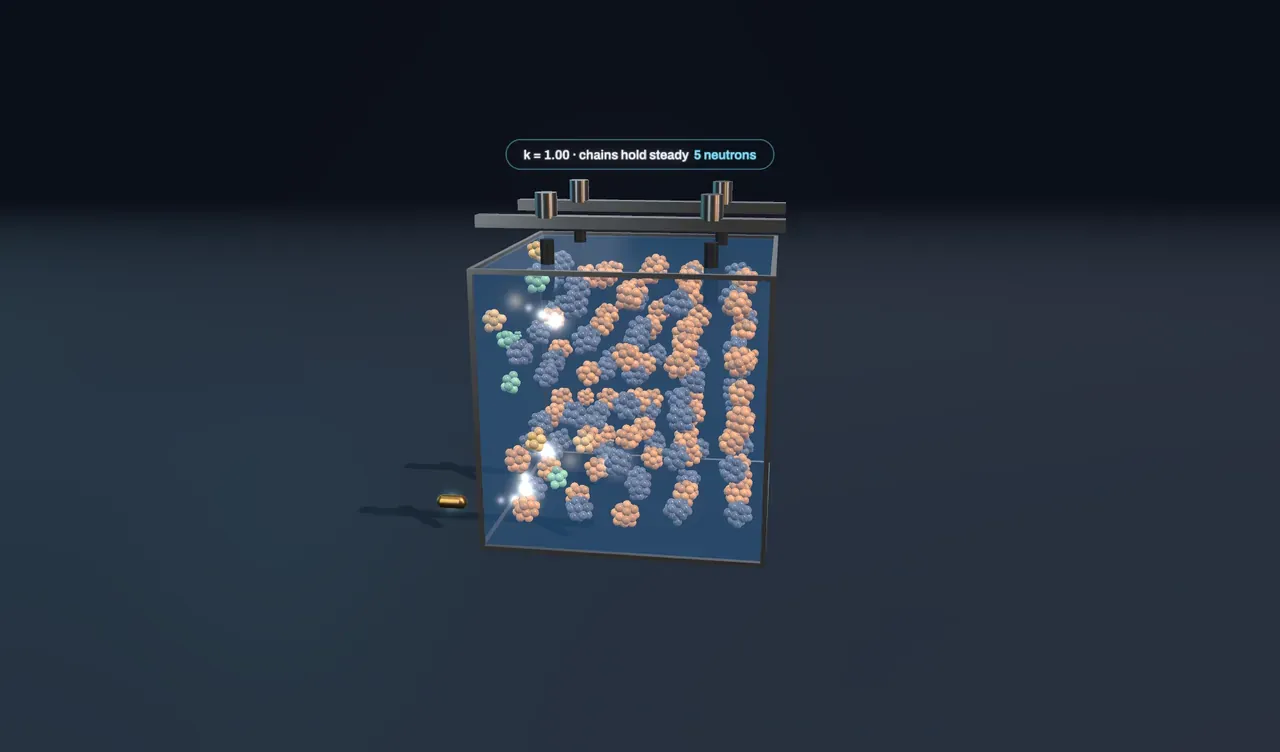
The new neutrons can split more nuclei, and those release more neutrons. What matters is how many of the new neutrons, on average, go on to cause another split. This is the multiplication factor, k. If k is below 1, every chain dies out. If k is exactly 1, each split leads to one more, and the reaction holds steady. If k is above 1, the number of splits grows with every generation, and because a generation can last much less than a millisecond, it grows very fast.
In the scene, a split frees 2.5 neutrons on average, and each must miss the rods and find a fissile nucleus.
Try it: set Fissile fuel to 50% and Control rods to 20% absorbed, so k is exactly 1. Choose On under Count the neutrons. Then pull the rods all the way out, to 0%, and watch the line climb, or push them in to 60% and watch the chains die.
Fuel, moderators and control rods
Natural uranium is only about 0.7% uranium-235; almost all the rest is uranium-238, which usually swallows a neutron without splitting. That is why fuel is enriched, to a few per cent for most power reactors. Fast neutrons are also poor at causing fission, so reactors surround the fuel with a moderator, usually water or graphite, that slows the neutrons down by letting them bounce off light nuclei.
Control rods, made of materials such as boron or cadmium, soak up neutrons. Pushing them in lowers k, pulling them out raises it. A reactor is held at k = 1: a steady chain whose heat boils water for a turbine.
Critical mass
A lump of fuel also leaks neutrons out of its surface. A small lump loses so many that k stays below 1 no matter what. Make the lump bigger and the surface becomes small compared with the bulk, until it just reaches k = 1: the critical mass, tens of kilograms for bare uranium-235. A bomb assembles more than that in an instant, so k is well above 1 and the energy is released before the material blows itself apart.
What this model leaves out
Real neutrons travel in zigzags, slowing as they bounce, and many escape; here those losses are folded into the fuel and rod settings. Split nuclei quietly refill so the fuel never runs out, and a small source sends in a neutron now and then. A real reactor can be controlled at human speed partly because a small fraction of neutrons, well under one in a hundred, arrive seconds late from decaying fragments. The fragments stay radioactive for a long time: that is nuclear waste.