A uranium nucleus that tears in two: why a neutron splits it, where the energy comes from by E = mc², the multiplication factor k, control rods that hold a chain steady, and why a growing chain multiplies itself.
Step 1 of 6 · A nucleus that tears
Step 1 of 6
A nucleus that tears
Uranium is the heaviest element found in quantity in nature, and its nuclei are barely holding together: their 92 protons push on each other, held in only by the short-range strong force. In 1938 Otto Hahn and Fritz Strassmann found barium, a much lighter element, in uranium they had bombarded with neutrons. Lise Meitner and Otto Frisch worked out what had happened: the nucleus had split in two. They called it fission.
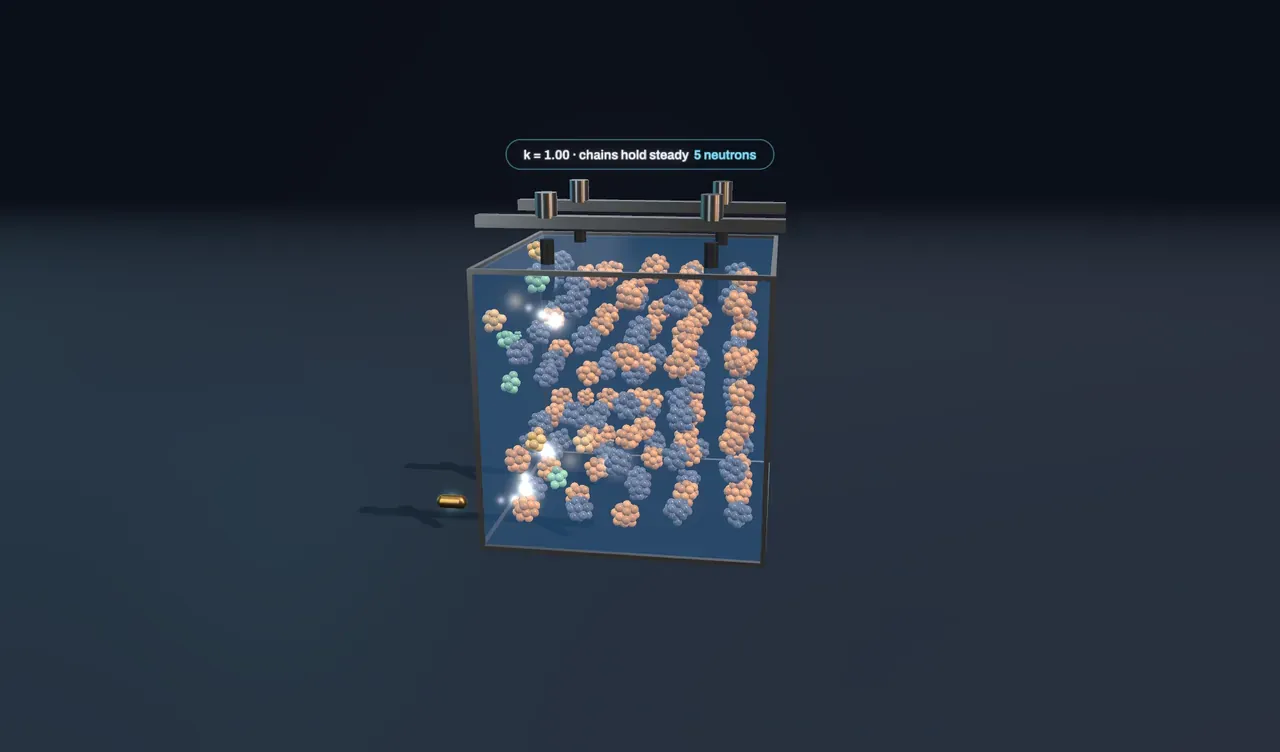
The Scene has a reactor core: the orange nuclei are fissile, like uranium-235, and the grey ones swallow a neutron without splitting, like uranium-238.
Step 2 of 6
Where the energy comes from
The fragments after a split weigh about a tenth of a per cent less than the uranium nucleus and neutron that went in. The missing mass has become energy, by Einstein’s formula:
The speed of light squared is an enormous number, so a little mass is a great deal of energy: about 200 MeV a split, millions of times more than any chemical reaction between two atoms.
Step 3 of 6
The multiplication factor
The new neutrons can split more nuclei, and those release more neutrons. What matters is how many of the new neutrons, on average, cause another split: the multiplication factor . Here each split frees 2.5 neutrons on average, and each must miss the Control rods and meet a fissile nucleus:
If , every chain dies out. If , each split leads to exactly one more, and the reaction holds steady. If , the number of splits grows with every generation. Fissile fuel and Control rods are fixed now.
Step 4 of 6
A steady chain
Natural uranium is only about 0.7% uranium-235, so fuel is enriched, to a few per cent in most reactors. Control rods, of boron or cadmium, soak up neutrons: pushing them in lowers , pulling them out raises it. Count the neutrons is On: the graph shows how many neutrons are in flight, on a log scale. The Fissile fuel is fixed at 90%.
Step 5 of 6
Pulling the rods out
Fissile fuel at 50% and Control rods at 20% absorbed: . After you predict, Count the neutrons will switch On.
Try it: after answering, push Control rods in to 60% absorbed, and watch the chains die out.
Step 6 of 6
Ten generations
A generation in a reactor lasts much less than a thousandth of a second. A real reactor can be controlled at human speed only because a small share of the neutrons, under one in a hundred, arrive seconds late from decaying fragments. Fissile fuel and Control rods are fixed: .
Loading the interactive version…
Loading the interactive version…
Each step sets up the Scene for you, and a control marked “fixed” stays put for that step.
Practice · Choose
Why is it a neutron, not a proton, that splits a uranium-235 nucleus?
Practice · Choose
Why is it a neutron, not a proton, that splits a uranium-235 nucleus?
Practice · Calculate
When one kilogram of uranium-235 is split completely, the fragments together weigh about 0.9 g less. How much energy is released? The speed of light is 3 × 10⁸ m/s.
Practice · Calculate
When one kilogram of uranium-235 is split completely, the fragments together weigh about 0.9 g less. How much energy is released? The speed of light is 3 × 10⁸ m/s.
Practice · Calculate
Each split frees 2.5 neutrons on average. The Fissile fuel is at 90%, and the Control rods absorb 20% of the neutrons. What is the multiplication factor ?
Practice · Calculate
Each split frees 2.5 neutrons on average. The Fissile fuel is at 90%, and the Control rods absorb 20% of the neutrons. What is the multiplication factor ?
Practice · Reach the target
The Fissile fuel is fixed at 90%. Push the Control rods in until the chain holds steady: .
Practice · Reach the target
The Fissile fuel is fixed at 90%. Push the Control rods in until the chain holds steady: .
Practice · Predict, then look
The Fissile fuel is at 50% and the Control rods at 20% absorbed, so : the number of neutrons holds steady. The rods are now pulled all the way out, to 0%. Predict what will happen.
Practice · Predict, then look
The Fissile fuel is at 50% and the Control rods at 20% absorbed, so : the number of neutrons holds steady. The rods are now pulled all the way out, to 0%. Predict what will happen.
Practice · Calculate
The Control rods absorb 12% of the neutrons, and . For every neutron now, how many will there be ten generations on?
Practice · Calculate
The Control rods absorb 12% of the neutrons, and . For every neutron now, how many will there be ten generations on?
Lesson complete. Every practice question here is done.