Light nuclei that join into heavier ones: the repulsion to overcome, heat that is speed, a rate that soars with temperature and with the square of the fuel density, the neutron that escapes the plasma, and why the Sun gets away with less.
Step 1 of 7 · Repulsion
Step 1 of 7
Repulsion
Deep inside the Sun, hydrogen nuclei join to make helium, and a little of their mass becomes the energy that reaches us as sunlight. Fusion is the opposite of fission: instead of splitting heavy nuclei, it joins light ones.
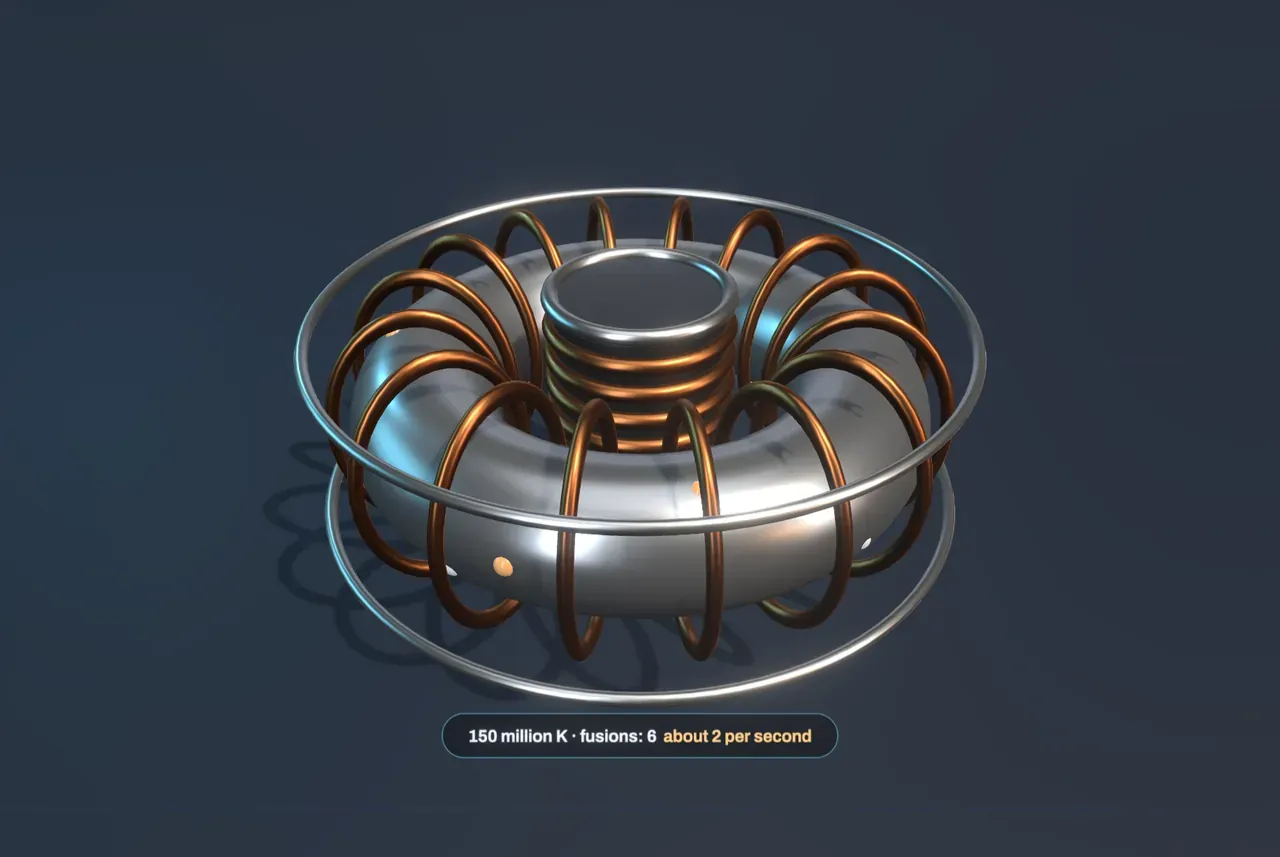
The Scene has a plasma of deuterium and tritium, two heavy forms of hydrogen, inside a tokamak: a ring-shaped chamber wrapped in magnetic coils. The Temperature is at Sun’s core.
Step 2 of 7
Heat is speed
The only practical way to drive nuclei at each other is to heat them. At millions of degrees atoms lose their electrons and become a plasma, a gas of bare nuclei and free electrons. The hotter it is, the faster the nuclei move and the closer they come before the repulsion turns them away. The Fuel density is fixed now.
Step 3 of 7
A thousandfold
Even at 100 million kelvin a typical nucleus has only a few per cent of the energy needed to climb the wall of repulsion. Fusion happens for two reasons: a few nuclei in any plasma move much faster than average, and at this tiny scale particles behave partly like waves, so there is a small chance a nucleus tunnels through the wall rather than going over it. Cut into the plasma is at Plasma: each flash is a fusion.
Step 4 of 7
Fuel density
Each deuterium–tritium fusion makes helium-4 and a fast neutron. The Temperature is fixed at Tokamak now.
Step 5 of 7
The neutron that escapes
Nothing solid can touch a plasma that hot, so a tokamak holds it in a magnetic field. Charged particles can’t easily cross it, and the plasma loops round the ring without reaching the walls. The helium nuclei, which are charged, stay in the plasma and help keep it hot. The neutron has no charge, and the field can’t hold it.
Step 6 of 7
Why the Sun gets away with less
On Earth fusion machines aim for 100–150 million kelvin, about ten times the centre of the Sun. No power station runs on fusion yet: the hard part is keeping a plasma hot, dense and confined long enough to give out more energy than it takes.
Step 7 of 7
How many fusions a second
Back to the tokamak, to count. The number of fusions depends on how many nuclei there are, and how fast each pair of them fuses at this temperature.
Loading the interactive version…
Loading the interactive version…
Each step sets up the Scene for you, and a control marked “fixed” stays put for that step.
Practice · Choose
Why is it so hard to make two heavy-hydrogen nuclei fuse?
Practice · Choose
Why is it so hard to make two heavy-hydrogen nuclei fuse?
Practice · Predict, then look
The Temperature is at Sun’s core, 15 million kelvin, and almost nothing fuses. It is raised tenfold, to Tokamak, 150 million kelvin. Predict: how many times faster will each pair of nuclei fuse?
Practice · Predict, then look
The Temperature is at Sun’s core, 15 million kelvin, and almost nothing fuses. It is raised tenfold, to Tokamak, 150 million kelvin. Predict: how many times faster will each pair of nuclei fuse?
Practice · Reach the target
Find the Temperature at which each pair of nuclei fuses 1000 times faster than in the Sun’s core.
Practice · Reach the target
Find the Temperature at which each pair of nuclei fuses 1000 times faster than in the Sun’s core.
Practice · Predict, then look
The Fuel density is doubled from 80 to 160 nuclei, at the same temperature. Predict: what will happen to the fusion rate in the whole plasma?
Practice · Predict, then look
The Fuel density is doubled from 80 to 160 nuclei, at the same temperature. Predict: what will happen to the fusion rate in the whole plasma?
Practice · Calculate
Each deuterium–tritium fusion frees 17.6 MeV: a helium nucleus and a fast neutron, which carries 14.1 MeV of it. What share of the energy leaves with the neutron? Write it as a decimal.
Practice · Calculate
Each deuterium–tritium fusion frees 17.6 MeV: a helium nucleus and a fast neutron, which carries 14.1 MeV of it. What share of the energy leaves with the neutron? Write it as a decimal.
Practice · Choose
The Sun’s core is only at 15 million kelvin, yet it fuses about 600 million tonnes of hydrogen a second. How?
Practice · Choose
The Sun’s core is only at 15 million kelvin, yet it fuses about 600 million tonnes of hydrogen a second. How?
Practice · Calculate
The Temperature is locked at Tokamak, 150 million kelvin. Each cubic metre of the plasma holds 5 × 10¹⁹ deuterium nuclei and as many tritium nuclei. Each pair meets and fuses at a rate cubic metres a second, and the number of fusions in each cubic metre per second is . How many fusions happen in each cubic metre every second?
Lesson complete. Every practice question here is done.