Squeezing nuclei together
Deep inside the Sun, hydrogen nuclei join to make helium, and a little of their mass becomes the energy that reaches us as sunlight. Fusion is the opposite of fission: instead of splitting heavy nuclei, it joins light ones.
The trouble is getting them to touch. Every nucleus carries positive charge, and like charges repel. The closer two nuclei come, the harder they push apart. Only when they are about the width of a nucleus apart does the strong force take over and pull them together, and that is a very small target behind a very steep wall.
Heat is speed
The only practical way to drive nuclei at each other is to make them hot. Temperature is the speed of jiggling particles: at millions of degrees, atoms lose their electrons and become a plasma, a gas of bare nuclei and free electrons, all racing about. The hotter it is, the faster they go and the closer they can come before their charges turn them away.
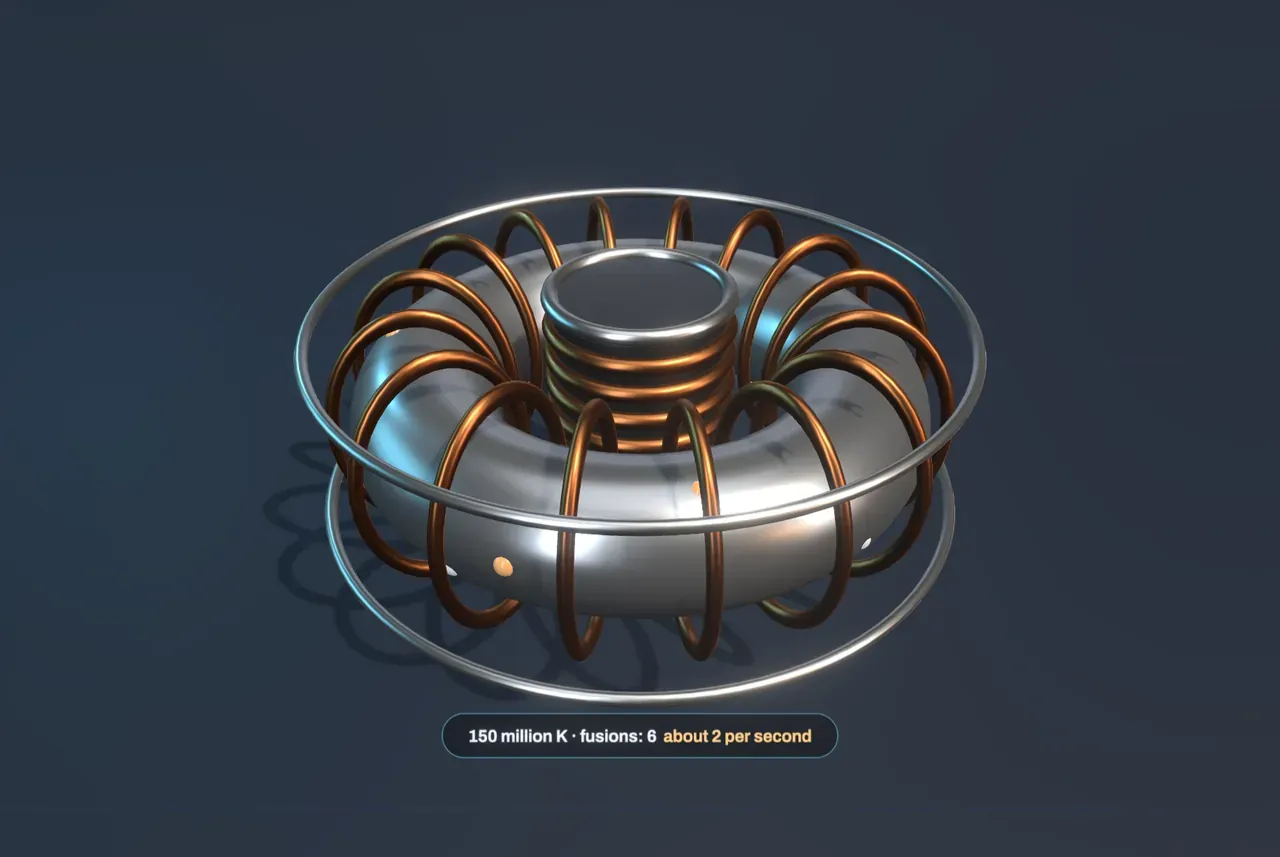
Try it: drag Temperature down to Sun’s core and watch the nuclei veer away from each other with almost nothing fusing. Then choose Tokamak and choose Plasma under Cut into the plasma to see the flashes.
Tunnelling through the wall
Even at 100 million kelvin, a typical nucleus has only a few per cent of the energy needed to climb the electric wall. Fusion still happens for two reasons. A few nuclei in any plasma move much faster than average. And at this tiny scale particles behave partly like waves, so there is a small chance that a nucleus tunnels through the wall rather than going over it. Both effects grow steeply with temperature. In the scene, cooling the plasma from 150 to 15 million kelvin makes fusion nearly seven thousand times rarer.
Why the Sun gets away with less
The Sun’s core is only about 15 million kelvin, yet it fuses around 600 million tonnes of hydrogen every second. It wins by size and by gravity: its own weight squeezes the core to more than a hundred times the density of water, holds it there for billions of years, and gives it an almost unimaginable number of nuclei. Each one waits on average billions of years to fuse, but there are so many that the total is huge.
On Earth we have no such gravity, a plasma far thinner than air and only seconds to work with, so we make up for it with heat. Fusion machines aim for 100 to 150 million kelvin, around ten times hotter than the centre of the Sun. They also use the easiest fuel: deuterium and tritium, two heavy forms of hydrogen. They fuse into helium-4 and a fast neutron, releasing 17.6 million electronvolts each time; the neutron carries 14.1 of them.
Holding a star in a bottle
Nothing solid can touch a plasma that hot, so a tokamak holds it with magnetism. Coils wrapped around a doughnut-shaped chamber make a magnetic field that charged particles cannot easily cross, so the plasma loops around the ring without reaching the walls. The helium nuclei, which are charged, stay in the plasma and help keep it hot. The neutron has no charge, so the field cannot hold it; it flies straight into the walls, where its energy can be collected as heat. Doubling the Fuel density raises the fusion rate four times: each deuterium nucleus has twice as many tritium partners.
What this model leaves out
The scene’s fusion rate rises with temperature by the measured deuterium–tritium rate, but it is slowed and scaled to be watchable, and the nuclei are enormous compared with the gaps between them. A real plasma loses heat constantly, and keeping it hot, dense and confined long enough to produce more energy than it takes is the central challenge; no power station runs on fusion yet. The Sun mostly fuses ordinary hydrogen through a slower chain of steps, not deuterium with tritium.