Lesson 3 of 4
Radiometric dating and the age of the Earth.
A zircon crystal that sets its own clock to zero: the ratio of lead to uranium after a half-life, reading the age from the ratio, a clock that is spent and a clock that doesn't fit, lead that leaks and clocks that stop agreeing, and how we know the age of the Earth.
Step 1 of 7 · The clock starts at zero
Step 1 of 7
The clock starts at zero
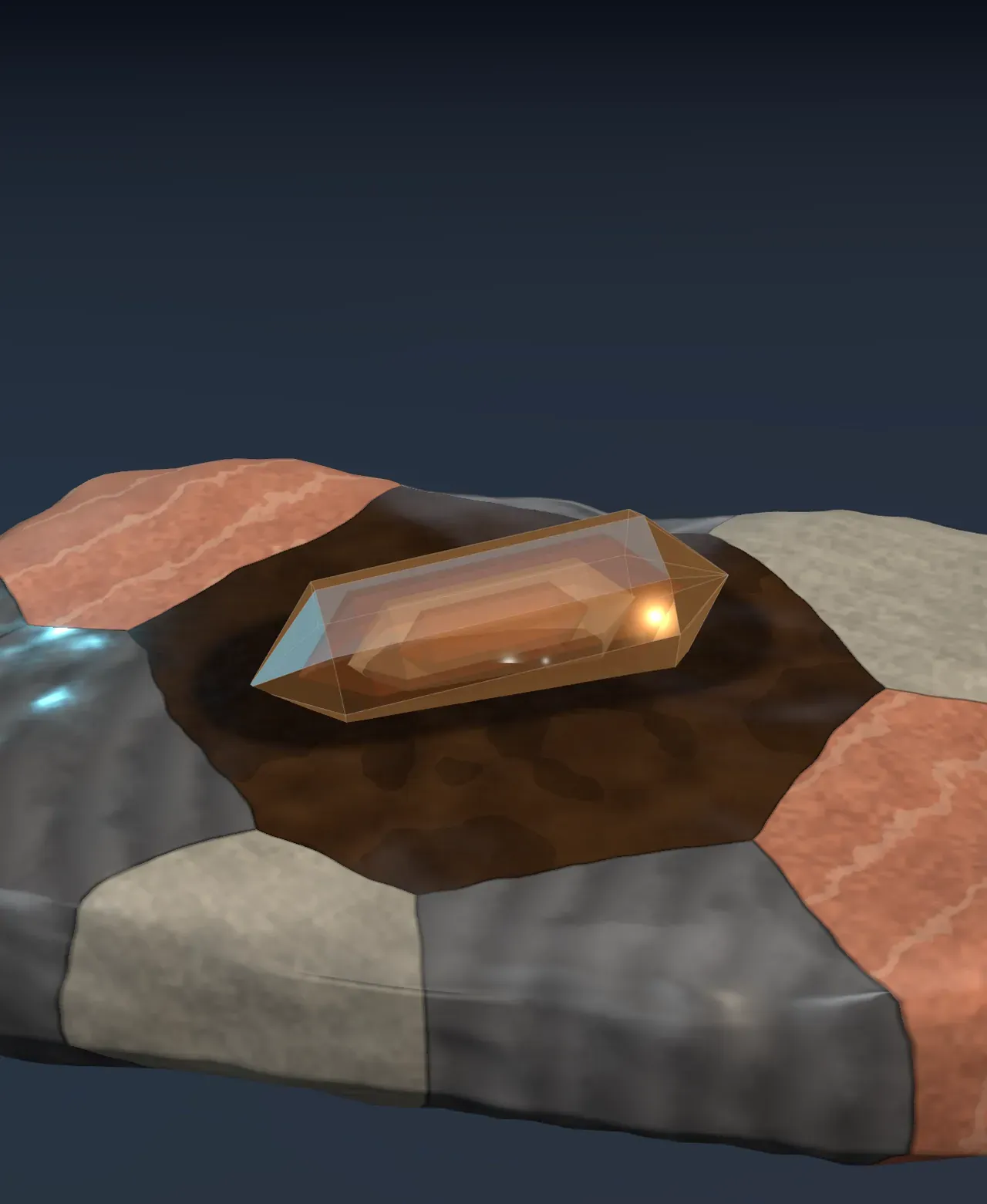
Zircon is a mineral of zirconium, silicon and oxygen that grows as tiny, hard crystals in cooling magma, especially in granite. The Scene has one such crystal, and Zoom to the atoms is at Atoms inside: the glowing atoms are uranium, and the grey ones lead. Time since the crystal formed is at Just formed.
Step 2 of 7
A half-life
From then on the uranium decays and lead appears. Uranium-238 passes through a chain of fourteen decays, by way of thorium, radium and radon, to stable lead-206. Every step after the first is fast by comparison, so the pace is set by uranium-238 itself, with a half-life of 4.47 billion years: after that time half of any starting amount is left.
Each uranium atom that decays becomes one lead atom, so the crystal keeps a record of both what is left and what has gone. You don’t need to know how much uranium there was at the start: count the lead atoms for each uranium atom still there. The Clock is fixed at Uranium-238.
Step 3 of 7
Reading the age
After half-lives of the uranium is left, and each atom left has lead atoms with it. Turn that round and you get the age from the ratio , the daughter (lead) atoms for each parent (uranium) atom:
In a laboratory the rock is crushed, the zircons sorted out, and an instrument called a mass spectrometer counts the uranium and lead isotopes. Here the Clock is on Uranium-235, which decays to lead-207, and the age is hidden.
Step 4 of 7
A spent clock
The same crystal carries two more clocks: Uranium-235 decays to lead-207 with a half-life of 0.704 billion years, and Thorium-232 to lead-208 with a half-life of 14 billion years. Each makes its own isotope of lead, so all three can be read at once. The crystal here is 4.4 billion years old, the Oldest crystal, and the chart beside the Scene shows the age each clock reads.
Step 5 of 7
Which clock
A clock reads best when its half-life is not far from the age being measured. Too few half-lives, and hardly any lead has formed; too many, and hardly any uranium is left. Either way a small error in the measurement becomes a large error in the age.
Step 6 of 7
Lead that leaks
A clock is only as good as its seal. Hot fluids, a later heating or damage to the crystal can let some of the lead out, and then the crystal looks younger than it is. The two uranium clocks in one crystal tick at rates six times apart, so they cannot agree by accident.
Step 7 of 7
The age of the Earth
The oldest crystals found, from the Jack Hills of Western Australia, are about 4.4 billion years old. The oldest whole rock, in northern Canada, is about 4.0 billion years old. Time since the crystal formed is at Age of the Earth, 4.54 billion years, but no crystal on Earth is that old.
Loading the interactive version…
Loading the interactive version…
Each step sets up the Scene for you, and a control marked “fixed” stays put for that step.
Practice · Choose
Why does a zircon crystal that has just formed hold uranium but almost no lead?
Practice · Choose
Why does a zircon crystal that has just formed hold uranium but almost no lead?
Practice · Predict, then look
The Clock is on Uranium-238, whose half-life is 4.47 billion years. Time since the crystal formed is moved to 4.47 billion years. Predict: how many lead atoms will the crystal hold for each uranium atom left?
Practice · Predict, then look
The Clock is on Uranium-238, whose half-life is 4.47 billion years. Time since the crystal formed is moved to 4.47 billion years. Predict: how many lead atoms will the crystal hold for each uranium atom left?
Practice · Calculate
A zircon crystal holds about 7 lead-207 atoms for each Uranium-235 atom left. Uranium-235’s half-life is 0.704 billion years. How old is the crystal, in billions of years?
Practice · Calculate
A zircon crystal holds about 7 lead-207 atoms for each Uranium-235 atom left. Uranium-235’s half-life is 0.704 billion years. How old is the crystal, in billions of years?
Practice · Predict, then look
The crystal is 4.4 billion years old, and the Clock is on Uranium-238: about half the atoms are still uranium. It is switched to Uranium-235, with a half-life of 0.704 billion years. Predict: what share of the uranium-235 is left?
Practice · Predict, then look
The crystal is 4.4 billion years old, and the Clock is on Uranium-238: about half the atoms are still uranium. It is switched to Uranium-235, with a half-life of 0.704 billion years. Predict: what share of the uranium-235 is left?
Practice · Choose
Which clock can not date a 4.4-billion-year-old rock?
Practice · Choose
Which clock can not date a 4.4-billion-year-old rock?
Practice · Predict, then look
The crystal is 4.4 billion years old, and its clocks all agree. Lead lost later is raised to 30%: about a third of the lead escapes. Predict: what will the clocks read?
Practice · Predict, then look
The crystal is 4.4 billion years old, and its clocks all agree. Lead lost later is raised to 30%: about a third of the lead escapes. Predict: what will the clocks read?
Practice · Choose
The oldest crystals found on Earth are about 4.4 billion years old. How do we know the Earth itself is 4.54 billion years old?
Practice · Choose
The oldest crystals found on Earth are about 4.4 billion years old. How do we know the Earth itself is 4.54 billion years old?
Lesson complete. Every practice question here is done.