A crystal that sets its own clock
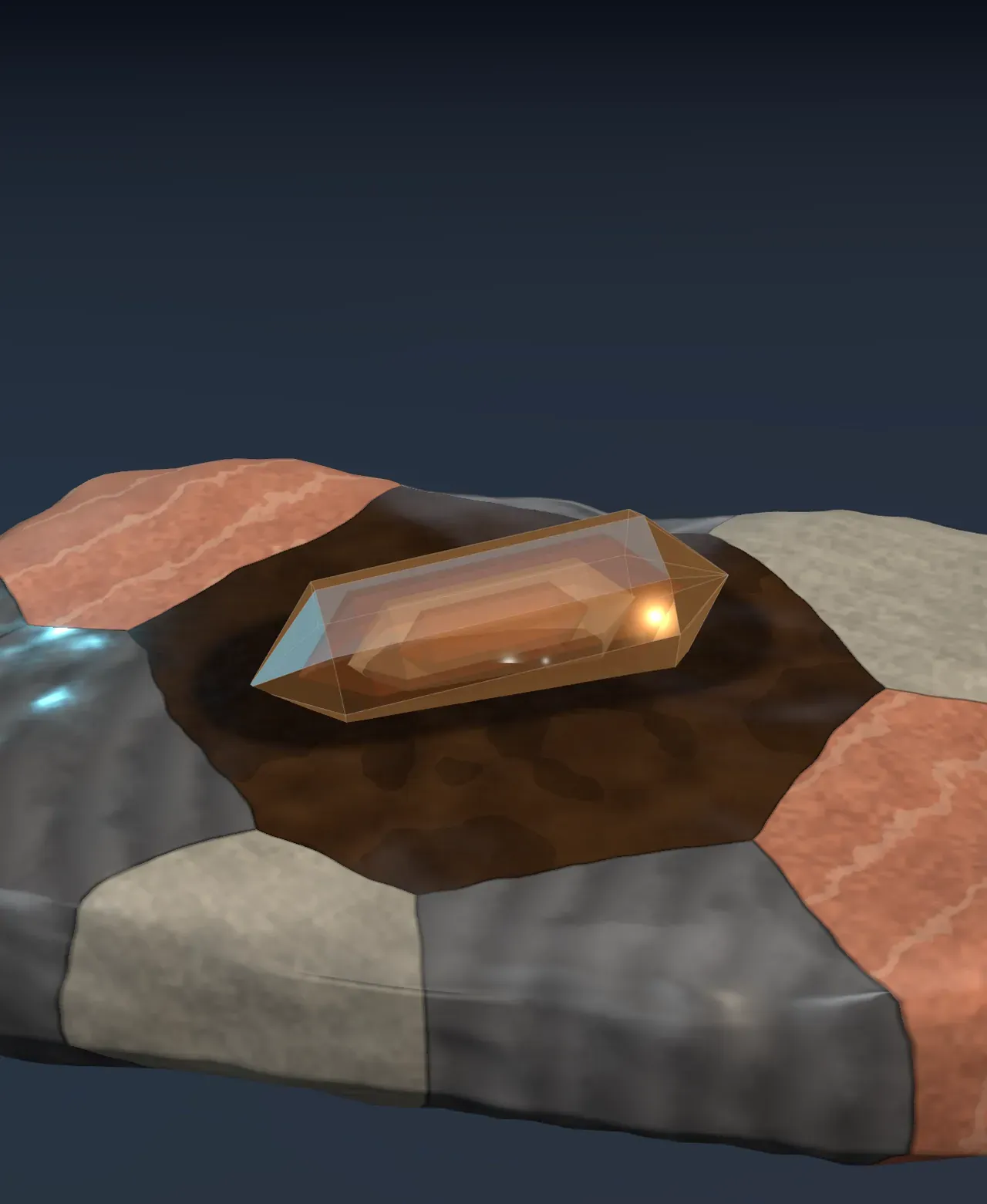
Zircon is a mineral of zirconium, silicon and oxygen (ZrSiO₄) that grows as tiny, hard, glassy crystals in cooling magma, especially in granite. A typical one is a fraction of a millimetre long, a square prism with a pyramid at each end, like the one in the Scene sitting in a flake of mica.
As it grows, zircon is picky about what it lets in. Uranium and thorium atoms fit into the places in its lattice that zirconium normally fills, so a zircon picks up a few hundred parts per million of uranium. Lead does not fit: its ions are the wrong size and carry the wrong charge, and the growing crystal shuts them out. A newly formed zircon therefore holds uranium and almost no lead. Its clock reads zero.
From then on, uranium decays and lead appears. The lead cannot have come from anywhere else, so every lead atom inside the crystal is a tick of the clock, made where it sits. How unstable nuclei decay, at random one by one and on a steady schedule by the trillion, is the subject of Radioactive decay; why uranium-238 and lead-206 are particular forms of their elements is in Isotopes. This Article is about reading that schedule back out of a rock.
Reading the ratio
Uranium-238 does not turn into lead in one jump. It passes through a chain of fourteen decays, eight of them alpha and six beta, by way of thorium, radium and radon, to lead-206, which is stable. Every step after the first is fast by comparison, so the pace is set by uranium-238 itself, with a half-life of 4.47 billion years.
Each uranium atom that decays becomes one lead atom, so the crystal keeps a record of both what is left and what has gone. You do not need to know how much uranium it started with. Count the lead for each uranium atom still there: after one half-life there is one lead atom for every uranium atom, after two there are three, after three there are seven. The rule is
where is the number of daughter (lead) atoms for each parent (uranium) atom.
Try it: with Clock on Uranium-238, choose Atoms inside under Zoom to the atoms, then drag Time since the crystal formed. Glowing uranium turns to grey lead. Press Oldest crystal: about half the atoms are lead, the ratio is 0.98, and the chart reads it back as 4.40 billion years.
In a laboratory the rock is crushed, the zircons are sorted from the rest by their weight and magnetism, set in resin and polished, and a mass spectrometer counts the uranium and lead isotopes, often in a spot a few hundredths of a millimetre across, struck by a beam of ions. The best measurements reach a tenth of a per cent or better, which pins an age of 4.4 billion years down to a few million years. Zircons grow in layers, like the faint bands in the Scene’s crystal, so one grain can have an old core and a younger rim grown in a later melting, each dated on its own.
Three clocks in one crystal
The same zircon carries two more clocks. Uranium-235, a lighter isotope of uranium, decays to lead-207 with a half-life of 704 million years; thorium-232 decays to lead-208 with a half-life of 14 billion years. Each makes its own isotope of lead, so a mass spectrometer can read all three at once.
A clock reads best when its half-life is not far from the age being measured. Over 4.4 billion years uranium-235 has been through more than six half-lives, and only about 1% of it is left; thorium-232 has managed less than a third of one. Carbon-14, with its half-life of 5,730 years, would be useless: after about 50,000 years too little is left to measure, so it dates bones and wood, never rocks. For volcanic rocks a fourth clock, potassium-40 decaying to argon-40 with a half-life of 1.25 billion years, is widely used.
Try it: keep Oldest crystal and switch Clock to Uranium-235: almost every atom is grey, and the Callout warns the clock is nearly spent. Switch to Thorium-232: most atoms still glow. The ratios differ enormously, but the three bars in the chart reach the same age.
That agreement is the point. Two uranium clocks ticking in the same crystal at rates six times apart cannot agree by accident. Geologists plot one ratio against the other, and a crystal that has kept all its lead lies on the curve where the two ages are the same, called concordia.
When lead escapes
A clock is only as good as its seal. Hot fluids, a later heating or damage to the crystal can let some of the lead out, and then the crystal looks younger than it is. Uranium-rich zircons are especially prone: the alpha particles and recoiling nuclei of billions of years of decay wreck their lattice, turning them brown and cloudy (the Scene’s crystal darkens with age), and the same alpha particles burn dark halos into the mica around them, as the Scene shows when the crystal is lifted out.
Lead loss does not shift every clock by the same amount. Uranium-235 has made seventy-five lead atoms for each one left, uranium-238 about one, so losing a third of the lead takes a large bite out of the uranium-238 age and a small one out of the uranium-235 age. The clocks disagree, and the disagreement gives the disturbance away.
Try it: with Oldest crystal, slide Lead lost later to 30 %. Lead atoms drift out through cracks, and the chart’s bars split: the uranium-238 clock reads 3.36 billion years, the uranium-235 clock 4.04. Neither is right, and the gap says so.
Ages are trusted when the clocks agree. A set of crystals from one rock that lost different amounts of lead falls on a straight line across the concordia plot, and where that line meets the curve gives back the age they formed.
How old is the Earth?
Arthur Holmes used uranium in 1913 to argue that some rocks are over a billion years old, at a time when many physicists still followed Lord Kelvin’s estimate, from how fast the Earth should have cooled, of a few tens of millions of years. Kelvin did not know that radioactive decay keeps heating the Earth from inside.
The oldest pieces of the Earth that survive are zircons: grains from the Jack Hills of Western Australia, about 4.4 billion years old, washed out of rocks that have since vanished and laid down in a much younger sedimentary rock. The oldest whole rock known, the Acasta Gneiss in northern Canada, is about 4.0 billion years old. Nothing older survives because the Earth’s surface is endlessly recycled, melted, worn down and rebuilt by plate tectonics and erosion, a story for the Article on rocks and the rock cycle.
The age of the Earth itself comes from meteorites, pieces of asteroids that formed with the planets from the same cloud and have hardly changed since. In 1956 Clair Patterson measured the lead in several meteorites and in sediment from the ocean floor and found that they fit a single age: about 4.55 billion years. (Working in an ultra-clean laboratory to keep stray lead out of his samples, he found lead everywhere, and went on to lead the fight against lead in petrol.) The oldest grains in meteorites are now dated at 4.567 billion years, and the Earth formed within a few tens of millions of years of them. Its age is given as 4.54 billion years, give or take about 50 million. The same clocks, read in layers of volcanic ash above and below fossils, put dates on the history of life, the subject of the fossil record.
What this model leaves out
The Scene draws a few hundred atoms of one clock; a real crystal this size holds trillions of uranium atoms, about one in 140 of them uranium-235, along with thorium, all ticking at once. The crystal’s own zirconium, silicon and oxygen atoms, many billions for every uranium atom, are left out, and every atom is drawn hugely enlarged. The flashes show what a decay looks like, not how often one happens. The many short-lived steps of each decay chain are not shown, since at any moment very few atoms are partway along.
Lead loss is modelled as a single event that happened recently. Real lead can leak at any time, and geologists work out when from the line the crystals fall on. Real zircons also start with a trace of lead, which is subtracted using lead-204, an isotope that no decay makes. The growth bands, the rate at which the crystal darkens and the strength of the mica’s halo are illustrative, and the granite’s grains are drawn smaller and simpler than real ones, which are often several millimetres across.