A clock that ticks at random
Some atoms are unstable. Their nucleus, the tiny core made of protons and neutrons, holds more energy than it can keep, and sooner or later it throws some out. That moment is radioactive decay.
Nothing triggers it, and an unstable nucleus does not age: one that has survived a thousand years is no more likely to decay in the next second than one made a moment ago. Heating it, squeezing it or locking it into a chemical compound makes no practical difference. Each nucleus simply has a fixed chance of decaying in any given second, the way a fair die has a fixed chance of rolling a six.
Half of what is left
Roll one die and you cannot say when the six will come. Roll a million and you can say with confidence that about a sixth of them show a six. Decay works the same way. With enough nuclei, a fixed fraction decays in every stretch of time, and so the sample shrinks by the same fraction again and again.
The time it takes for half of the sample to decay is the half-life. After one half-life, half is left. After two, a quarter. After three, an eighth. Every unstable isotope has its own half-life, from fractions of a second to billions of years: radon-222 halves in about 3.8 days, uranium-238 in about 4.5 billion years, roughly the age of the Earth.
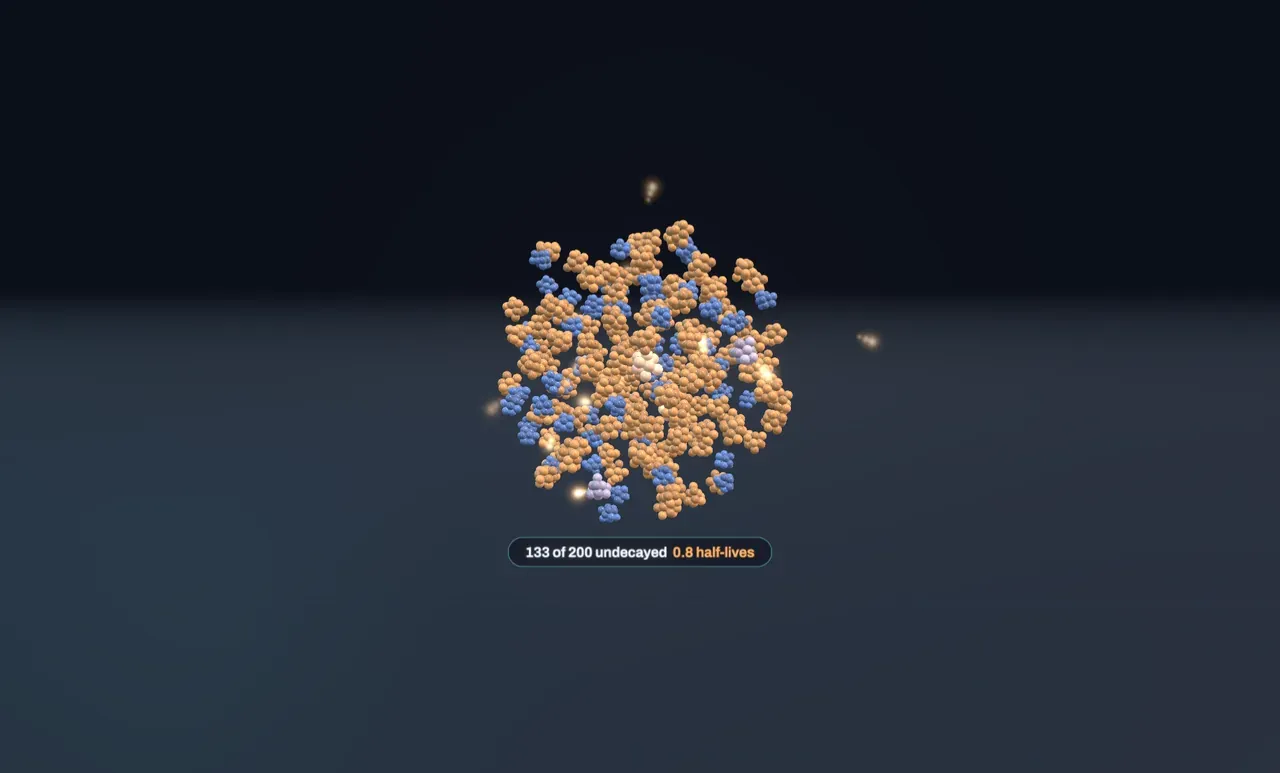
Try it: set Nuclei in the sample to 20 and choose On under Show the decay curve. Run it a few times and watch the orange line wander. Then slide it up to 400 and see it settle onto the white halving curve.
Small samples are noisy
The half-life is an average, and averages need numbers. With twenty nuclei, a whole half-life can pass with only six decays, or with fourteen. With four hundred, the result lands close to two hundred nearly every time. A real speck of radioactive material holds trillions of nuclei, which is why its decay follows the curve so precisely that it can be used as a clock.
Changing the Half-life changes how fast the nuclei decay, not the shape of the curve: measured in half-lives, every sample looks the same.
What comes out
A decaying nucleus releases radiation of three common kinds. In alpha decay it throws out a tight bundle of two protons and two neutrons, a helium nucleus, and becomes a lighter element; this is what the scene shows. In beta decay a neutron turns into a proton and an electron shoots out, so the element changes but the mass barely does. Gamma rays, bursts of high-energy light, often follow. Alpha particles are stopped by a sheet of paper, beta by a few millimetres of aluminium, and gamma only thinned by thick lead or concrete.
Dating the past
Carbon dating uses all of this. High in the atmosphere, cosmic rays turn a little nitrogen into carbon-14, a radioactive form of carbon with a half-life of about 5,730 years. Plants take it in with ordinary carbon, animals eat the plants, and every living thing carries roughly the same small share. When it dies, the intake stops and the carbon-14 starts to halve. Measure how much is left compared with a living thing and you know how many half-lives have passed: a quarter left means about 11,500 years. After about 50,000 years too little remains to measure reliably, so older rocks are dated with slower clocks such as uranium.
What this model leaves out
The scene gives every nucleus a random lifetime drawn from the true exponential law, so the statistics are real, but the clock is sped up from years to seconds. A new sample starts after five half-lives so you can watch again. Real decay often runs in chains, each daughter itself unstable, and a real sample holds far too many nuclei, each far too small, to see. The nuclei here are symbolic clusters, enormously enlarged.