The ground is moving
Look at a map and the coast of South America seems to fit into the bulge of Africa. In 1912 Alfred Wegener argued that this was no accident: the continents had once been joined and had drifted apart. Most geologists rejected the idea for decades: nobody could say what would push a continent. The answer came from the sea floor. Europe and North America move apart by about 2.5 centimetres a year, roughly as fast as your fingernails grow.
Plates on a slowly flowing mantle
The Earth’s outer shell is broken into seven huge plates and many smaller ones. Each plate is the crust plus the stiff top of the mantle beneath it, together called the lithosphere, up to about 100 km thick under the oceans and thicker under old continents. Below that lies the asthenosphere: solid rock, but so hot that over millions of years it creeps like very stiff putty. The plates ride on it.
Crust comes in two kinds. Ocean crust is dark, dense basalt about 7 km thick. Continental crust is lighter granite-like rock, about 35 km thick on average. That difference in weight decides what happens where plates meet.
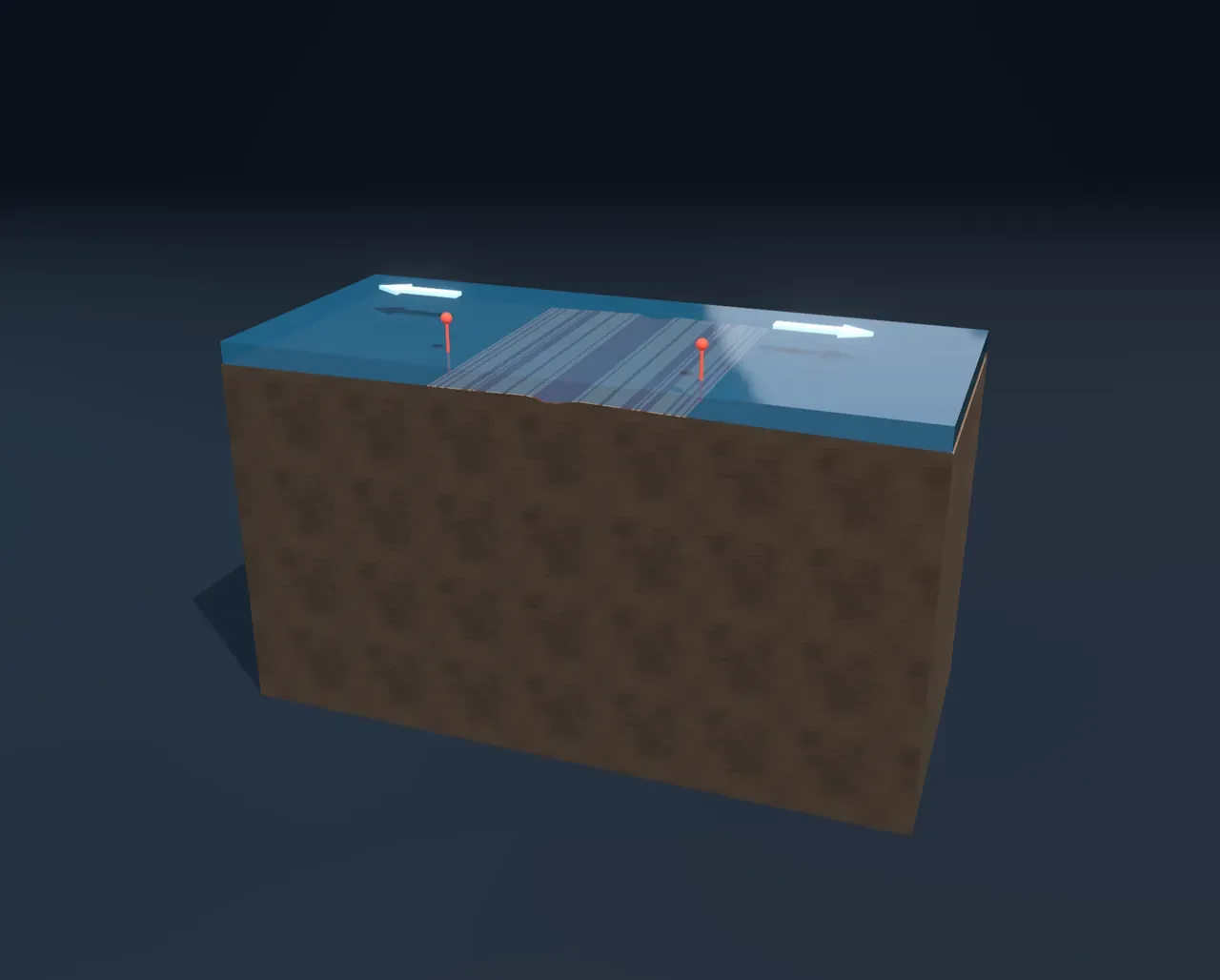
Try it: choose Spreading ridge and slide Time to 20 million years. Now choose Ocean under continent, then Continents collide, and choose Cut away under Cut away to see the slab, the magma and the root of the mountains.
Where plates pull apart
Along the middle of the Atlantic runs a mountain range under the sea, the mid-ocean ridge. Here two plates move apart, hot mantle rises to fill the gap, partly melts, and the magma freezes into new ocean floor. The new rock is hot and swollen, so the ridge stands high; as it cools it shrinks and the sea floor deepens.
As the lava cools, tiny magnetic minerals in it line up with the Earth’s magnetic field. Every few hundred thousand years the field flips, north becoming south, and the rock records each flip. The result, found in the 1960s, is a pattern of magnetic stripes running parallel to the ridge and mirrored on each side: a tape recording of the field’s history, written as the floor spreads. It was the clinching evidence that the sea floor moves.
Where plates meet
If ocean floor is made at ridges, it must be destroyed somewhere. Where an ocean plate meets a continent, the heavier ocean plate bends down into a deep trench and sinks into the mantle as a slab. When the slab reaches about 100 km down, water squeezed out of it helps the mantle above to melt, and the melt rises to build a chain of volcanoes. The Andes were made this way, and the Mariana Trench in the Pacific is about 11 km deep.
When two continents meet, neither will sink: continental rock is too light. Instead the crust crumples, stacks up and thickens. Like an iceberg, a mountain range floats on a deep root, roughly five times deeper than the mountains are high. India ran into Asia about 50 million years ago and is still pushing north by a few centimetres a year, raising the Himalaya and Tibet.
Where plates slide past
Some plates neither make nor destroy crust; they grind sideways past each other along a transform fault. California’s San Andreas Fault is one. The plates do not glide smoothly: they lock, strain builds for decades or centuries, and then the fault slips by metres in seconds. That sudden slip is an earthquake. Over millions of years, rivers and roads that cross such a fault are torn apart, and the offset grows.
What the model leaves out
The block is a straight slice of one boundary. Real plate edges bend, branch and change type along their length. The mantle’s convection is drawn as tidy loops; in reality it is a three-dimensional churn, and the pull of a sinking slab does much of the driving. Earthquakes flash at a steady pace, while real ones come in irregular bursts.