The Earth's shell is broken into plates that move a few centimetres a year on a slowly flowing mantle. Distance is speed times time, and each kind of boundary builds something different: a ridge, a trench and volcanoes, mountains, or a fault.
Step 1 of 7 · Moving plates
Step 1 of 7
Moving plates
In the last Lesson we saw that the mantle is solid. Above it, the lithosphere, the crust together with the cold top of the mantle, is broken into about a dozen large plates, tens of kilometres to more than a hundred kilometres thick. They move relative to each other, and almost all earthquakes and volcanoes are at the boundaries between them.
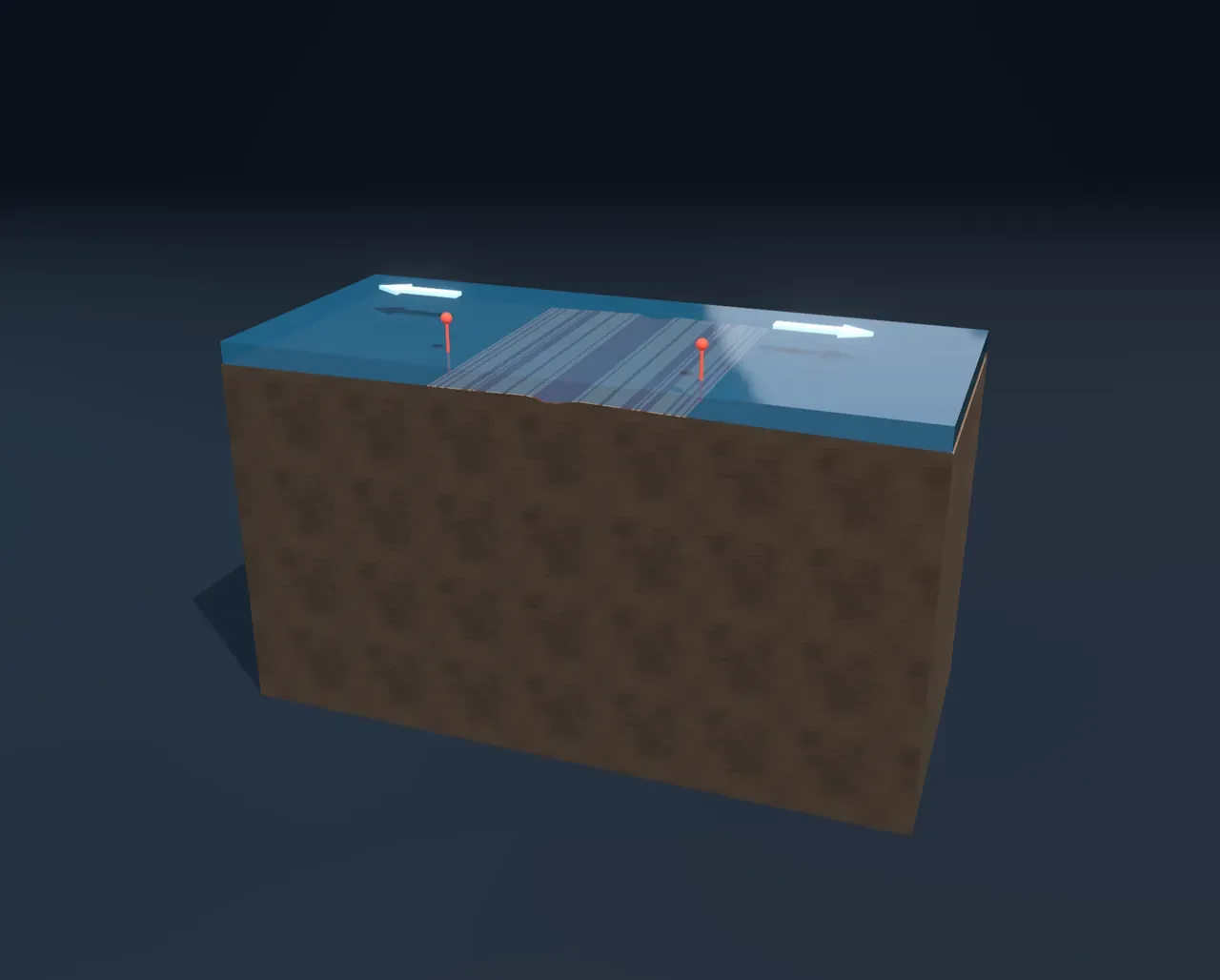
In the Scene there is a block cut from the top of the Earth, with two plates meeting in the middle. Cut away has cut it open, and the arrows show the convection currents in the mantle. The Boundary is now a Spreading ridge, where two ocean plates move apart.
Step 2 of 7
How far they move
The plates move slowly: 2–15 cm a year, about the rate fingernails grow. But the time is long: over a million years, a centimetre a year becomes ten kilometres. Plate speed and Time are locked.
Step 3 of 7
Three hundred kilometres
Plate speed is locked, and Time is at the start, .
Step 4 of 7
An ocean opens
At a ridge hot rock rises, partly melts, and hardens into new sea floor, which moves aside and makes room for the next. That is how a whole ocean opens. In 1912 Alfred Wegener suggested that the continents had moved, partly because the coasts of America and Africa fit like jigsaw pieces. Only in the 1960s, when the sea floor was mapped, did it become clear how.
Step 5 of 7
A trench and volcanoes
The Boundary is now an ocean plate going under a continent. Ocean floor cools and thickens as it moves away from the ridge, and in the end it is heavier than the mantle beneath and sinks into it. Where it dives, a deep trench forms, and the sinking plate grinds against the plate above it and gives the strongest earthquakes on Earth.
Step 6 of 7
Continents collide
Sometimes, after all the ocean between two continents has sunk, the two continents themselves meet.
Step 7 of 7
Sliding past
At a boundary of the third kind plates neither come together nor move apart, but slide past each other along a fault. The Boundary is now Sliding past.
Loading the interactive version…
Loading the interactive version…
Each step sets up the Scene for you, and a control marked “fixed” stays put for that step.
Practice · Choose
The Earth’s outer shell is broken into plates, which move a few centimetres a year. What do they move on, and what moves them?
Practice · Choose
The Earth’s outer shell is broken into plates, which move a few centimetres a year. What do they move on, and what moves them?
Practice · Calculate
Plate speed is locked at 5 cm a year, and Time at million years. How far apart have the plates moved?
Practice · Calculate
Plate speed is locked at 5 cm a year, and Time at million years. How far apart have the plates moved?
Practice · Reach the target
Plate speed is locked at 2.5 cm a year, as in the Atlantic Ocean. Change Time until the plates have moved 300 km apart, and press Check.
Practice · Reach the target
Plate speed is locked at 2.5 cm a year, as in the Atlantic Ocean. Change Time until the plates have moved 300 km apart, and press Check.
Practice · Calculate
The Atlantic Ocean is about 5000 km wide, and it is opening at the ridge in its middle at about 2.5 cm a year. Roughly how many million years ago were America and Africa joined?
Practice · Calculate
The Atlantic Ocean is about 5000 km wide, and it is opening at the ridge in its middle at about 2.5 cm a year. Roughly how many million years ago were America and Africa joined?
Practice · Choose
The Boundary is an ocean plate going under a continent, and Cut away has cut the block open. Where do volcanoes form at a boundary like this?
Practice · Choose
The Boundary is an ocean plate going under a continent, and Cut away has cut the block open. Where do volcanoes form at a boundary like this?
Practice · Predict, then look
At the last boundary an ocean plate sank under a continent. The Boundary is changed so that two continents collide. What will happen to one of them?
Practice · Predict, then look
At the last boundary an ocean plate sank under a continent. The Boundary is changed so that two continents collide. What will happen to one of them?
Practice · Choose
The Dead Sea Transform, which runs along the Arava, the Dead Sea and the Sea of Galilee, is a boundary where the Arabian plate and the Sinai plate slide past each other. What would you expect along it?
Practice · Choose
The Dead Sea Transform, which runs along the Arava, the Dead Sea and the Sea of Galilee, is a boundary where the Arabian plate and the Sinai plate slide past each other. What would you expect along it?
Lesson complete. Every practice question here is done.