Liquid iron flowing in the core makes the magnetic field like a dynamo, which is why the field can flip. The sea floor keeps the flips in stripes, and from their width the spreading rate is measured.
Step 1 of 6 · A magnet that is not
Step 1 of 6
A magnet that is not
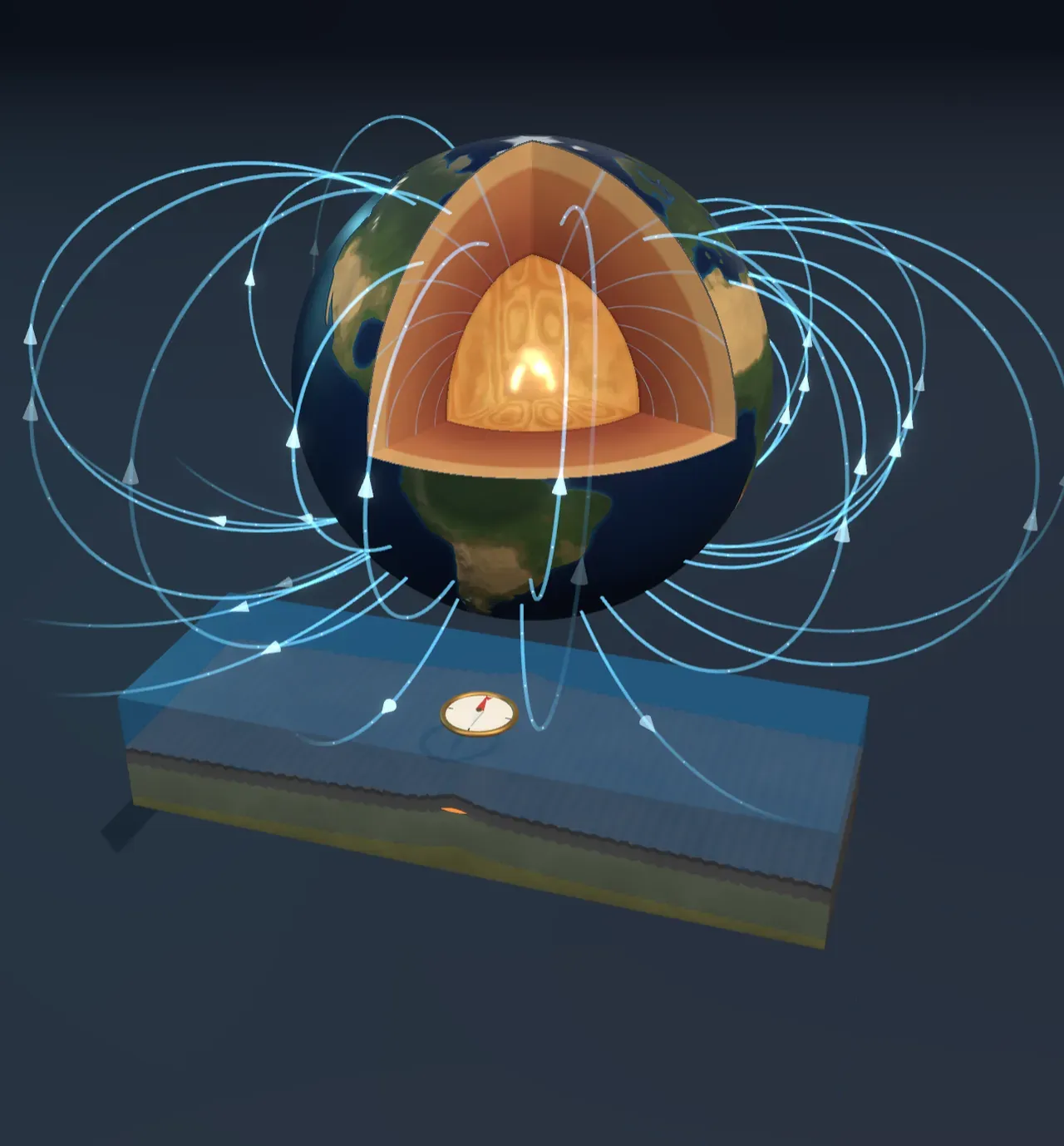
Near the Earth the magnetic field looks almost like the field of a bar magnet: field lines leave in one hemisphere, curve round, and enter in the other. In the Scene the Earth is cut open to the outer core, the liquid one, and the field lines come out of it. Beneath it is a block of sea floor, with a ridge in the middle and a compass above it.
Step 2 of 6
Which pole is which
A compass is a small magnet free to turn, and it lines up along the field lines. Since the Middle Ages it has been used to find north.
Step 3 of 6
Reversals
In the Unit on magnetism and induction we saw that a conductor moving through a magnetic field gets an induced current, and that a current makes a field. In the outer core liquid iron, an excellent conductor, flows in convection currents and turns with the Earth. Its motion through the field induces currents, and the currents build the field again: this is the geodynamo. A dynamo like that does not have to keep one direction. Change Time, and predict what the compass will show.
Step 4 of 6
Stripes on the sea floor
At a ridge, fresh lava cools into basalt. Magnetic minerals in it line up with the field of that moment, and as the rock hardens the direction “freezes” in it. The new sea floor moves aside, so each flip of the field is kept as a stripe of sea floor magnetised the other way, on both sides of the ridge, like a tape recording. Show the magnetic record has drained the water and shown the stripes: rust in a field like today’s, pale in a reversed field. Spreading rate and Time are locked.
Step 5 of 6
A fast ridge
Spreading rate is the rate at which the two plates move apart. The higher it is, the wider each stripe. Time is locked on today.
Step 6 of 6
Measuring the spreading
The age of each flip is known from volcanic rocks on land, which can be dated by radioactive decay. So the width of a stripe says how fast the sea floor moves. A magnetometer towed by a ship over the ridge records the stripes as a graph, like the one beside the Scene.
Loading the interactive version…
Loading the interactive version…
Each step sets up the Scene for you, and a control marked “fixed” stays put for that step.
Practice · Choose
The Earth’s magnetic field looks like the field of a big bar magnet. Why can it not come from a permanent iron magnet in the core?
Practice · Choose
The Earth’s magnetic field looks like the field of a big bar magnet. Why can it not come from a permanent iron magnet in the core?
Practice · Choose
The north end of a compass needle points north. Which pole of the Earth’s “magnet” is near the geographic North Pole?
Practice · Choose
The north end of a compass needle points north. Which pole of the Earth’s “magnet” is near the geographic North Pole?
Practice · Predict, then look
Today the compass over the ridge points north. Time is taken back to million years ago. Which way will the compass point?
Practice · Predict, then look
Today the compass over the ridge points north. Time is taken back to million years ago. Which way will the compass point?
Practice · Calculate
Spreading rate is locked at 5 cm a year, and Time on today. Show the magnetic record shows the magnetic stripes in the sea floor. The last flip was years ago. How far from the ridge, on each side, does the central stripe reach?
Practice · Calculate
Spreading rate is locked at 5 cm a year, and Time on today. Show the magnetic record shows the magnetic stripes in the sea floor. The last flip was years ago. How far from the ridge, on each side, does the central stripe reach?
Practice · Reach the target
At a fast ridge in the Pacific the central stripe reaches about 50 km from the ridge on each side. Change Spreading rate until the stripe in the Scene reaches 50 km on each side, and press Check.
Practice · Reach the target
At a fast ridge in the Pacific the central stripe reaches about 50 km from the ridge on each side. Change Spreading rate until the stripe in the Scene reaches 50 km on each side, and press Check.
Practice · Calculate
A ship towing a magnetometer over the Mid-Atlantic Ridge finds that the central stripe reaches 9.7 km from the ridge on each side. The last flip was years ago. What is the ridge’s spreading rate, in centimetres a year?
Practice · Calculate
A ship towing a magnetometer over the Mid-Atlantic Ridge finds that the central stripe reaches 9.7 km from the ridge on each side. The last flip was years ago. What is the ridge’s spreading rate, in centimetres a year?
Lesson complete. Every practice question here is done.